

How Many Grafts Do You Need for Grade 2–7 Baldness?
One of the first questions patients ask during consultation is:
“Doctor, how many grafts will I need?”
The answer depends on:
-
Baldness grade
-
Donor density
-
Hair thickness
-
Desired density
-
Long-term planning
At RECOMB Hair Transplant Centre, graft calculation is never a fixed number—it is a strategic decision based on medical safety and aesthetics.
Let’s break it down grade by grade.
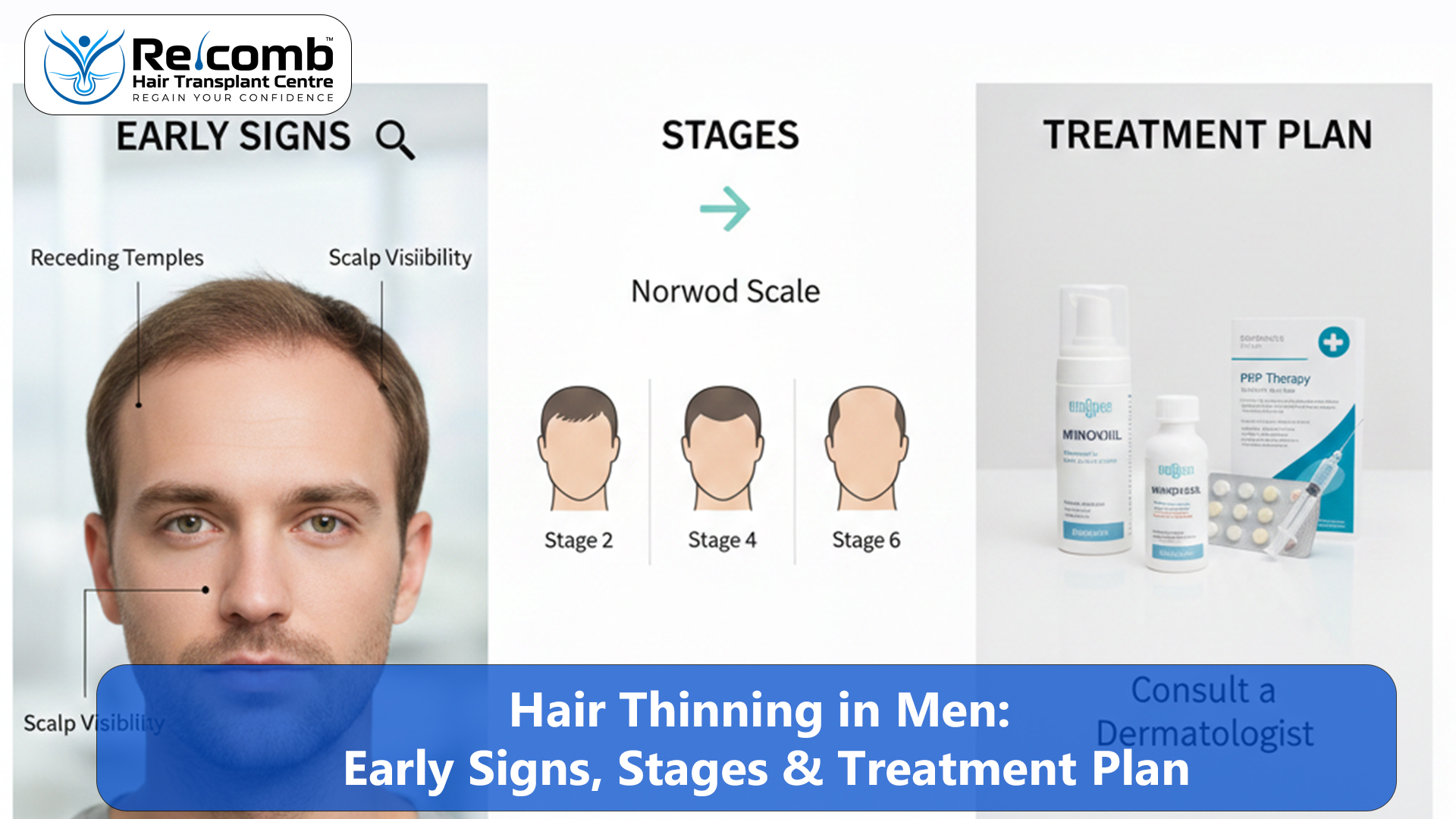
Understanding Baldness Grades (Norwood Scale)
Male pattern baldness is classified from Grade 1 to Grade 7.
For transplant planning, we typically assess Grade 2–7, where visible hair loss exists.
Grade 2 Baldness
Mild Hairline Recession
-
Slight temple recession
-
Hairline mostly intact
-
Crown unaffected
Estimated Grafts Required:
1,000 – 1,500 grafts
Goal:
-
Refine hairline
-
Restore temple angles
Grade 3 Baldness
Deeper Temple Recession
-
Noticeable “M-shaped” hairline
-
Frontal thinning may begin
Estimated Grafts Required:
1,500 – 2,500 grafts
Goal:
-
Rebuild frontal zone
-
Maintain natural density
Grade 4 Baldness
Frontal Loss + Early Crown Thinning
-
Significant frontal recession
-
Crown area begins thinning
Estimated Grafts Required:
2,500 – 3,500 grafts
Goal:
-
Prioritize frontal coverage
-
Possibly stage crown later
Grade 5 Baldness
Frontal and Crown Areas Merge
-
Bridge area thins
-
Crown enlarges
Estimated Grafts Required:
3,500 – 4,500 grafts
Goal:
-
Strategic distribution
-
Preserve donor for future
Grade 6 Baldness
Extensive Baldness
-
Frontal and crown fully connected
-
Large bald scalp area
Estimated Grafts Required:
4,500 – 6,000 grafts (often staged)
Goal:
-
Focus on front and mid-scalp
-
Conservative crown approach
Grade 7 Baldness
Advanced Baldness
-
Minimal hair on top
-
Only side and back hair remain
Estimated Grafts Required:
6,000+ grafts (multi-session planning)
Limitations:
-
Donor supply may not cover entire scalp
-
Realistic density expectations required
Why Graft Numbers Vary Between Patients
Two Grade 4 patients may need different graft counts because of:
-
Hair thickness
-
Hair color contrast
-
Curl pattern
-
Scalp laxity
-
Donor density
Thicker hair creates better visual density with fewer grafts.
Natural Density vs Safe Density
Natural scalp density:
80–100 follicles per cm²
Transplant density (safe range):
35–70 grafts per cm²
Trying to replicate full natural density in one session can damage blood supply.
Safety always comes first.
Why Crown Needs More Grafts
The crown:
-
Has circular pattern
-
Reflects light directly
-
Requires higher graft distribution
However, crown density is often prioritized after frontal restoration.
Donor Area Is the Limiting Factor
The donor zone:
-
Is permanent
-
Is finite
-
Cannot regenerate
Poor planning can exhaust donor supply early, leaving no option for future correction.
At RECOMB, long-term donor preservation is always prioritized over short-term density.
Single Session vs Staged Approach
In advanced grades:
-
One mega session may not be ideal
-
Two staged sessions improve survival
-
Gradual coverage protects donor safety
Long-term planning ensures sustainable results.
What Happens If You Underestimate Grafts?
-
Patchy appearance
-
Visible thinning
-
Need for revision surgery
What Happens If You Overestimate Grafts?
-
Donor overharvesting
-
Reduced survival
-
Poor vascular support
-
Irreversible donor damage
Balance is essential.
RECOMB’s Graft Planning Protocol (2026)
At RECOMB:
-
Baldness grade is mapped precisely
-
Donor density is measured
-
Hair caliber is evaluated
-
Long-term hair loss progression is predicted
-
Realistic density targets are set
We plan for how you will look at 40 or 50 years of age—not just next month.
Final Medical Takeaway
Graft requirement by grade:
-
Grade 2: 1,000–1,500
-
Grade 3: 1,500–2,500
-
Grade 4: 2,500–3,500
-
Grade 5: 3,500–4,500
-
Grade 6: 4,500–6,000
-
Grade 7: 6,000+ (staged)
These are estimates—not fixed promises.
Correct graft planning protects your donor hair for life.
Contact RECOMB Hair Transplant Centre
Phone: +91 7624008000
Website: www.recombhair.com