
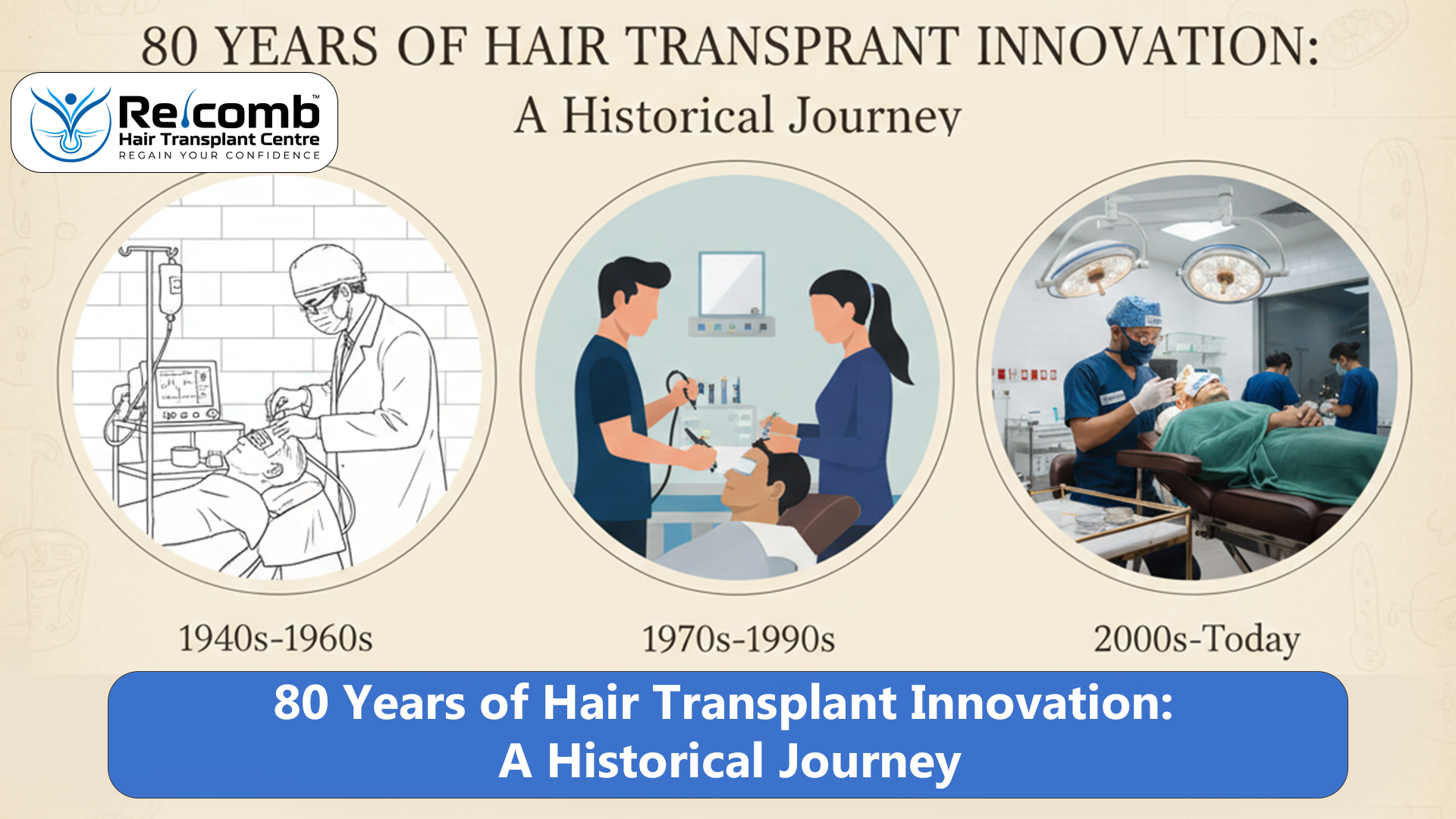
Hair transplantation did not become advanced overnight. What we see today as refined, natural, and minimally invasive surgery is the result of eight decades of medical experimentation, failures, refinements, and scientific breakthroughs.
Understanding the history of hair transplantation helps patients appreciate why modern techniques work, why older myths persist, and why ethical clinics follow strict medical principles.
At RECOMB Hair Transplant Centre, Surat, modern practice is deeply rooted in lessons learned from this long evolution.
1940s–1950s: The Birth of Hair Transplantation
The First Surgical Experiments
Hair transplantation began in 1946 when Japanese dermatologist Dr. Shoji Okuda described moving hair-bearing skin to bald areas in burn patients.
Soon after, Dr. Norman Orentreich in the United States introduced the concept of donor dominance—the principle that transplanted hair retains the characteristics of its original location.
This discovery remains the foundation of all modern hair transplants.
1960s–1970s: The Plug Graft Era
During this period:
-
Large punch grafts (3–4 mm) were used
-
Each graft contained many hairs
-
Results looked unnatural and “doll-like”
Although these procedures restored hair, they lacked aesthetic finesse. The term “hair plugs” originated from this era and still influences public fear today.
1980s: Mini-Grafts and Micro-Grafts
To improve results:
-
Smaller grafts were introduced
-
Surgeons began separating grafts into mini- and micro-units
-
Hairlines became slightly more natural
However, scarring and inconsistent density remained major issues.
This decade marked the transition from coverage to cosmetic realism.
1990s: The Follicular Unit Concept
A major scientific leap occurred with the recognition that hair grows in natural follicular units (1–4 hairs per unit).
This led to:
-
Follicular Unit Transplantation (FUT)
-
Linear strip harvesting
-
Microscopically dissected grafts
Results improved dramatically, but linear scars and longer recovery limited acceptance.
Early 2000s: The Rise of FUE (Follicular Unit Extraction)
FUE revolutionized hair transplantation by allowing:
-
Individual follicle extraction
-
No linear scar
-
Faster healing
-
Shorter downtime
Initially, FUE was time-consuming and technically demanding, but it marked the shift toward minimally invasive hair restoration.
2010–2015: Refinement of FUE Techniques
During this phase:
-
Motorized punches improved efficiency
-
Smaller punch diameters reduced scarring
-
Better graft handling improved survival
Hair transplant outcomes became more consistent, but density and hairline precision were still evolving.
2016–2020: Sapphire FUE and Precision Surgery
The introduction of Sapphire FUE changed recipient-site creation.
Sapphire blades allowed:
-
Finer V-shaped incisions
-
Higher graft density
-
Better angle and direction control
-
Faster healing
-
More natural hairlines
This era defined the modern gold standard for aesthetic hair transplantation.
2020–2026: Ethical, Customized, and Regenerative Era
Modern hair transplantation is no longer just about moving hair.
Current focus includes:
-
Ethical candidate selection
-
Donor preservation
-
Long-term planning
-
Integration with PRP and GFC
-
Natural, age-appropriate design
-
Surgeon-led procedures
Technology now supports precision, but ethics guide decisions.
Why Modern Hair Transplants Look So Natural Today
After 80 years of evolution, modern results are superior because:
-
Follicular units are respected
-
Hairlines follow natural anatomy
-
Density is strategically planned
-
Donor areas are preserved
-
Growth cycles are medically understood
Failures of the past directly shaped today’s best practices.
Lessons Learned from 80 Years of Innovation
Key takeaways:
-
Bigger grafts are not better
-
Surgery without planning leads to regret
-
Hair loss is progressive and lifelong
-
Donor hair is limited and precious
-
Ethics matter more than marketing
These lessons define responsible clinics today.
The Future of Hair Transplantation
Looking ahead beyond 2026:
-
Regenerative therapies will support surgery
-
AI-assisted planning may enhance precision
-
Hair transplant will remain a surgical art
-
Ethical standards will define excellence
Despite innovation, no technology can replace good medical judgment.
RECOMB’s Place in This Journey
At RECOMB Hair Transplant Centre, Surat, modern techniques are applied with respect for historical lessons:
-
Surgeon-led Sapphire FUE
-
Conservative donor harvesting
-
Natural hairline artistry
-
Long-term patient planning
Innovation without ethics repeats past mistakes.
Final Perspective
Hair transplantation has evolved from crude plug grafts to refined microsurgery over 80 years. Today’s natural results are the outcome of science, experience, and ethical discipline.
Patients benefit most when they choose clinics that understand not just how to transplant hair, but why modern methods exist.
Contact RECOMB Hair Transplant Centre
Phone: +91 7624008000
Website: www.recombhair.com