
Two of the most important clinical measurements in hair transplant planning are among the least discussed in patient-facing content. Scalp laxity and donor density are not topics that appear prominently in clinic marketing or in the online forums where patients research hair restoration. Yet both measurements directly determine what a procedure can achieve, how many grafts can safely be extracted in a session, and whether the plan being proposed is genuinely designed around the patient's individual anatomy or around a standard offering applied to everyone.
At RECOMB, these tests are performed before any treatment discussion takes place. This blog explains what each test involves, what it reveals, and why the information it produces changes the surgical plan for almost every patient who has it measured rather than estimated.
If you have been through consultations elsewhere where these measurements were not taken, what you were quoted may be based on assumptions rather than your actual clinical parameters.
Book a Complete Pre-Surgical Assessment at RECOMB, Surat →
WhatsApp: +91 7624008000 | www.recombhair.com
What Scalp Laxity Is and Why It Matters
Scalp laxity refers to the looseness or mobility of the scalp skin over the underlying skull. It varies significantly between individuals and changes with age, hydration status, and scalp health. A patient with high scalp laxity has skin that moves freely over the skull with gentle pressure. A patient with low scalp laxity has skin that feels tight and resistant to movement.
This measurement is clinically relevant to hair transplant planning for several specific reasons.
In FUE procedures, scalp laxity affects how grafts are extracted from the donor zone. During the circular punch incision around each follicular unit, the scalp skin needs to remain sufficiently stable to allow accurate tracking of the follicle beneath. In a scalp with very low laxity, the skin tension can cause the follicle to shift relative to the punch during extraction, increasing transection risk. The surgeon must adjust extraction technique, including the use of counter-traction to stabilise the skin during each punch, to account for reduced laxity.
Scalp laxity also affects the visual recovery of the donor zone after extraction. In a scalp with good laxity, the skin around each extraction site redistributes more effectively after the procedure, reducing the visual contrast between extraction sites and the surrounding donor area. In a scalp with poor laxity, extraction sites remain more visible during healing because the surrounding skin does not redistribute as readily.
For patients with very tight scalps, the maximum safe extraction density per session may be lower than for patients with normal to high laxity, which has direct implications for the total graft count achievable in a single session without creating a compromised donor appearance post-operatively.
Laxity also influences the tumescent anaesthesia technique used during the procedure. Proper tumescent infiltration, where anaesthetic fluid is injected beneath the scalp to create a slight firmness that protects follicles during extraction, must be calibrated to the patient's baseline laxity to achieve the desired protective effect without creating excessive tension that would alter follicle angle.
How Scalp Laxity Is Assessed
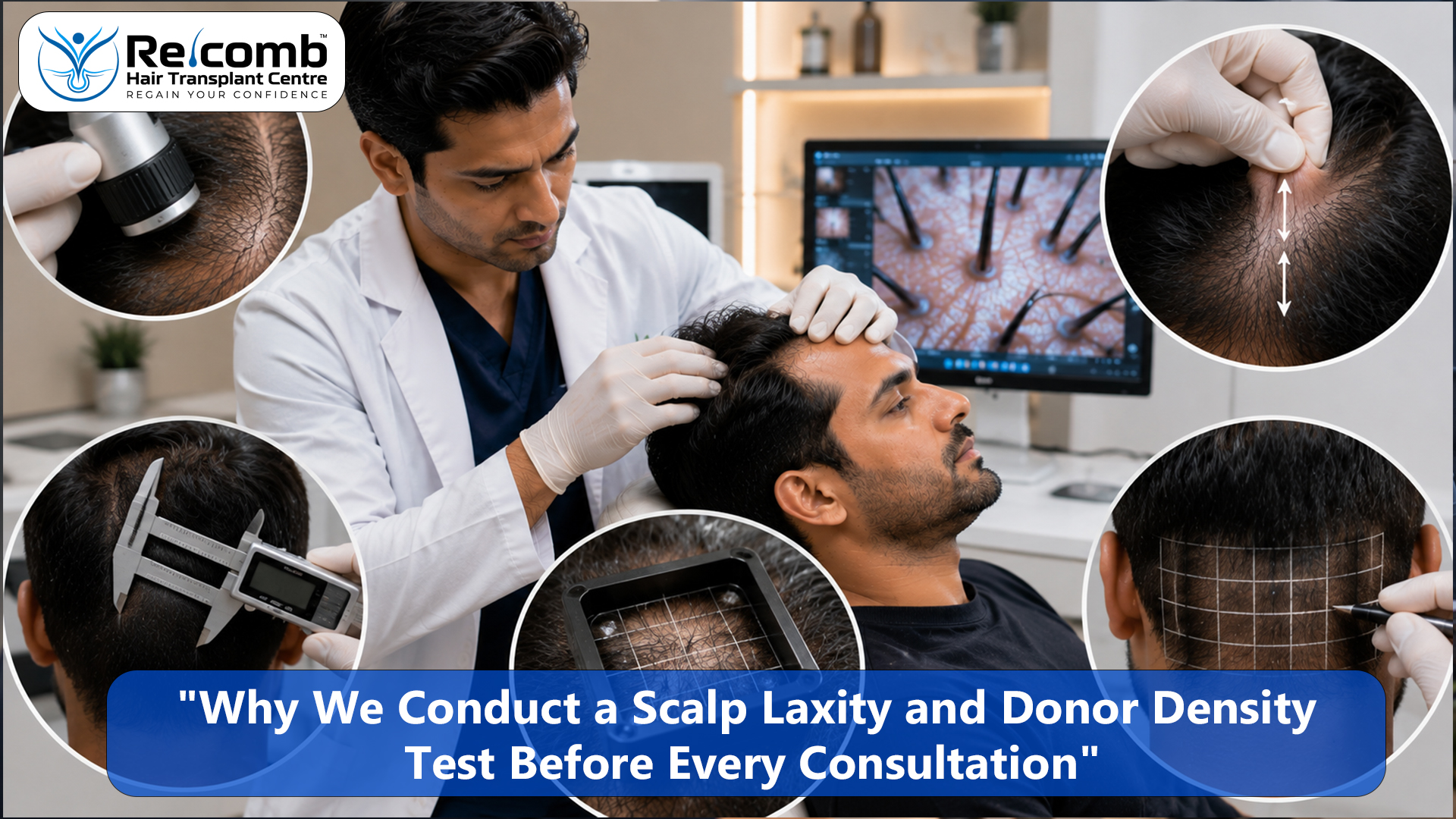
Scalp laxity assessment is a physical examination performed by the surgeon during the pre-surgical consultation. It involves applying gentle bidirectional pressure to the scalp in the donor zone and assessing the degree of skin movement, the resistance encountered, and the skin's return to baseline position after pressure is released.
At RECOMB, laxity is assessed across the full donor zone because laxity is not uniform across the scalp. The occipital region at the back of the head typically has different laxity from the temporal zones on the sides. Understanding the laxity profile across the full safe donor area allows the surgical approach to be calibrated specifically for each zone during the procedure rather than applying a uniform technique that may not be appropriate throughout.
Patients who have undergone previous procedures have additional considerations. Prior extraction leaves scar tissue beneath the scalp surface that reduces laxity in the previously harvested areas. In repair or second-session patients, the laxity assessment is particularly important for determining where within the donor zone fresh extraction can be performed efficiently and where the reduced laxity of previously operated tissue requires modified technique.
What Donor Density Is and Why It Is the Foundation of the Graft Plan
Donor density refers to the number of follicular units per square centimetre in the safe donor zone of the scalp. It is the most fundamental measurement in hair transplant planning because it determines the total number of grafts available to the patient across their lifetime and therefore constrains every decision about how those grafts should be allocated.
Most patients assume that if they have hair at the back of their head, they have an adequate donor area. This assumption is frequently inaccurate in its specifics. Two patients with visually similar donor areas can have follicular unit densities that differ by 30 to 50 percent, a difference that changes the lifetime graft budget from approximately 4,000 grafts to approximately 6,000 grafts. This 2,000 graft difference is the difference between one well-planned session with modest reserve and two full sessions with adequate reserve for both.
Donor density also varies within the safe zone of a single patient. The central occipital area typically has the highest density. The peripheral zones of the safe area tend to have lower density and may transition gradually into the area where follicles are not DHT-resistant. The density profile across the full donor zone determines where extraction is most efficient, which areas should be harvested first, and where extraction should be conservative to preserve visual donor appearance.
How Donor Density Is Measured
At RECOMB, donor density is measured using trichoscopy, a magnified scalp examination that provides a specific follicular unit count per square centimetre at multiple points across the donor zone.
The trichoscopy examination at follicular level identifies the number of follicular units per unit area, the average number of hairs per follicular unit which ranges from one to four in most patients, whether any miniaturisation is present in the donor zone itself which can occur in certain diffuse loss patterns, and the general health and calibre of donor zone follicles.
The combination of these measurements produces two clinically important numbers: the safe extraction density, meaning the maximum number of grafts that can be removed from a given area without leaving visible thinning in the donor zone, and the total extractable graft estimate across the full safe donor zone.
From these numbers, the lifetime graft budget is calculated. If a patient has 80 follicular units per square centimetre across a safe donor area of 80 square centimetres, a rough total of 6,400 follicular units is present. The maximum safe extraction rate across most of this area is approximately 40 to 50 percent of what is present, giving a lifetime extractable estimate of approximately 2,500 to 3,200 follicular units. This patient's lifetime budget is meaningfully lower than the sometimes cited figure of 5,000 to 6,000 grafts, and their surgical planning must reflect that reality.
For another patient with 120 follicular units per square centimetre across a similar area, the same calculation produces a substantially higher lifetime budget that supports more aggressive coverage in the first session or a more complete two-session plan.
Without trichoscopy-based measurement, these numbers are guesses. With them, the graft plan is a clinical calculation.
What Happens When These Tests Are Not Done
When scalp laxity and donor density are not formally assessed before a procedure, several specific clinical problems arise.
Graft count recommendations become estimates inflated upward toward commercial rather than clinical targets. A clinician who has not measured donor density quotes a graft count based on visual impression and standard packages rather than on the patient's actual available lifetime supply. The patient pays for and receives a graft count that may deplete their donor area faster than a measured plan would have recommended.
Extraction technique is not calibrated to the patient's actual scalp characteristics. A patient with low laxity who is treated with a technique appropriate for normal laxity will have higher transection rates and a less visually clean donor area post-operatively than if the technique had been adjusted to their specific scalp.
The lifetime graft budget is unknown. A patient who proceeds with a procedure without knowing their lifetime budget does not know what percentage of their total supply they are using in the first session, how much remains for future sessions, or whether the plan being proposed will leave them in a position to address future hair loss progression. This is the planning gap most responsible for the over-harvested donor areas seen in patients presenting for second opinions and repair consultations.
How These Tests Interact With the Full Pre-Surgical Assessment
Scalp laxity and donor density measurement do not exist in isolation. They are part of the ten-step pre-surgical assessment described in the RECOMB pre-surgery protocol blog, and their findings interact with other assessment components.
Donor density interacts with Norwood staging to determine the ratio of available donor supply to required recipient coverage. A Grade 4 patient with high donor density has a more favourable ratio than a Grade 4 patient with low donor density and the surgical plan for each should differ accordingly.
Scalp laxity interacts with the planned extraction density to determine what is achievable in a single session without visual donor compromise. A patient with low laxity may benefit from a staged approach not only for the biological graft survival reasons discussed in the staged versus single session blog but also for the practical donor appearance reason that lower laxity limits the density of extraction achievable in one sitting.
Hair shaft characteristics measured during trichoscopy interact with donor density to determine the visual density achievable per graft in the recipient area. High donor density with coarse, dark hair produces better visual results with fewer grafts than lower donor density with fine, light hair.
All of these interactions are mapped before any procedure is planned at RECOMB, because the graft plan that emerges from a complete multi-component assessment is more accurate, more conservative where conservation matters, and more ambitious where the clinical parameters support ambition than any plan derived from visual impression alone.
RECOMB's Approach (2026)
At RECOMB Hair Transplant Centre, Surat, scalp laxity assessment and trichoscopy-based donor density measurement are performed at every new patient consultation before any graft count is discussed. Dr. Krishna Bhalala and Dr. Nilesh Kachhadiya use these measurements as the foundation of the graft plan rather than as confirmatory steps performed after a commercial recommendation has already been made.
Patients leave the consultation knowing their specific donor density, their estimated lifetime graft budget, how the proposed procedure fits within that budget, and what the laxity assessment means for how their procedure will be technically managed. This transparency is not a clinical courtesy. It is the information that allows a patient to genuinely evaluate the recommendation rather than accept it on trust.
Get Your Scalp Laxity and Donor Density Measured Before Any Decision →
WhatsApp: +91 7624008000 | www.recombhair.com
Final Takeaway
Scalp laxity and donor density are not supplementary measurements that refined clinics add to a standard process. They are the clinical foundation without which the standard process, the graft count, the session planning, the donor area management, is built on assumptions rather than measurements.
A patient who does not know their donor density does not know how many grafts they have available across their lifetime. A patient whose laxity has not been assessed does not know whether the extraction technique planned for their procedure is calibrated to their scalp. Both of these gaps have specific, predictable clinical consequences that play out over the months and years following the procedure.
Dr. Krishna Bhalala and Dr. Nilesh Kachhadiya conduct a limited number of personal consultations each week at RECOMB, Surat. If you want to start your surgical planning from measured clinical data rather than visual estimates, this is where that process begins.
Start With Measurements, Not Estimates, at RECOMB →
WhatsApp: +91 7624008000
We respond within 24 hours, 6 days a week.
www.recombhair.com
Contact RECOMB Hair Transplant Centre
RECOMB Hair Transplant Centre
19, Ground Floor, Zenon Building, Opp. Unique Hospital, near Kiran Motors, Khatodara Wadi, Surat, Gujarat 395001
Phone: +91 7624008000
Website: www.recombhair.com