Most patients research the surgery. Very few research what comes after it.
The 12 months following a hair transplant are not a passive waiting period. They are an active clinical phase during which the result develops, potential issues are identified and managed, medications are reviewed, and decisions are made about whether additional support treatments would improve the growth trajectory. What happens during this period, and how actively it is managed, directly influences the quality of the result at the twelve-month mark.
At RECOMB, the 12-month follow-up process is structured, scheduled, and built into every patient's treatment plan from the day of their procedure. It is not an open-door policy where patients can come back if something seems wrong. It is a defined protocol with specific clinical objectives at each checkpoint.
This blog details exactly what that process looks like, checkpoint by checkpoint, so patients know what to expect and can evaluate any clinic's follow-up commitment against a specific clinical standard.
Why Follow-Up Is as Important as the Procedure Itself
A hair transplant procedure produces grafts that need to survive, integrate, rest, and then regrow over a 12 to 18 month period. During this time, several things can happen that, if identified and managed early, produce a significantly better final result than if they are discovered only at the end of the growth period when intervention is less impactful.
Graft survival issues that produce thin density in specific zones can be identified at three months and partially addressed through post-operative GFC or PRP therapy that supports follicle re-entry into anagen. Shock loss recovery can be monitored and supported. Medical management can be adjusted if finasteride or minoxidil tolerability issues arise. Scalp conditions including early folliculitis or seborrheic dermatitis that develop post-operatively can be identified and treated before they affect graft growth. And the patient's understanding of what they are seeing at each stage can be managed with accurate clinical communication that prevents alarm about normal processes and alerts the team to patterns that warrant genuine clinical attention.
None of this is possible without a structured follow-up process that includes specific clinical assessment at each stage.
The Surgery Day and Immediate Discharge
Before the patient leaves RECOMB on surgery day, the clinical team conducts a brief post-operative assessment to confirm the procedure has been completed as planned, the recipient and donor zones look as expected, and the patient has a clear understanding of their immediate aftercare instructions.
The patient leaves with written post-operative guidance covering sleeping position, activity restrictions, what to expect in the first 72 hours including swelling and tightness, the first wash protocol beginning around day four, medications prescribed for the first week, and direct contact details for the clinical team.
The first 72 hours carry specific graft vulnerability. Patients know exactly who to contact and how if anything during this period is outside the expected range.
Day 7 to 10: First Wash Review
For local patients, a brief in-person review around days seven to ten confirms that the first wash has been performed correctly, scabs are clearing as expected, and the recipient and donor zones are healing normally. Any adherent scabs that have not shed naturally are gently managed at this visit.
For patients travelling from Ahmedabad, Vadodara, or other cities, this review is conducted via WhatsApp photograph assessment. Patients send standardised photographs of both the recipient and donor zones, which the clinical team reviews and responds to with specific feedback and guidance for the ongoing healing phase.
One Month: The First Formal Checkpoint
At one month, the first formal follow-up assessment takes place. By this stage, the scalp is externally healed. Redness has resolved in most patients. Scabbing has cleared. The immediate post-operative appearance has returned to a baseline state.
The one-month assessment covers confirmation that healing has progressed normally in both the recipient and donor zones, review of any scalp symptoms the patient has experienced including itching, tenderness, or visible folliculitis, review of medication tolerance particularly for patients who started finasteride as part of the peri-operative plan, and management of any concerns the patient has accumulated over the first month.
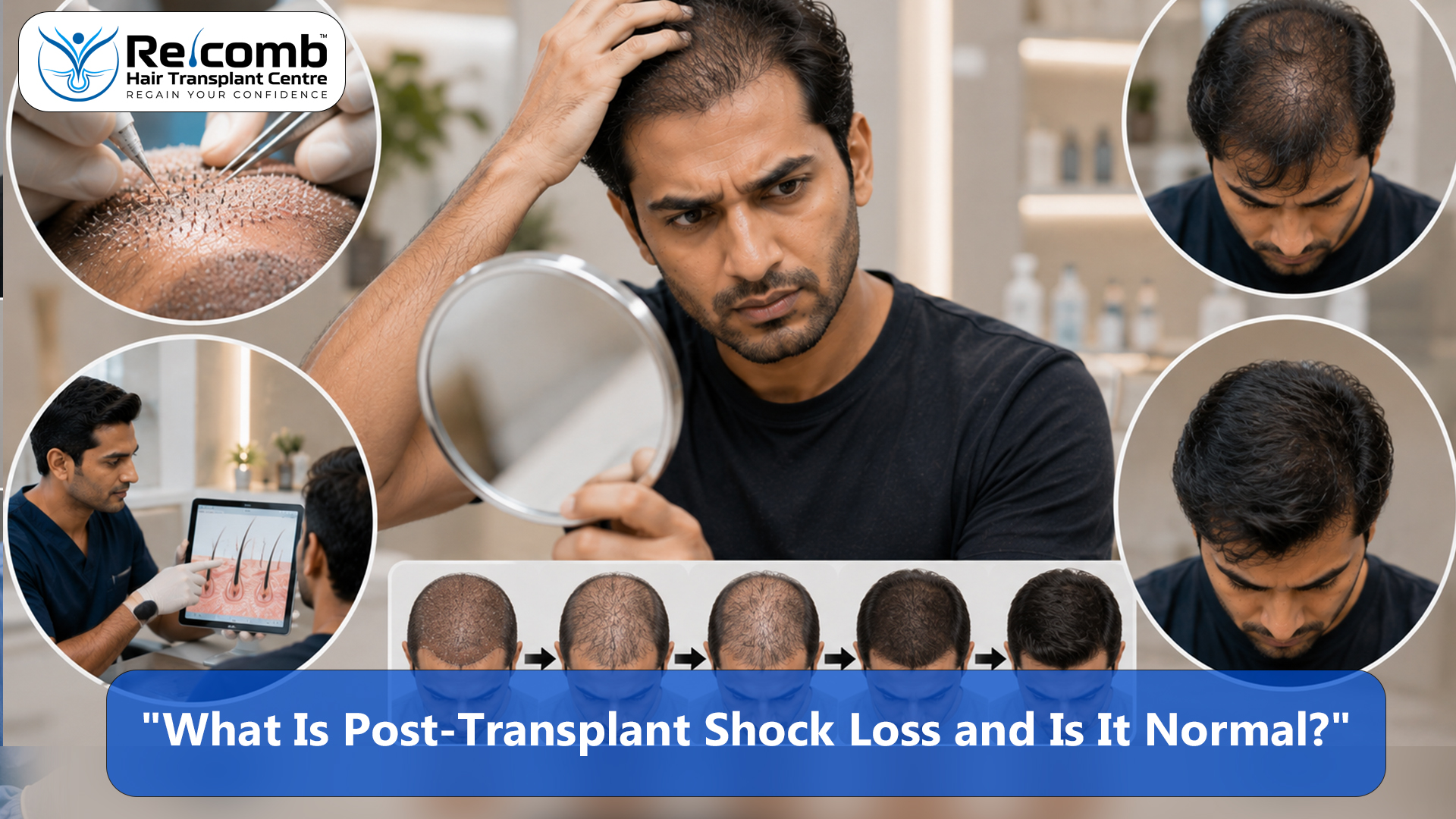
This is also the appointment where the shedding phase is discussed and confirmed if it has not yet been addressed. Patients who are beginning to see transplanted hair shedding at this stage are reassured specifically and given a clear timeline for what the next several months will look like.
Months 2 to 3: The Quiet Period and Proactive Check-In
This is the period most commonly associated with patient anxiety. The transplanted hairs have shed. The scalp looks largely unchanged from or occasionally thinner than the pre-surgical baseline. Visible growth has not yet begun. The result that was anticipated feels as though it is not coming.
RECOMB manages this period proactively rather than reactively. At approximately the six-week and ten-week marks, the clinical team initiates contact with every patient to confirm their experience is within the expected range, address any concerns, and reinforce the accurate timeline for the growth phase that follows.
This proactive communication during the quiet period is one of the most consistently valued aspects of the RECOMB follow-up process. Patients who know what is happening clinically navigate this period significantly better than those who are left to interpret it without guidance.
Three Months: Growth Assessment and Treatment Decision
The three-month assessment is the first clinically meaningful evaluation of how the procedure is progressing. By this stage, early growth is beginning in most patients, though density at three months represents only a fraction of the final result.
Trichoscopy is performed to assess the early growth pattern, confirm that transplanted follicles are re-entering anagen, and evaluate the recovery status of native hairs in the recipient zone that may have experienced shock loss. This examination provides specific, measured information rather than a subjective impression of how the result is developing.
The three-month assessment is also the point at which post-operative GFC or PRP therapy is typically introduced for patients where it was planned. For patients where the three-month trichoscopy suggests slower than expected early growth or incomplete shock loss recovery, GFC or PRP is specifically recommended as a growth phase support treatment. For patients where early growth is tracking well, the timing and need for biological support therapy is reviewed based on the trichoscopy findings.
Medical management is reviewed at this appointment. Patients who have been on finasteride since before or shortly after the procedure are assessed for tolerance and response. Any adjustments to the medical management plan are made at this point rather than left until the twelve-month result assessment.
Six Months: Visible Progress Assessment
The six-month assessment is the checkpoint that most patients approach with the most emotional investment, because it is the first point at which a meaningful visible result is assessable.
At six months, most patients have achieved 50 to 65 percent of their final density. The improvement compared to the pre-surgical baseline is visible and satisfying for most patients, though the full result continues to develop. Standardised photographs taken from identical angles to the pre-surgical documentation allow a direct comparison that shows clearly what has been achieved.
Trichoscopy at six months provides a density measurement that can be compared to the pre-surgical donor density baseline, giving a specific assessment of how graft survival has translated into growing density in the recipient zone. It also evaluates the extent to which shocked native hairs have recovered, which is an important contributor to total visible density at this stage.
The six-month assessment is where the twelve-month result is projected with reasonable confidence. Patients who are at 50 to 65 percent density at six months with normal growth trajectory are on track for a satisfying twelve-month result. Patients where growth is tracking below expectation are identified at this stage and specific management decisions are made, which may include additional GFC or PRP sessions, adjustment of medical management, or assessment of whether specific zones warrant discussion about a planned second session.
Months 7 to 11: Growth Maturation and Optional Check-Ins
Between the six and twelve month assessments, the growth process continues to mature. Hair shafts thicken progressively and density continues to increase. This phase does not typically require formal clinical appointments for patients whose six-month assessment showed normal trajectory.
For patients with specific concerns, changes in growth pattern, or questions about medications during this period, the RECOMB team is accessible via WhatsApp for photograph-based assessment and guidance without requiring an in-person visit for matters that do not require physical examination.
Patients who were identified at the six-month assessment as tracking below expectation have an additional in-person assessment at approximately nine months to evaluate progress and refine the management plan ahead of the twelve-month result evaluation.
Twelve Months: Result Evaluation and Long-Term Planning
The twelve-month assessment is the most comprehensive appointment in the follow-up schedule. By this stage, 80 to 90 percent of the final density is visible for most patients and the result is assessable against the original plan.
The assessment includes standardised photography from identical angles to all prior documentation, allowing a direct visual comparison from pre-surgical baseline through the growth period to the current result. Trichoscopy provides specific density measurements in each zone. The Norwood or Ludwig staging is repeated to document the current state of native hair in surrounding areas, which is important for understanding how medical management has performed and what the trajectory of non-transplanted zones looks like going forward.
The result is discussed specifically against the graft plan that was established before surgery. Were the density targets for each zone achieved? Are there zones where additional grafts in a planned second session would meaningfully improve the result? Has native hair in the surrounding areas responded well to medical management?
For patients with a staged plan, the twelve-month assessment is where the timing and clinical parameters for the second session are confirmed based on the actual observed result rather than the projection made before the first session.
For all patients, the twelve-month appointment concludes with a long-term management plan covering ongoing finasteride and minoxidil use, the maintenance schedule for GFC or PRP if applicable, and the timing for the next annual trichoscopy assessment to monitor native hair in non-transplanted zones.
RECOMB's Approach (2026)
At RECOMB Hair Transplant Centre, Surat, the 12-month follow-up process described above is not a service upgrade or an optional premium offering. It is the standard of care that every patient receives as part of their treatment plan.
Dr. Krishna Bhalala and Dr. Nilesh Kachhadiya personally conduct the formal follow-up assessments. The continuity of care between the surgeon who performed the procedure and the clinician evaluating its progress ensures that every assessment is informed by specific knowledge of the original plan, the technical decisions made during the procedure, and the clinical context of that individual patient.
For patients from outside Surat, the follow-up schedule is adapted to minimise travel where possible while maintaining the clinical integrity of the key assessment points. The one-month check-in and routine interim contact can be managed remotely. The three, six, and twelve month formal assessments, where trichoscopy is performed and clinical decisions are made, are recommended in person.
Understand the Full Care Plan That Comes With Your Procedure at RECOMB →
WhatsApp: +91 7624008000 | www.recombhair.com
Final Takeaway
The 12-month follow-up process is not a courtesy offered after the important work is done. It is half of the clinical work. The procedure places the grafts. The follow-up process manages the environment in which those grafts develop, identifies and addresses issues at the points in the timeline where intervention is most effective, and ensures the patient arrives at their twelve-month result with the full benefit of everything the procedure had the potential to deliver.
Patients evaluating any clinic should ask specifically what the follow-up schedule looks like, what clinical assessments are included at each point, whether trichoscopy is performed at the key intervals, and whether the same surgeon conducts the follow-up as performed the procedure. The answers to these questions predict the quality of the recovery management as reliably as any other factor in the clinic evaluation.
Dr. Krishna Bhalala and Dr. Nilesh Kachhadiya conduct a limited number of personal consultations each week at RECOMB, Surat. If you want to understand the complete care plan that accompanies a procedure at RECOMB before making any commitment, this is where that conversation starts.
See the Complete 12-Month Care Plan That Comes With Every RECOMB Procedure →
WhatsApp: +91 7624008000
We respond within 24 hours, 6 days a week.
www.recombhair.com
Contact RECOMB Hair Transplant Centre
RECOMB Hair Transplant Centre
19, Ground Floor, Zenon Building, Opp. Unique Hospital, near Kiran Motors, Khatodara Wadi, Surat, Gujarat 395001
Phone: +91 7624008000
Website: www.recombhair.com