
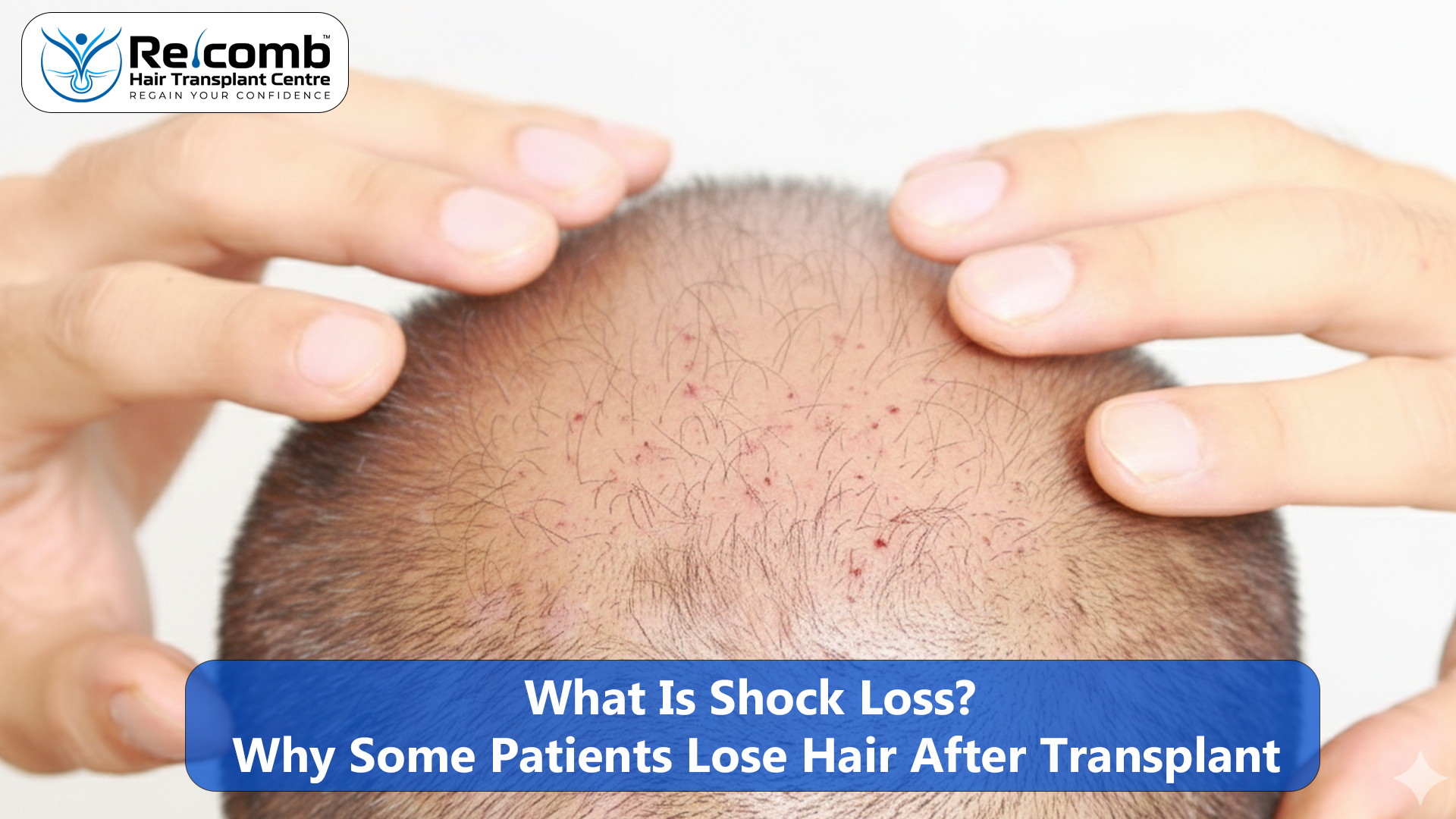
Shock loss is one of the most misunderstood phases after a hair transplant. Many patients become worried when they see their newly transplanted or existing hair fall out within weeks of surgery.
However, in most cases, this shedding is temporary, normal, and part of the healing process.
At Recomb Hair Transplant Centre, Surat, we educate every patient about shock loss so they understand what is expected and what requires medical attention.
What Is Shock Loss?
Shock loss refers to the temporary shedding of transplanted hair or native (existing) hair following a hair transplant procedure.
This usually happens within 2 to 8 weeks after surgery.
It occurs because the scalp undergoes temporary “trauma” from:
-
Incisions
-
Graft placement
-
Reduced blood flow
-
Inflammation
As a protective response, hair follicles enter the telogen (resting) phase, causing the hair shaft to fall out.
The root remains intact and grows new hair after the resting phase ends.
Types of Shock Loss
1. Shock Loss of Transplanted Hair
The newly implanted hair falls out temporarily.
This is completely normal and expected.
New hair begins to grow after 3–4 months.
2. Shock Loss of Native Hair
The existing hair around the transplanted area sheds due to stress on the scalp.
This happens mostly if:
-
The native hair is already weak
-
The area is densely implanted
-
The patient has active androgenetic alopecia
Native hair grows back in most cases, especially with medical support.
Why Does Shock Loss Happen?
1. Surgical Trauma
Even with advanced methods like Sapphire FUE, micro-incisions can temporarily reduce blood flow in the area, triggering hair shedding.
2. Weak or Miniaturized Native Hair
If the surrounding hair is already sensitive to DHT or thinning, it is more likely to shed temporarily.
3. Inflammation or Swelling
Post-operative swelling around follicles can interrupt the hair cycle, causing temporary shedding.
4. Lack of Medical Maintenance
Patients not on prescribed DHT blockers or supportive treatment may experience higher shock loss of native hair.
5. Heavy Smoking or Poor Lifestyle
Reduced scalp circulation increases the risk of shock loss.
6. Tight Hairstyles or Rough Handling
Friction or pulling soon after surgery can disturb grafts and existing follicles.
Is Shock Loss Permanent?
In the majority of cases, shock loss is temporary.
Hair grows back from the same follicle after the resting phase.
Transplanted hair returns in:
-
3–4 months (initial growth)
-
8–12 months (visible density)
-
12–18 months (final result)
Native hair also typically regrows, especially with proper medical therapy.
Permanent shock loss is rare and is usually linked to miniaturized hair that was already destined to fall.
How to Prevent Shock Loss After a Hair Transplant
1. Start Medical Therapy Before and After Surgery
This stabilizes native hair and reduces trauma response.
Includes:
-
DHT blockers (under medical guidance)
-
Growth serums
-
Nutritional support
2. Gentle Post-Operative Care
Avoid pressure, rubbing, or tight caps for the first few weeks.
3. Avoid Smoking and Alcohol
These reduce oxygen supply to follicles and increase shock loss risk.
4. Use Anti-Inflammatory and Antioxidant Support
Reduces scalp inflammation after surgery.
5. Choose Experienced Surgeons
Proper incision density, handling, and implantation speed reduce trauma and shock loss.
At Recomb, we use Sapphire blades and advanced implantation protocols to minimize trauma and maintain maximum graft survival.
When Should You Be Concerned?
Consult a specialist if:
-
Shedding continues beyond 10–12 weeks
-
You see patches without regrowth after 4–6 months
-
Redness, infection, or excessive inflammation occurs
Timely evaluation helps prevent long-term thinning.
Contact Recomb Hair Transplant Centre
Phone: +91 7624008000
Website: www.recombhair.com