
GFC (Growth Factor Concentrate) therapy is widely promoted as an advanced solution for hair fall and thinning. Many patients therefore ask an important question:
Can GFC therapy regrow hair that is already lost?
The answer requires a clear understanding of hair follicle biology, the mechanism of GFC, and the stage of hair loss. At RECOMB Hair Transplant Centre, Surat, we focus on setting realistic expectations based on medical science, not marketing claims.
What Is GFC Therapy?
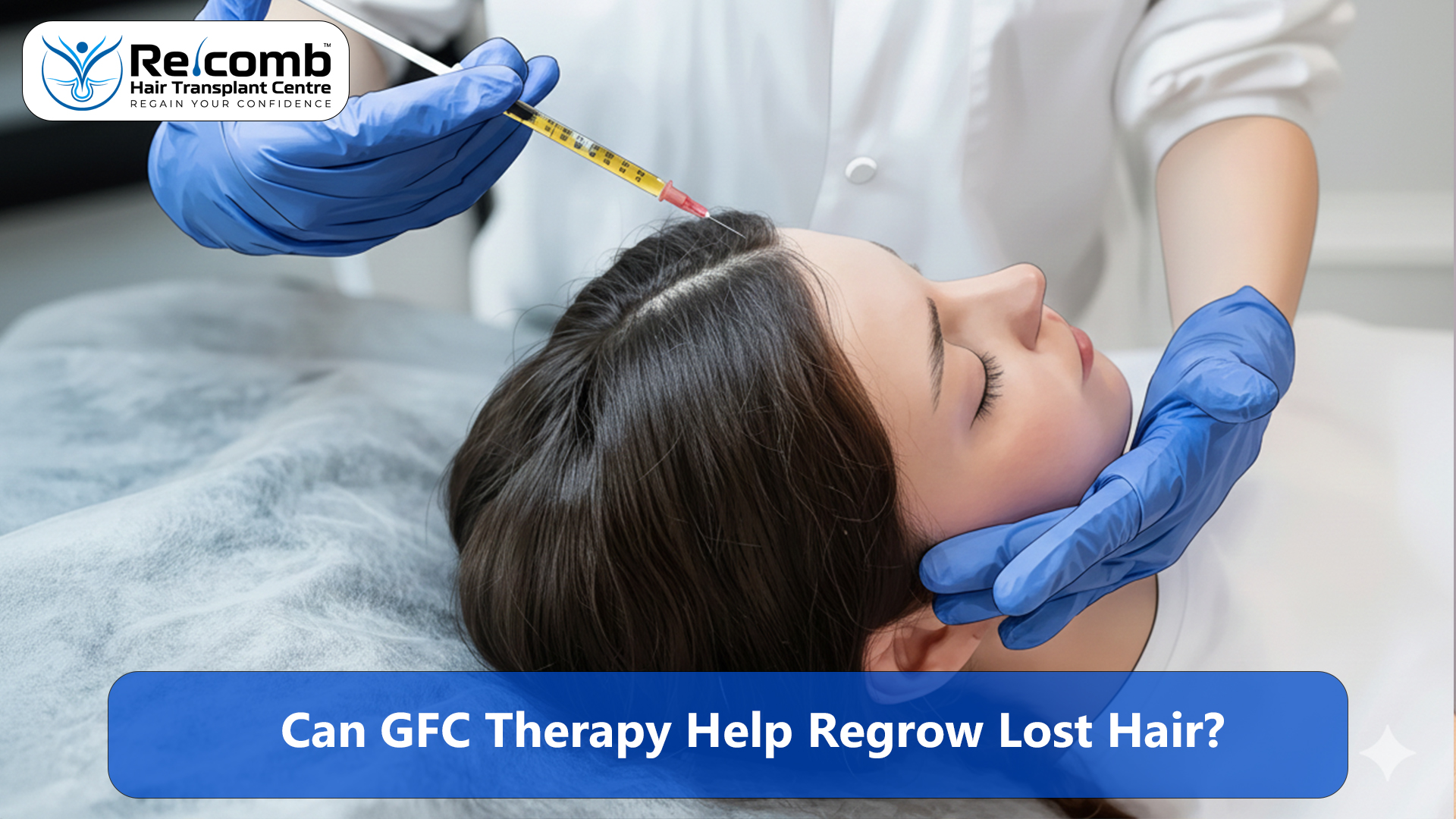
GFC is a next-generation regenerative treatment where pure growth factors are extracted from a patient’s own blood using a specialized filtration process.
GFC contains:
-
Platelet-derived growth factors
-
Vascular endothelial growth factors
-
Epidermal growth factors
-
Anti-inflammatory mediators
Unlike PRP, GFC is cell-free, more concentrated, and causes minimal inflammation.
How GFC Works on Hair Follicles
Hair follicles cycle through growth (anagen), resting (telogen), and shedding phases.
GFC helps by:
-
Improving blood supply to follicles
-
Reducing inflammation around hair roots
-
Reactivating weak or dormant follicles
-
Increasing hair shaft thickness
-
Prolonging the growth phase
However, GFC can act only on follicles that are still alive.
The Key Medical Rule: Dead Follicles Cannot Be Revived
If a hair follicle is:
-
Completely miniaturized
-
Replaced by fibrous tissue
-
Bald for several years
Then no injection therapy, including GFC, can regrow hair in that area.
This is why understanding the difference between thinning hair and lost hair is critical.
When GFC CAN Help Regrow Hair
GFC therapy can help regrow hair in the following situations:
1. Early-Stage Hair Loss
When follicles are weakened but not destroyed, GFC can reactivate growth.
2. Diffuse Thinning
Patients with overall reduction in density but preserved follicles respond well.
3. Recent Hair Fall
Hair loss triggered by stress, illness, or nutritional issues can improve significantly.
4. Post-Hair Transplant Support
GFC improves graft survival and strengthens surrounding native hair.
In these cases, GFC can lead to visible regrowth and thickness improvement.
When GFC CANNOT Regrow Hair
GFC will not regrow hair if:
-
The scalp area is completely bald
-
Hairline has receded permanently
-
Crown has long-standing baldness
-
Follicles are absent on trichoscopy
In such cases, hair transplant is the only permanent solution.
GFC vs Hair Transplant: Clear Difference
| Aspect | GFC Therapy | Hair Transplant |
|---|---|---|
| Regrows Lost Hair | No | Yes |
| Strengthens Existing Hair | Yes | No |
| Works on Bald Areas | No | Yes |
| Non-Surgical | Yes | No |
| Long-Term Maintenance | Required | Required |
GFC and hair transplant are complementary, not competing treatments.
Why Some Patients Think GFC “Didn’t Work”
Common reasons include:
-
Starting GFC too late
-
Expecting regrowth in bald areas
-
Inadequate number of sessions
-
Ignoring medical maintenance
-
Advanced androgenetic alopecia
At RECOMB, every patient undergoes scalp analysis and follicle assessment before recommending GFC.
RECOMB’s Ethical GFC Protocol
At RECOMB Hair Transplant Centre, GFC is advised only when medically appropriate:
-
Detailed scalp and donor evaluation
-
Honest explanation of achievable results
-
No false promises of regrowth in bald areas
-
Combination with medical therapy when needed
-
Regular follow-up to assess response
We prioritize long-term outcomes over short-term claims.
Final Medical Conclusion
GFC therapy can help regrow hair only if follicles are still alive.
It cannot regrow hair in permanently bald areas.
-
GFC is excellent for early thinning and stabilization
-
Hair transplant is required for lost hair
-
Combination therapy gives the best results
At RECOMB, the goal is not just hair growth—but medically correct, sustainable restoration.
Contact RECOMB Hair Transplant Centre
Phone: +91 7624008000
Website: www.recombhair.com