
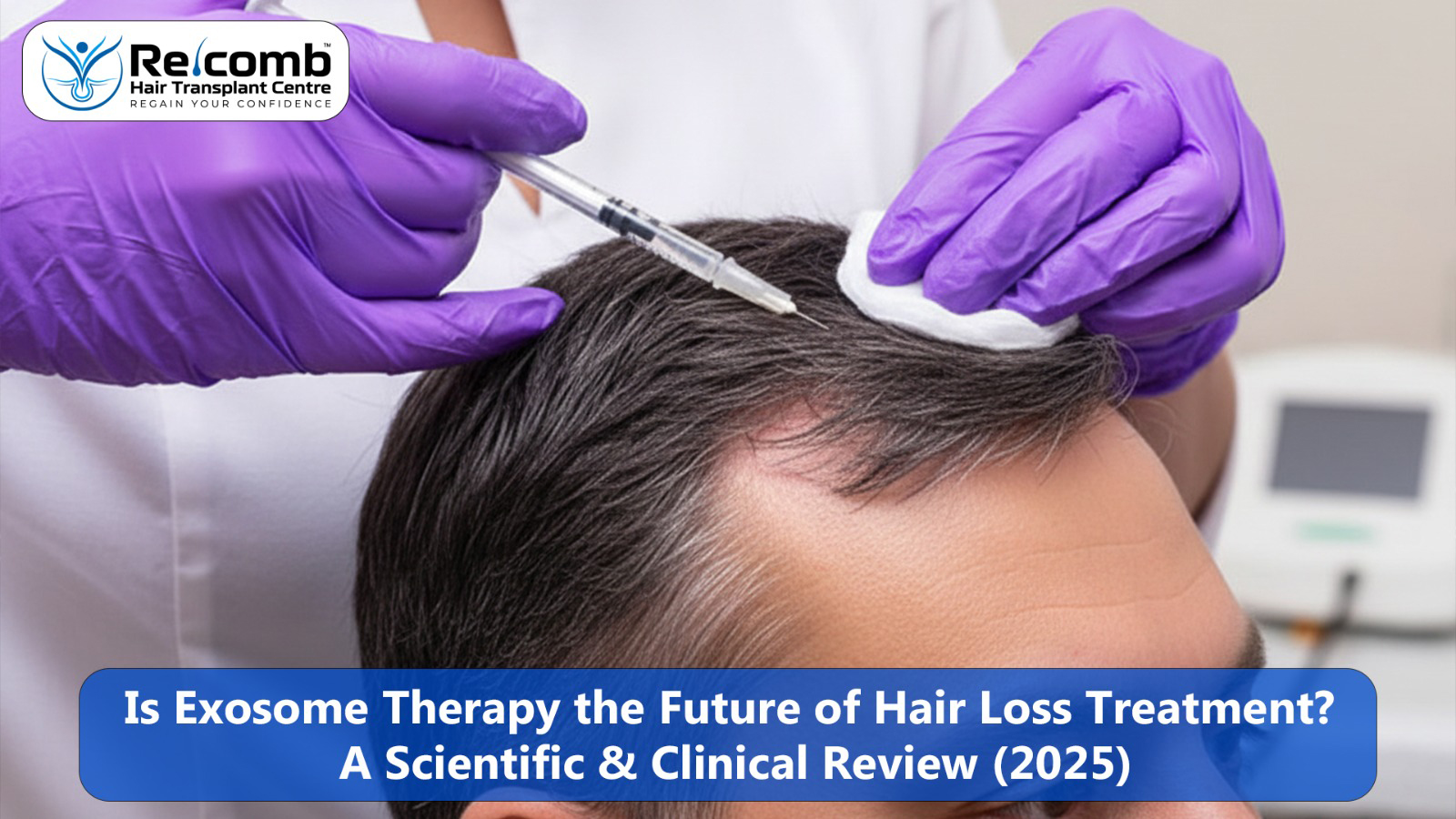
Hair loss treatment has evolved rapidly over the last decade—from basic medicines to PRP, GFC, and advanced hair transplantation techniques. One of the newest and most discussed innovations is Exosome Therapy.
Marketed as a regenerative, stem-cell–derived solution, exosome therapy has gained global attention for its potential to stimulate hair follicles at a cellular level. But is it truly the future of hair loss treatment, or just early-stage science with marketing hype?
At RECOMB Hair Transplant Centre, Surat, we believe in evidence-based medicine. This article explains what exosome therapy really is, where it stands today, and how it fits into modern hair restoration.
What Are Exosomes?
Exosomes are microscopic extracellular vesicles released by cells, especially stem cells.
They act as biological messengers, carrying:
-
Growth factors
-
Proteins
-
mRNA and microRNA
-
Signaling molecules
These signals influence cell repair, inflammation control, and tissue regeneration.
In hair biology, exosomes aim to reactivate dormant follicles and improve the scalp environment.
How Exosome Therapy Works for Hair Loss
In androgenetic alopecia, follicles gradually shrink due to hormonal and inflammatory signals.
Exosome therapy works by:
-
Reducing scalp inflammation
-
Improving follicle cell communication
-
Stimulating dermal papilla cells
-
Supporting transition from resting to growth phase
Unlike PRP, exosomes are cell-free and contain highly concentrated signaling molecules.
Exosome Therapy vs Existing Treatments
Exosome Therapy vs PRP
| Feature | Exosome Therapy | PRP |
|---|---|---|
| Source | Stem-cell derived | Patient’s own blood |
| Growth Factor Consistency | Very high | Variable |
| Inflammation | Minimal | Moderate |
| Sessions Required | 1–3 | 4–8 |
| Evidence Level | Emerging | Well-established |
Exosome Therapy vs GFC
| Feature | Exosome Therapy | GFC |
|---|---|---|
| Concentration | Extremely high | High |
| Regulation | Limited | Better standardized |
| Predictability | Still evolving | More predictable |
| Cost | Very high | Moderate |
Exosome Therapy vs Hair Transplant
-
Exosomes cannot create new follicles
-
Hair transplant restores lost hair permanently
-
Exosomes may support maintenance and early thinning
Who May Benefit from Exosome Therapy?
Exosome therapy may be suitable for:
-
Early-stage androgenetic alopecia
-
Diffuse thinning
-
Patients intolerant to oral medications
-
Post-hair-transplant maintenance
-
Inflammatory scalp conditions
It is not suitable for:
-
Completely bald areas
-
Advanced hairline recession
-
Grade 4–7 baldness as standalone therapy
Scientific Reality: Is It Proven Yet?
Current status of exosome therapy:
-
Promising lab and early clinical data
-
Limited large-scale human trials
-
No universal protocol or dosage standard
-
Regulatory status varies by country
This means exosome therapy is experimental-adjacent, not yet a gold standard.
Risks and Limitations
Important considerations:
-
Expensive treatment
-
Variable product quality globally
-
Lack of long-term outcome data
-
Not a replacement for proven therapies
-
Requires strict medical sourcing and protocols
At RECOMB, patient safety and scientific validation take priority over trends.
Is Exosome Therapy the Future?
Yes—but with conditions.
Exosome therapy represents the next generation of regenerative medicine, but it is best viewed as:
-
A future adjunct therapy
-
A complement to PRP, GFC, and medicines
-
A possible maintenance option after transplant
It is not a replacement for hair transplant or established medical treatments at present.
RECOMB’s Evidence-Based Approach
At RECOMB Hair Transplant Centre, Surat, we believe:
-
Innovation must follow evidence
-
New therapies must be ethically introduced
-
Patient education comes before marketing
We continuously evaluate emerging treatments and adopt them only when proven safe, effective, and ethical.
Contact RECOMB Hair Transplant Centre
Phone: +91 7624008000
Website: www.recombhair.com