
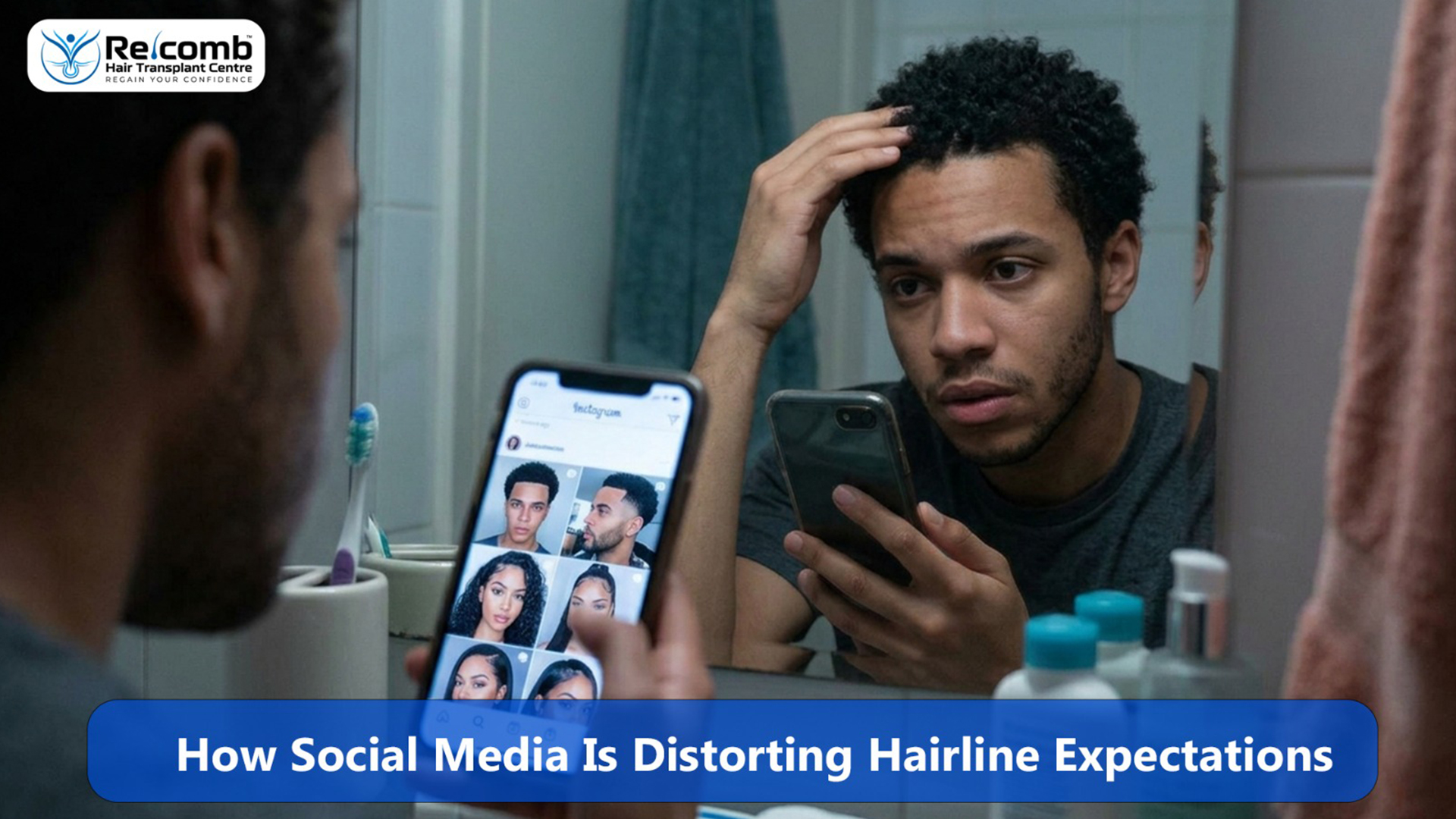
In today’s digital world, social media has become one of the biggest influences on how people perceive beauty—including hairlines.
Platforms like Instagram, YouTube, and short-form video apps constantly showcase:
- Perfectly shaped hairlines
- Instant transformation videos
- Dense, youthful results
- “Before and after” success stories
While these visuals are engaging, they often create unrealistic expectations about what hair restoration can actually achieve.
At RECOMB Hair Transplant Centre, many patients arrive with reference photos that are influenced more by social media than by medical reality.
1. The “Perfect Hairline” Illusion
Social media often promotes:
- Very low hairlines
- Extremely sharp temple angles
- High-density frontal zones
However, natural hairlines are:
- Slightly irregular
- Age-dependent
- Soft and gradual
The “perfect” hairline seen online is often designed for visual impact—not long-term realism.
2. Filters and Lighting Effects
Many transformation posts use:
- Filters
- Controlled lighting
- Angles that hide scalp visibility
These techniques can:
- Enhance density appearance
- Mask imperfections
- Make results look better than reality
Patients may expect similar results without understanding these visual enhancements.
3. Immediate Results Misconception
Social media often compresses timelines:
- Day 1 to Month 12 results shown in seconds
- No emphasis on shedding phase
- No discussion of gradual growth
In reality:
- Hair sheds after transplant
- Growth begins after 3–4 months
- Final results take up to a year
This mismatch creates unrealistic expectations.
4. Influencer Marketing Without Full Disclosure
Some influencers promote hair transplants or treatments without explaining:
- Ongoing medical therapy
- Multiple sessions
- Maintenance requirements
- Individual variability
This creates the impression that results are:
Instant, guaranteed, and effortless
Which is not medically accurate.
5. Ignoring Donor Limitations
Social media rarely discusses:
- Donor area limitations
- Safe graft extraction limits
- Long-term hair loss progression
Patients may assume:
- Unlimited density is possible
- Full coverage can be achieved in one session
In reality, hair transplant is limited by available donor hair.
6. Standardized Hairlines for Everyone
Many online results show similar hairline designs.
However, a natural hairline must be:
- Customized to facial structure
- Age-appropriate
- Aligned with future hair loss
Copying someone else’s hairline often leads to unnatural results.
7. Psychological Impact
Constant exposure to idealized images can lead to:
- Increased self-comparison
- Dissatisfaction with natural appearance
- Pressure to act quickly
- Fear of missing out on “perfect results”
This emotional influence often drives premature decisions.
The Reality of Natural Hair Transplant Results
A successful hair transplant should:
- Blend naturally with existing hair
- Follow natural growth patterns
- Age appropriately over time
- Preserve donor area
Natural results are often subtle—not exaggerated.
How to Set Realistic Expectations
Patients should:
- Understand their baldness stage
- Evaluate donor capacity
- Focus on long-term planning
- Review unedited, real patient results
- Consult qualified professionals
Realistic expectations lead to higher satisfaction.
RECOMB’s Ethical Approach (2026)
At RECOMB:
- Hairlines are designed based on facial proportions
- Conservative planning is prioritized
- Donor preservation is emphasized
- Patients are educated about realistic outcomes
The focus is on results that look natural in real life—not just on social media.
Final Takeaway
Social media has made hairline expectations sharper, denser, and often unrealistic.
However, hair transplant is a medical procedure with:
- Biological limitations
- Long-term considerations
- Individual variability
The best results are not the most dramatic ones—but the ones that look natural and age well over time.
Contact RECOMB Hair Transplant Centre
Phone: +91 7624008000
Website: www.recombhair.com