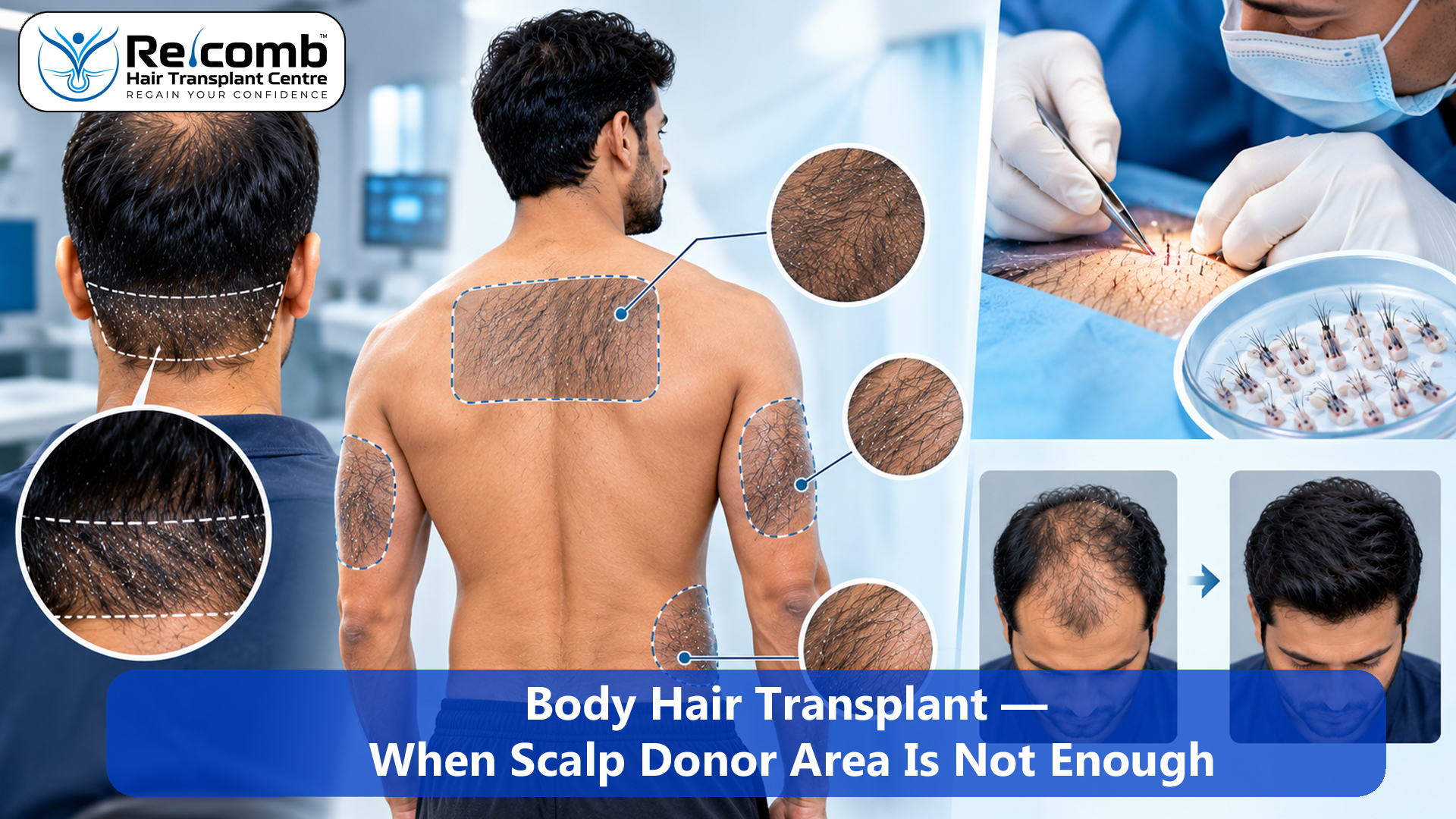

Hair transplant has become widely accessible, but with growing demand comes aggressive marketing. Many clinics highlight only the positives—dense results, permanent hair, and quick transformation.
What often gets ignored are the limitations, trade-offs, and long-term realities.
At RECOMB Hair Transplant Centre, patient education is considered as important as the procedure itself.
Here are key truths patients should know before deciding.
1. Hair Transplant Does NOT Stop Hair Loss
This is one of the most misunderstood points.
A hair transplant:
- Moves existing hair from donor to recipient area
- Does not stop ongoing hair loss
Your native hair can continue to thin after surgery.
What This Means
Without proper planning:
- Transplanted hair remains
- Surrounding hair may disappear
- Result may look unnatural over time
2. Donor Hair Is Limited Forever
Your donor area is not unlimited.
Once grafts are extracted:
- They do not grow back
- The donor capacity reduces permanently
Most patients have a lifetime limit of around 4,000–6,000 grafts.
Why It Matters
Poor planning in the first surgery can:
- Exhaust donor early
- Limit future correction options
3. You Will Not Get Your Teenage Density Back
Many advertisements show extremely dense results.
Reality:
- Natural density = 80–100 follicles/cm²
- Transplant density = 35–70 grafts/cm²
Hair transplant improves appearance—but does not fully replicate original density.
4. Results Take Time (Not Instant)
Surgery is just the beginning.
Timeline:
- First month: shedding phase
- 3–4 months: initial growth
- 6–8 months: visible improvement
- 10–12 months: final result
Many clinics show only final results—not the full journey.
5. More Grafts Is NOT Always Better
Some clinics promote:
- “Maximum grafts”
- “Unlimited graft packages”
But excessive graft extraction can:
- Damage donor area
- Reduce survival rate
- Compromise long-term results
Quality and planning matter more than numbers.
6. Technician-Led Surgery Is Common
In some clinics:
- Technicians perform most of the procedure
- Doctor involvement is limited
Hair transplant requires:
- Artistic hairline design
- Precise angle control
- Medical judgment
Lack of proper supervision increases risk of unnatural results.
7. Hairline Design Is Permanent
Hairline placement is one of the most critical decisions.
A poorly designed hairline:
- Is difficult to correct
- May look unnatural over time
- Consumes valuable grafts
Lower is not always better—natural is better.
8. You May Need Future Procedures
Hair loss is progressive.
Even after a successful transplant:
- New areas may thin
- Additional sessions may be required
Planning for the future is essential.
9. Not Everyone Is a Good Candidate
Some patients should delay or avoid surgery:
- Unstable hair loss
- Poor donor density
- Unrealistic expectations
- Active scalp conditions
Ethical clinics will sometimes advise against surgery.
10. Cheapest Option Can Be Most Expensive Later
Low-cost procedures may compromise:
- Planning
- Technique
- Donor safety
Poor results may require correction surgery, which is more complex and costly.
What You SHOULD Expect From a Good Clinic
A responsible clinic will:
- Evaluate your condition properly
- Explain limitations honestly
- Plan for long-term results
- Prioritize donor preservation
- Set realistic expectations
Transparency is a sign of quality.
RECOMB’s Ethical Approach (2026)
At RECOMB:
- Patients are educated before treatment
- Surgery is not recommended when unnecessary
- Hairline design is conservative and long-term focused
- Donor management is prioritized
The goal is not just performing surgery—but achieving natural, sustainable results.
Final Takeaway
Hair transplant is an effective solution—but only when done with proper understanding.
Before surgery, you should know:
- It does not stop hair loss
- Donor hair is limited
- Results take time
- Planning matters more than marketing
Making an informed decision today prevents complications tomorrow.
Contact RECOMB Hair Transplant Centre
Phone: +91 7624008000
Website: www.recombhair.com