
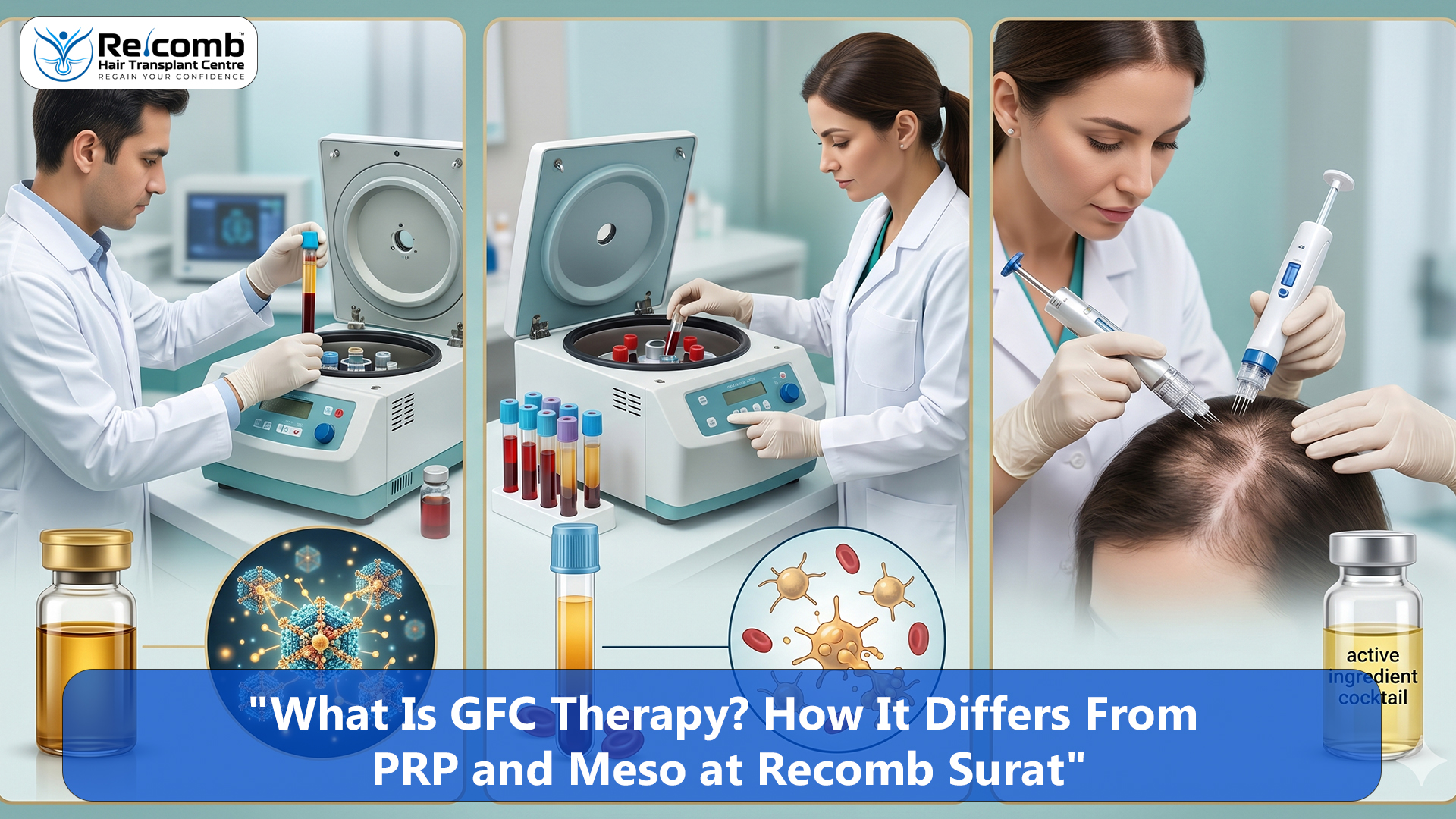
Patients researching non-surgical hair loss treatment in Surat increasingly encounter three names: GFC, PRP, and Mesotherapy. All three are offered at clinics. All three involve injections into the scalp. All three are described, in various marketing materials, as treatments for hair loss.
Beyond that, most patients have no clear picture of what separates them, which one is appropriate for their specific condition, or whether any of them are actually worth doing in their case.
This blog gives a direct, clinical explanation of each treatment, what the evidence says, how they differ from each other, and how RECOMB approaches the decision of which to recommend and when.
If you are currently losing hair and trying to decide whether a non-surgical treatment is right for your stage of loss, a consultation at RECOMB will give you a specific answer based on your scalp and your blood results, not a generalised recommendation.
Book a Hair Loss Treatment Consultation at RECOMB, Surat → WhatsApp: +91 7624008000 | www.recombhair.com
What Is GFC Therapy and How Does It Work
GFC stands for Growth Factor Concentrate. It is a relatively newer treatment in hair restoration and represents a significant clinical advancement over standard PRP.
The procedure begins with a blood draw from the patient. The blood is processed using a specialised closed-system kit that separates and concentrates specific growth factors, primarily platelet-derived growth factor, vascular endothelial growth factor, epidermal growth factor, and transforming growth factor beta. These are the signalling proteins that directly regulate follicle behaviour, stimulating the growth phase, improving blood supply to the follicle, and reducing the inflammatory environment that contributes to miniaturisation.
What distinguishes GFC from PRP is the processing method. Standard PRP concentrates platelets along with the plasma in which they sit. GFC extracts and concentrates only the active growth factor proteins, discarding the plasma and other components. The result is a preparation with a significantly higher concentration of the specific biological molecules that act on follicles, with less dilution and less inflammatory component than whole PRP.
GFC is injected directly into the scalp at the level of the follicle using a fine needle technique. The procedure takes approximately 45 to 60 minutes including preparation time and is performed under topical anaesthesia.
Results from GFC therapy develop over three to six months. Patients typically notice reduced shedding within the first four to six weeks, followed by progressive improvement in hair density and shaft diameter over the following months. A standard course is three to four sessions spaced four weeks apart, followed by maintenance sessions every four to six months.
What Is PRP and How Does It Work
PRP stands for Platelet Rich Plasma. It has been in use in hair restoration for over a decade and has the most extensive evidence base of the three treatments discussed here.
The procedure is similar in its first step to GFC: a blood draw from the patient. The blood is then centrifuged to separate the platelet-rich layer from the red blood cells and platelet-poor plasma. This concentrated platelet layer is then injected into the scalp.
Platelets contain growth factors within granules that are released when the platelets are activated. PRP delivers these growth factors to the follicular environment along with the plasma in which they are suspended. The plasma itself has some biological activity but also dilutes the effective growth factor concentration relative to GFC.
PRP has good evidence for reducing hair shedding in androgenetic alopecia, improving hair shaft diameter, and supporting follicle health in early to moderate loss. It is less effective as loss becomes more advanced because it cannot stimulate follicles that have completely miniaturised.
A standard PRP course is four to six sessions spaced two to four weeks apart with maintenance every three to six months.
What Is Mesotherapy and How Does It Work
Mesotherapy is different in principle from both GFC and PRP. Rather than using the patient's own biological material, mesotherapy delivers a cocktail of externally sourced compounds directly into the scalp via microinjection.
The mesotherapy solution used in hair loss treatment typically contains a combination of vitamins, minerals, amino acids, and pharmaceutical agents such as minoxidil, biotin, finasteride, and DHT blockers in varying concentrations depending on the formulation used by the clinic. The goal is to deliver these compounds directly to the follicular level, bypassing the systemic route and achieving higher local concentrations than oral or topical administration.
The evidence base for mesotherapy in hair loss is more variable than for PRP or GFC because the composition of mesotherapy solutions is not standardised. Different clinics use different formulations with different concentrations and different active agents. This makes direct comparison across studies difficult and makes clinical outcomes highly dependent on what specific formulation is being used.
Mesotherapy is generally used as a supportive treatment rather than a primary one. It can be effective for patients who cannot or do not want to take oral finasteride, as it delivers DHT-blocking agents locally. It is also used to address nutritional deficiencies directly at the scalp level.
GFC vs PRP vs Mesotherapy: The Direct Comparison
The three treatments differ in source, mechanism, evidence, and appropriate patient profile.
GFC uses only the patient's concentrated growth factors with no external additives. It delivers the highest growth factor concentration of the three. It is the most recent of the three treatments and has the strongest emerging evidence for efficacy in androgenetic alopecia. It is best suited for patients with early to moderate loss who want the most targeted biological intervention currently available.
PRP uses the patient's own platelet-rich plasma. It delivers growth factors within a plasma environment. It has the most established evidence base and the longest clinical track record. It is appropriate across a wider range of loss stages and is often the first-line non-surgical recommendation for patients with confirmed androgenetic alopecia at early to moderate stages.
Mesotherapy uses externally formulated compounds injected locally. It does not rely on the patient's own biology. It is most useful as an adjunct to medical management or for delivering DHT-blocking agents locally in patients who cannot tolerate systemic medication. It is not a standalone treatment for significant hair loss and should not be positioned as equivalent to GFC or PRP in terms of biological mechanism.
The choice between them is not simply a matter of which is newer or more expensive. It depends on the patient's stage of loss, their blood results, their medical history, their existing treatment plan, and what the clinical examination shows about follicle health.
What These Treatments Cannot Do
This is the point that marketing materials rarely address directly and that patients deserve to understand clearly before spending money on any non-surgical treatment.
GFC, PRP, and mesotherapy cannot reverse established baldness. They cannot restore follicles that have completely miniaturised. They cannot replace a hair transplant in patients who need one. Their role is to support and preserve follicles that are still active, slow the progression of miniaturisation, reduce shedding, and improve the quality of hair that is still growing.
A patient with Norwood Grade 5 baldness who undergoes GFC therapy will not regrow hair in the bald zone. A patient with Grade 2 loss who starts GFC alongside medical management may preserve significantly more of their existing hair over the following years than one who does nothing.
The appropriate expectation is preservation and improvement, not restoration.
How RECOMB Decides Which Treatment to Recommend
At RECOMB Hair Transplant Centre, Surat, non-surgical treatment recommendations follow a clinical assessment, not a price list or a treatment menu.
The assessment includes trichoscopy to evaluate follicle health and miniaturisation pattern, blood investigations to identify nutritional or hormonal contributors, Norwood or Ludwig staging to map the loss, and a detailed history of progression rate and previous treatments.
From this assessment, Dr. Krishna Bhalala and Dr. Nilesh Kachhadiya determine whether a non-surgical treatment is appropriate at this stage, which specific treatment or combination is most likely to benefit this patient's follicular profile, whether medical management needs to accompany the treatment, and at what point surgical planning should be considered if loss continues to advance.
We do not offer GFC, PRP, or mesotherapy to every patient who asks for it. If a patient's loss is advanced enough that non-surgical treatment will not produce a meaningful result, we say so and explain what will. If a patient's loss is early enough that mediczl management alone is sufficient, we say that too.
Know Exactly Which Treatment Is Right for Your Hair Loss Stage → WhatsApp: +91 7624008000 | www.recombhair.com
RECOMB's Approach (2026)
At RECOMB Hair Transplant Centre, Surat, non-surgical treatments are part of a comprehensive hair restoration plan, not standalone offerings. GFC therapy, where indicated, is performed using a standardised closed-system protocol that ensures consistent growth factor concentration and sterile preparation. PRP is offered where the clinical profile supports it. Mesotherapy is used selectively as an adjunct where locally delivered compounds serve a specific purpose in the patient's overall plan.
Every patient who undergoes a non-surgical treatment at RECOMB leaves with a clear understanding of what the treatment does, what results to expect and over what timeline, and how it fits into their broader hair restoration strategy. No treatment is sold without that context.
Final Takeaway
GFC, PRP, and mesotherapy are not interchangeable. They work through different mechanisms, have different evidence bases, suit different patient profiles, and should be recommended based on clinical assessment rather than patient preference or clinic convenience.
GFC represents the most targeted biological approach currently available for non-surgical hair loss treatment. PRP has the most established track record. Mesotherapy has a specific role as a supportive adjunct. None of them are appropriate for every patient and none of them replace surgery when surgery is what is actually needed.
The right non-surgical treatment, used at the right stage with realistic expectations, can meaningfully slow hair loss progression and preserve density that would otherwise be lost. Used without proper assessment, it can delay the right treatment while the loss continues.
Dr. Krishna Bhalala and Dr. Nilesh Kachhadiya conduct a limited number of personal consultations each week at RECOMB, Surat. If you want a clinical answer on which treatment is right for your specific hair loss stage, this is where that conversation starts.
Get a Treatment Plan Built for Your Stage of Hair Loss → WhatsApp: +91 7624008000 We respond within 24 hours, 6 days a week. www.recombhair.com
Contact RECOMB Hair Transplant Centre
Phone: +91 7624008000
Website: www.recombhair.com