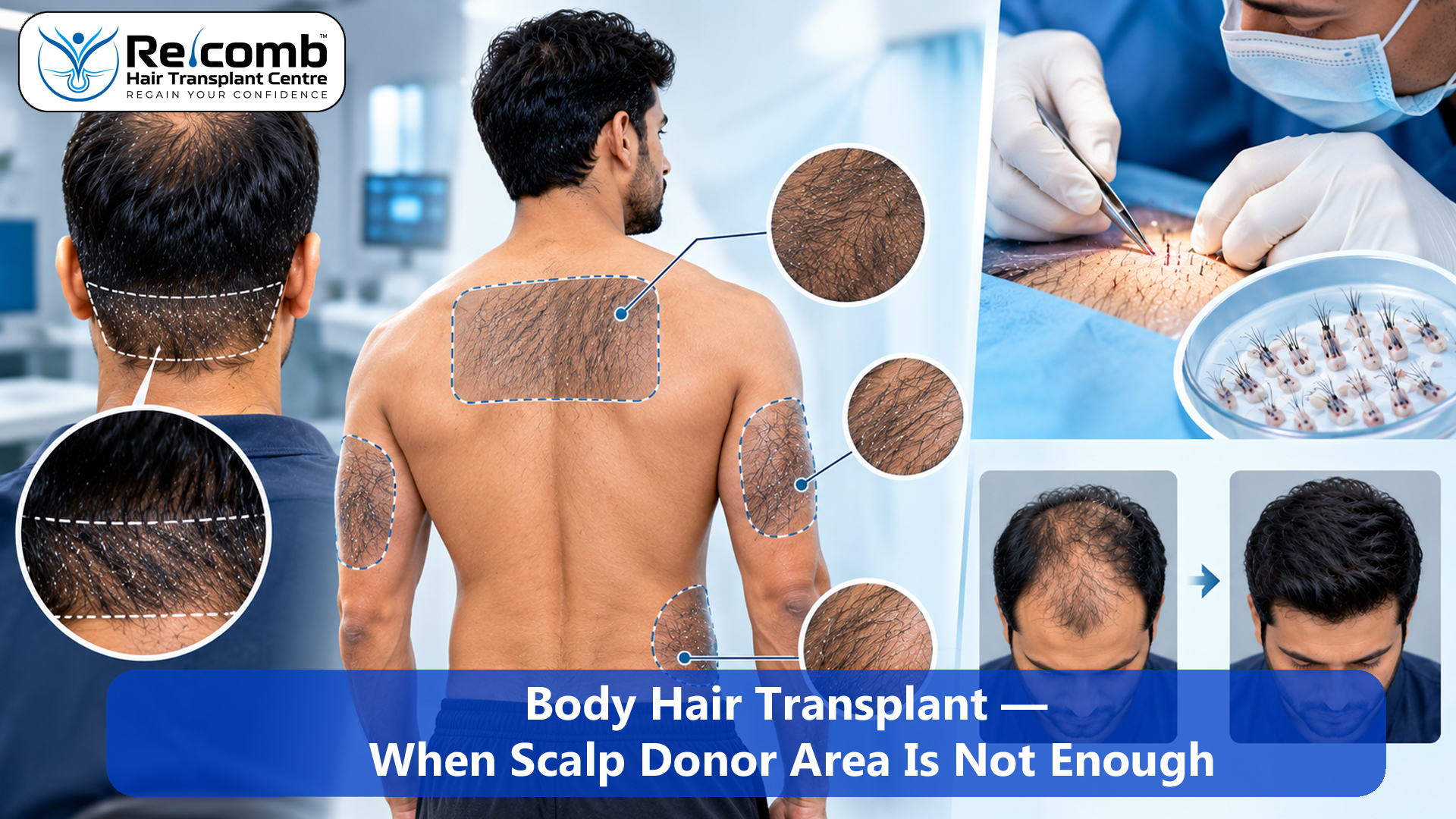

Many patients expect a thick, natural look after their hair transplant, but sometimes the density appears lower than expected. This can happen due to medical, technical, or donor-related factors. Understanding the real causes helps patients make better decisions and ensures improved outcomes in future sessions.
At Recomb Hair Transplant Centre, Surat, we focus on donor safety, correct angulation, and high-density implantation using Sapphire FUE to achieve the most natural results. Here are the seven hidden reasons why some transplants look thin or patchy.
1. Insufficient Graft Count
One of the most common reasons for low density is simply not implanting enough grafts.
Correct planning depends on:
-
Baldness grade
-
Donor density
-
Desired density (45–70 grafts/cm²)
-
Hairline size
If fewer grafts are used, the result will always look sparse, especially in the frontal zone.
2. Low Donor Density
A weak donor area limits how many grafts can be safely extracted.
A healthy donor area ideally has:
-
50–80 follicles/cm²
-
Thick hair shafts
-
Uniform growth
If density is low, overharvesting must be avoided, leading to fewer usable grafts.
3. Poor Graft Survival Rate
If grafts are mishandled or stay outside the body for too long, they may not survive.
Common causes include:
-
Rough extraction
-
Dehydration of grafts
-
Long exposure time
-
Incorrect storage solution
At Recomb, grafts are kept in chilled preservation media to maintain 95–98% survival.
4. Incorrect Angle and Direction
Even if grafts survive, wrong angulation can make the hair stand upright or look unnatural. This makes the scalp look emptier.
Correct angle ensures:
-
Natural layering
-
Maximum coverage
-
Better optical density
Sapphire blades help create precise, natural angles.
5. Fine Hair Diameter
Hair thickness matters as much as the graft count.
Thicker hair shafts provide better visual coverage.
Even 40 grafts/cm² of thick hair can look better than 60 grafts/cm² of very fine hair.
This is why genetic hair type influences the final appearance.
6. Shock Loss After Surgery
Temporary hair shedding can happen after a transplant, especially if native hair is already weak.
This can make the area look thin for 2–3 months.
However, with proper medical treatment, native hair regrows and density improves.
7. Unrealistic Expectations
Some patients assume a transplant will fully restore childhood density.
Natural hair density is around 80–100 follicles/cm².
Transplant density typically ranges from:
-
40–50 grafts/cm² in crown
-
50–70 grafts/cm² in the frontal zone
The correct goal is to create the illusion of fullness, not replicate childhood density.
How Recomb Ensures High-Density & Natural Results
At Recomb Hair Transplant Centre, every case is evaluated using digital density analysis, donor mapping, and Sapphire FUE tools.
Our protocol includes:
-
Extraction only from the safe donor zone
-
High-density implantation using sapphire blades
-
Proper graft storage for maximum survival
-
Natural angle, direction, and distribution
-
Use of beard grafts for coverage when needed
This ensures maximum density, minimum scarring, and long-lasting results.
Contact Recomb Hair Transplant Centre
Phone: +91 7624008000
Website: www.recombhair.com