
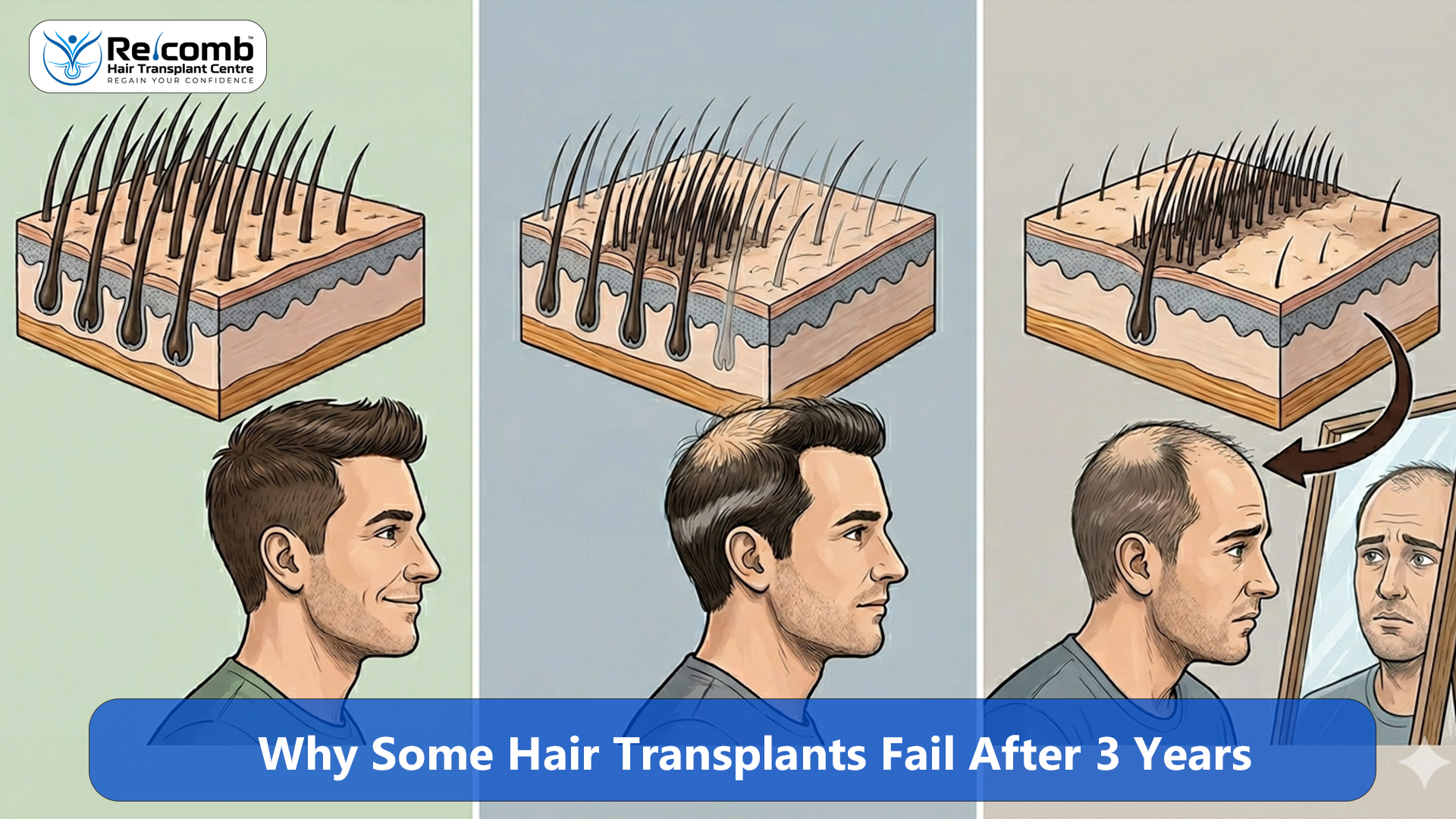
Many patients expect hair transplant results to last forever—and in most cases, transplanted hair is indeed permanent.
However, some patients notice that their results look thinner or less dense after 2–3 years.
This leads to a common concern:
“Did my hair transplant fail?”
The truth is, most “failures” are not due to the transplanted hair itself—but due to poor planning, ongoing hair loss, or unrealistic expectations.
At RECOMB Hair Transplant Centre, long-term outcomes are prioritized to prevent such issues.
Let’s break down the real reasons.
1. Ongoing Native Hair Loss
This is the most common cause.
Hair transplant does not stop:
- Genetic hair loss (DHT effect)
- Progressive thinning of existing hair
Over time:
- Transplanted hair remains
- Surrounding natural hair continues to thin
This creates the illusion of:
“Transplant failure”
2. Poor Initial Planning
If the first surgery is not planned properly:
- Hairline may be placed too low
- Grafts may be concentrated only in one area
- Future hair loss may not be considered
As hair loss progresses, imbalance becomes visible.
3. Low Graft Survival
In some cases, initial graft survival may not be optimal due to:
- Poor surgical technique
- Excessive trauma
- Improper graft handling
- Inadequate post-op care
This leads to thinner results over time.
4. Donor Overharvesting
Overharvesting can affect overall aesthetics.
Problems include:
- Weak donor area
- Reduced future graft availability
- Poor density planning
This may limit corrective options later.
5. Lack of Medical Maintenance
Hair transplant alone is not always sufficient.
Without maintenance:
- Native hair continues to thin
- Density reduces over time
Maintenance strategies help preserve existing hair.
6. Unrealistic Density Expectations
Some patients expect:
- Full natural density
- Complete scalp coverage
Even a successful transplant may appear “less dense” after a few years if expectations were unrealistic.
7. Crown Area Challenges
Crown transplants are more complex:
- Require more grafts
- Have different growth patterns
- Show thinning more easily under light
This can create the impression of declining results.
8. Aging and Hair Changes
With age:
- Hair thickness may reduce
- Hair color may change
- Overall density perception may decrease
These natural changes can affect how results look over time.
How to Prevent Long-Term Failure
Proper Planning
- Design hairline conservatively
- Consider future hair loss
- Distribute grafts strategically
Donor Preservation
- Avoid overharvesting
- Plan for future sessions if needed
Maintenance Treatment
- Stabilize ongoing hair loss
- Support existing hair follicles
Realistic Expectations
- Understand density limitations
- Accept gradual improvement rather than perfection
What If Your Results Are Declining?
Options may include:
- Medical stabilization
- Density enhancement sessions
- Corrective transplant (if donor allows)
Early evaluation helps improve outcomes.
RECOMB’s Long-Term Success Strategy (2026)
At RECOMB:
- Hair transplant is planned for decades—not months
- Donor usage is carefully controlled
- Hair loss progression is predicted
- Patients are guided for long-term maintenance
The focus is on results that remain natural over time.
Final Takeaway
Hair transplant rarely “fails” suddenly.
Most cases of perceived failure are due to:
- Ongoing hair loss
- Poor initial planning
- Lack of long-term strategy
With proper planning and maintenance, results can remain natural and stable for many years.
Contact RECOMB Hair Transplant Centre
Phone: +91 7624008000
Website: www.recombhair.com