
A significant proportion of patients who present at hair clinics with hair loss also have dandruff. They have been managing the flaking with anti-dandruff shampoos for years, often without consistent success, while their hair has thinned progressively. When they mention both in the consultation, the question they are really asking is whether the two are related or whether they happen to be dealing with two separate problems at the same time.
The clinical answer is that dandruff and hair loss can be connected, and in a meaningful number of patients they are, but the connection is not straightforward and understanding it requires distinguishing between different types of scalp flaking and their different relationships to hair follicle health.
If you have both dandruff and hair loss and want a clinical assessment of how the two are interacting in your specific case, a consultation at RECOMB gives you that specific picture.
Book a Scalp and Hair Loss Assessment at RECOMB, Surat →
WhatsApp: +91 7624008000 | www.recombhair.com
What Dandruff Actually Is
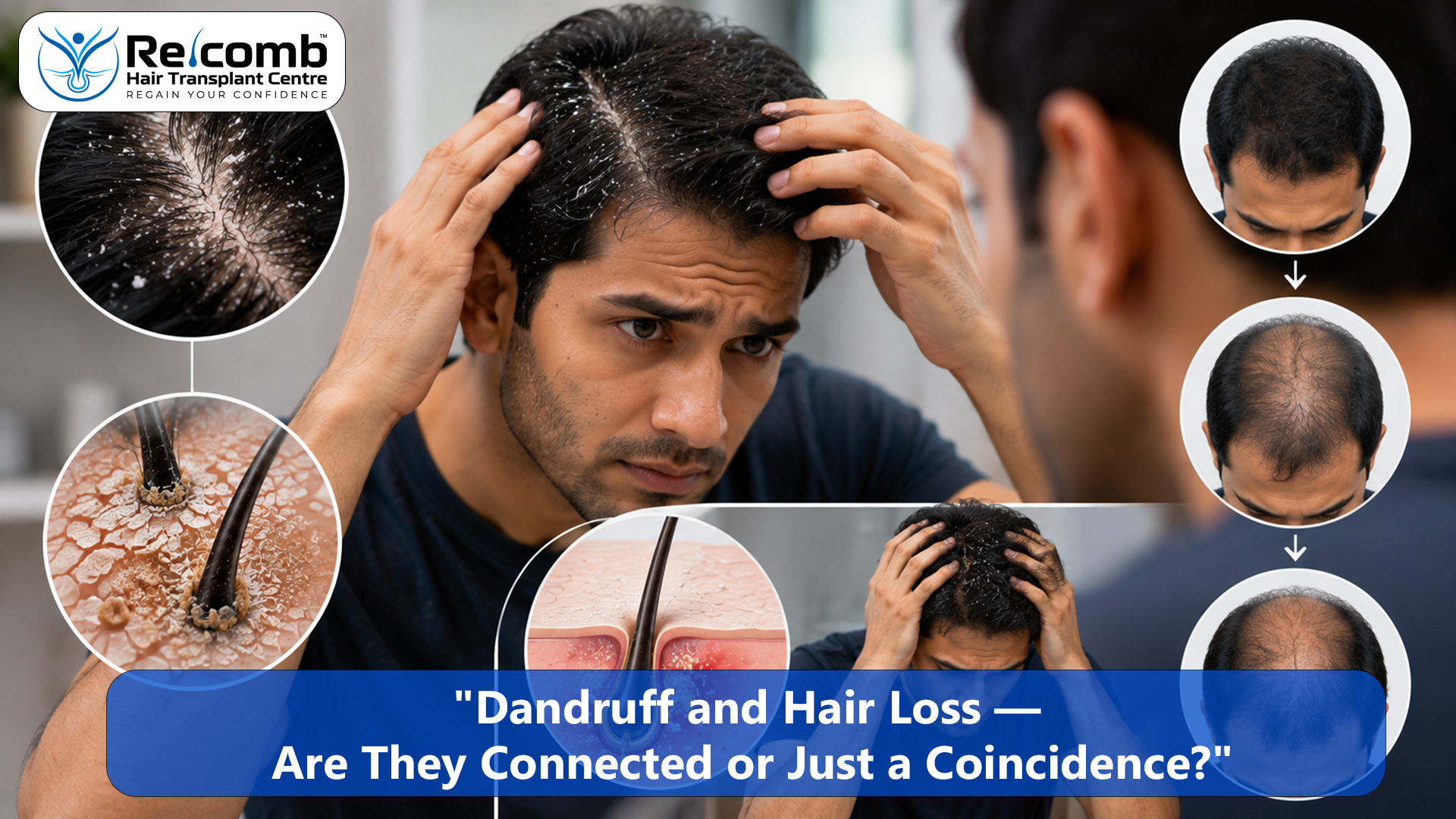
The word dandruff is used loosely to describe any scalp flaking, but clinically it refers specifically to seborrheic dermatitis of the scalp, a common inflammatory condition driven primarily by overgrowth of Malassezia, a fungus naturally present on all human scalps.
Malassezia feeds on the sebum produced by scalp sebaceous glands. In susceptible individuals, its metabolic byproducts, particularly oleic acid, penetrate the skin surface and trigger an inflammatory response. This inflammation accelerates the turnover of scalp skin cells, producing the visible flaking characteristic of dandruff. The flakes in seborrheic dermatitis are typically yellowish, greasy, and adherent to the scalp surface or hair shafts, distinguishing them from the dry, white flakes of a dry scalp condition.
Seborrheic dermatitis is chronic and relapsing. It responds to antifungal treatment, particularly ketoconazole and zinc pyrithione, but returns when treatment is stopped because the underlying Malassezia colonisation is not permanently eliminated. This chronic, relapsing pattern is relevant to its relationship with hair loss because the scalp inflammation it produces is not episodic but sustained.
How Seborrheic Dermatitis Contributes to Hair Loss
The connection between seborrheic dermatitis and hair loss operates through several mechanisms that are distinct from each other and require different management approaches.
Perifollicular Inflammation
Malassezia-driven inflammation concentrates around hair follicle openings. The oleic acid produced by Malassezia metabolism triggers a local immune response that produces prostaglandins and cytokines within the perifollicular tissue. This inflammatory environment affects the follicle's growth cycle, specifically by shortening the anagen phase through disruption of the dermal papilla signalling environment.
In patients without androgenetic alopecia, this shortening is modest and usually produces diffuse shedding rather than pattern loss. In patients with concurrent androgenetic alopecia, the perifollicular inflammation driven by seborrheic dermatitis acts as an accelerator on top of the DHT-driven miniaturisation already in progress. The follicles most vulnerable to androgenetic alopecia are also in the zones where seborrheic dermatitis tends to be most active, the frontal scalp and crown, because sebum production is highest in these areas. This geographic overlap means the two conditions compound each other directly at the sites of maximum clinical impact.
Follicular Plugging
Active seborrheic dermatitis produces adhesive scaling that accumulates around follicle openings. This scaling, combined with excess sebum, physically obstructs the follicle opening and creates an occluded environment with reduced oxygen availability. Over time, this contributes to suboptimal follicle function and a hostile microenvironment for normal hair cycling. The follicle is not destroyed by this process, but its performance is reduced, producing thinner, weaker shafts and a higher resting phase proportion.
Scalp pH Disruption
Healthy scalp skin is mildly acidic at approximately pH 4.5 to 5.5. Seborrheic dermatitis, particularly when poorly controlled, disrupts this acidic pH environment. An alkaline shift on the scalp surface reduces the natural barrier against pathogenic microorganisms, encourages further Malassezia proliferation, and interferes with the normal hair cuticle structure. The altered pH also reduces the effectiveness of topical treatments, including minoxidil, that depend on appropriate skin pH for optimal penetration and absorption.
Why the Connection Is Not Straightforward
The relationship between dandruff and hair loss has an important complication: not everyone with severe dandruff experiences significant hair loss, and not everyone with hair loss has dandruff. The connection is real but not causally deterministic.
Seborrheic dermatitis is a significant contributor to hair loss in patients who have both conditions simultaneously, particularly when genetic predisposition to androgenetic alopecia is present. But seborrheic dermatitis alone, in the absence of androgenetic alopecia or another primary hair loss driver, typically causes diffuse shedding that is reversible when the scalp condition is adequately controlled rather than pattern hair loss.
The practical implication is that treating dandruff alone does not reverse androgenetic alopecia, and treating androgenetic alopecia without addressing concurrent seborrheic dermatitis leaves an active inflammatory contributor unmanaged. Both must be addressed for the treatment of either to work at maximum effectiveness.
Dry Scalp Flaking Versus Dandruff: A Clinically Important Distinction
Not all scalp flaking is dandruff. Dry scalp flaking is a different condition that is frequently confused with seborrheic dermatitis but has a different relationship to hair loss and requires a different management approach.
Dry scalp flaking produces small, white, dry flakes that shed freely from the scalp rather than adhering to the hair shafts. The scalp feels tight and itchy rather than greasy. There is no excess sebum, no Malassezia overgrowth, and no greasiness to the flakes. The cause is insufficient sebum production or impaired scalp barrier function rather than the excess sebum environment that drives seborrheic dermatitis.
Dry scalp flaking is related to hair loss through scalp barrier disruption, chronic dehydration of the perifollicular tissue, and the suboptimal follicular environment that a compromised barrier produces, but it does not involve the direct Malassezia-driven follicular inflammation of seborrheic dermatitis. The relationship is less direct and typically less severe in its contribution to active hair loss.
Treating dry scalp flaking with an antifungal shampoo, which is the correct treatment for seborrheic dermatitis, can worsen the dry scalp condition by further stripping the already compromised barrier. This is why distinguishing between the two before treatment is clinically important and cannot be done reliably without scalp examination.
How to Know Which You Have
The characteristics that distinguish seborrheic dermatitis from dry scalp flaking in clinical examination include the appearance and adherence of the flakes, the presence or absence of scalp redness or irritation, the oiliness of the scalp surface, and the trichoscopic appearance of the perifollicular tissue.
At RECOMB, trichoscopy is the primary tool for this distinction. Under magnification, seborrheic dermatitis shows characteristic yellowish scaling adherent to follicle openings, perifollicular redness, and in more active cases, visible vessel changes in the perifollicular tissue. Dry scalp presents with a different flaking pattern and no perifollicular inflammation. The distinction is made in minutes during the scalp analysis and directly determines the treatment approach.
Managing Dandruff as Part of Hair Loss Treatment
For patients where seborrheic dermatitis is identified as a contributing factor to hair loss, its management is integrated into the broader treatment plan rather than treated as a separate cosmetic concern.
A ketoconazole shampoo at two percent concentration, used two to three times per week, is the first-line treatment for active seborrheic dermatitis and has the strongest evidence base for Malassezia reduction and symptom control. Zinc pyrithione shampoo used two to three times per week is an effective alternative and maintenance treatment with a lower likelihood of resistance development than ketoconazole used continuously.
For patients in Surat where hard water contributes to mineral accumulation on the scalp surface that worsens seborrheic dermatitis, the addition of a chelating shampoo used weekly alongside the antifungal treatment reduces the mineral substrate that compounds Malassezia activity.
Where scalp inflammation is significant and topical shampoos alone are producing insufficient control, mesotherapy formulations with anti-inflammatory and antifungal components delivered directly to the scalp tissue can address the follicular inflammation burden at a level topical products cannot reach.
For patients undergoing or planning hair transplant surgery, active seborrheic dermatitis must be controlled before the procedure. Operating on an inflamed scalp compromises graft survival, increases the risk of post-operative folliculitis, and reduces the predictability of healing in the recipient zone.
Get a Treatment Plan That Addresses Both Your Scalp and Your Hair Loss →
WhatsApp: +91 7624008000 | www.recombhair.com
RECOMB's Approach (2026)
At RECOMB Hair Transplant Centre, Surat, dandruff is not dismissed as a cosmetic concern when it presents alongside hair loss. Dr. Krishna Bhalala's background as a DNB Dermatologist means that scalp conditions including seborrheic dermatitis are assessed and managed as part of every hair loss evaluation rather than referred out or treated as secondary to the hair loss itself.
The scalp analysis performed at every new patient consultation specifically examines for seborrheic scaling, perifollicular inflammation, and follicular plugging that indicate active seborrheic dermatitis. Where it is found, treatment is integrated into the hair loss management plan from the outset, because a scalp condition that is compounding androgenetic alopecia cannot simply be set aside while the hair loss is treated in isolation.
For surgical patients, the management of any active scalp condition is part of the pre-surgical preparation protocol, and surgery is not booked until the scalp environment is adequately controlled. This commitment to managing the complete scalp picture rather than only the hair loss component is reflected in the consistency of graft survival and healing outcomes RECOMB achieves across its patient population.
Final Takeaway
Dandruff and hair loss are not always coincidental. In patients with concurrent seborrheic dermatitis and androgenetic alopecia, the two conditions compound each other through Malassezia-driven perifollicular inflammation that accelerates DHT-driven follicle miniaturisation. Managing only one while leaving the other unaddressed produces suboptimal results from both treatments.
The starting point is distinguishing between seborrheic dermatitis and dry scalp flaking, which requires scalp examination rather than self-diagnosis. From that distinction, a treatment approach that addresses both the scalp condition and the hair loss it is compounding can be built.
Dr. Krishna Bhalala and Dr. Nilesh Kachhadiya conduct a limited number of personal consultations each week at RECOMB, Surat. If you have both dandruff and hair loss and want to understand how they are interacting and what a complete management approach looks like for your case, this is where that assessment starts.
Address Your Scalp and Your Hair Loss Together at RECOMB →
WhatsApp: +91 7624008000
We respond within 24 hours, 6 days a week.
www.recombhair.com
Contact RECOMB Hair Transplant Centre
RECOMB Hair Transplant Centre
19, Ground Floor, Zenon Building, Opp. Unique Hospital, near Kiran Motors, Khatodara Wadi, Surat, Gujarat 395001
Phone: +91 7624008000
Website: www.recombhair.com