
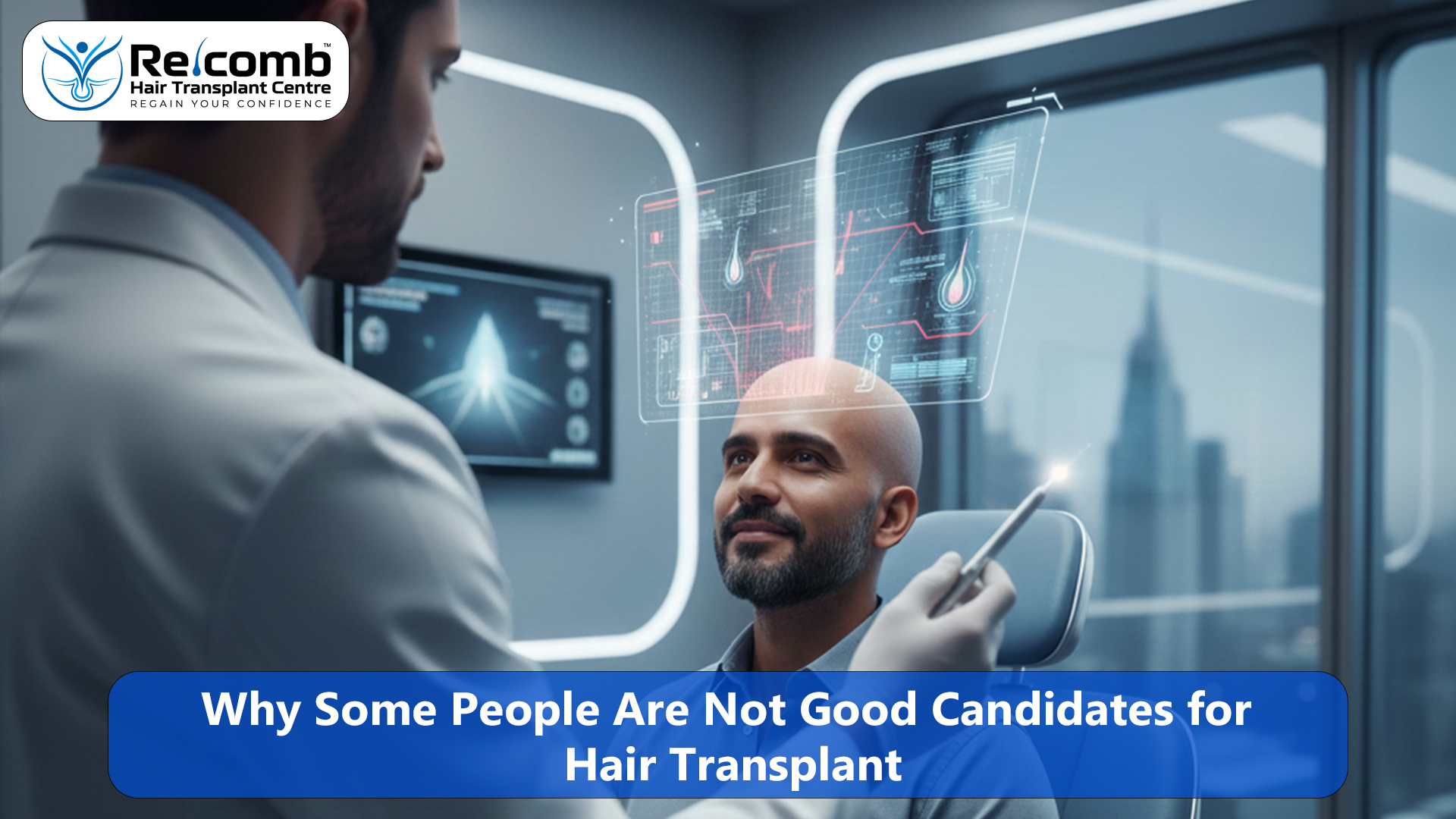
Hair transplant is often seen as a permanent solution to hair loss, but it is not suitable for everyone. Performing a transplant on the wrong candidate can lead to poor growth, unnatural results, donor damage, and long-term dissatisfaction.
At RECOMB Hair Transplant Centre, Surat, one of our core ethical principles is refusing surgery when it is not medically appropriate. This article explains the genuine medical and practical reasons why some individuals are not good candidates for hair transplantation.
1. Insufficient or Poor-Quality Donor Area
A hair transplant depends entirely on the donor area.
You may not be a good candidate if:
-
Donor density is very low
-
Hair shafts are extremely thin
-
Donor area shows miniaturization
-
Previous overharvesting has occurred
Without a healthy donor zone, graft survival and cosmetic density will be poor.
2. Advanced Diffuse Hair Loss (Diffuse Unpatterned Alopecia)
In diffuse hair loss, thinning occurs uniformly across the scalp, including the donor area.
This makes transplantation risky because:
-
Extracted grafts may also be weak
-
Transplanted hair may fall over time
-
Donor dominance principle fails
Such patients are better managed with medical therapy, not surgery.
3. Very Young Age with Unstable Hair Loss Pattern
Patients under 18–20 years with active hair loss are often not ideal candidates.
Problems include:
-
Unpredictable future hair loss
-
High risk of unnatural patterns later
-
Need for multiple corrective surgeries
At RECOMB, young patients are first stabilized medically before any surgical planning.
4. Unrealistic Expectations
Hair transplant restores hair, not perfection.
Poor candidates often expect:
-
Childhood-level density
-
One-session solution for advanced baldness
-
Zero maintenance after transplant
Unrealistic expectations lead to dissatisfaction even after technically good surgery.
5. Active Medical or Autoimmune Conditions
Certain conditions reduce transplant success:
-
Alopecia areata (active phase)
-
Uncontrolled thyroid disorders
-
Autoimmune diseases
-
Active scalp infections
-
Severe psoriasis or dermatitis
Transplanting during active disease increases graft failure risk.
6. Uncontrolled Diabetes or Poor Healing Capacity
Patients with:
-
Poorly controlled diabetes
-
Blood circulation issues
-
Smoking addiction
-
Severe obesity
may experience:
-
Poor wound healing
-
Infection risk
-
Reduced graft survival
Medical fitness is essential before considering surgery.
7. Low Hair Caliber and High Skin–Hair Contrast
Very fine hair with high contrast between hair and scalp can make results look thin even after transplantation.
While not an absolute contraindication, such patients require:
-
Conservative density planning
-
Realistic outcome discussion
-
Often staged procedures
Some may not achieve the visual density they expect.
8. Previous Failed or Overharvested Transplants
Patients with:
-
Multiple failed transplants
-
Scarred donor areas
-
Pluggy or unnatural results
have limited corrective options.
In some cases, no further surgery is advisable.
9. Psychological Factors (Hair Dysmorphia)
Some individuals are never satisfied despite good results.
Red flags include:
-
Obsessive focus on minor imperfections
-
Frequent clinic hopping
-
Emotional distress unrelated to objective hair loss
Ethical clinics avoid surgery in such cases and recommend counseling instead.
Ethical Approach: Why RECOMB Sometimes Says “No”
At RECOMB Hair Transplant Centre, refusing surgery can be the most ethical decision.
We say no when:
-
Donor safety is at risk
-
Results will not be natural
-
Long-term outcomes will be compromised
-
Patient expectations are unrealistic
This protects patients from irreversible damage and regret.
What Are Better Alternatives for Non-Candidates?
If you are not a transplant candidate, effective alternatives include:
-
Medical therapy for hair stabilization
-
PRP or GFC therapy
-
Low-level laser therapy
-
Scalp health correction
-
Hair systems (in selected cases)
A correct diagnosis ensures the right solution, not unnecessary surgery.
Final Medical Conclusion
Hair transplant is a powerful tool—but only when used selectively and ethically.
Not everyone with hair loss needs or qualifies for surgery.
Choosing the right candidate matters more than choosing the technique.
At RECOMB, patient safety, honesty, and long-term outcomes come before numbers or marketing.
Contact RECOMB Hair Transplant Centre
Phone: +91 7624008000
Website: www.recombhair.com