
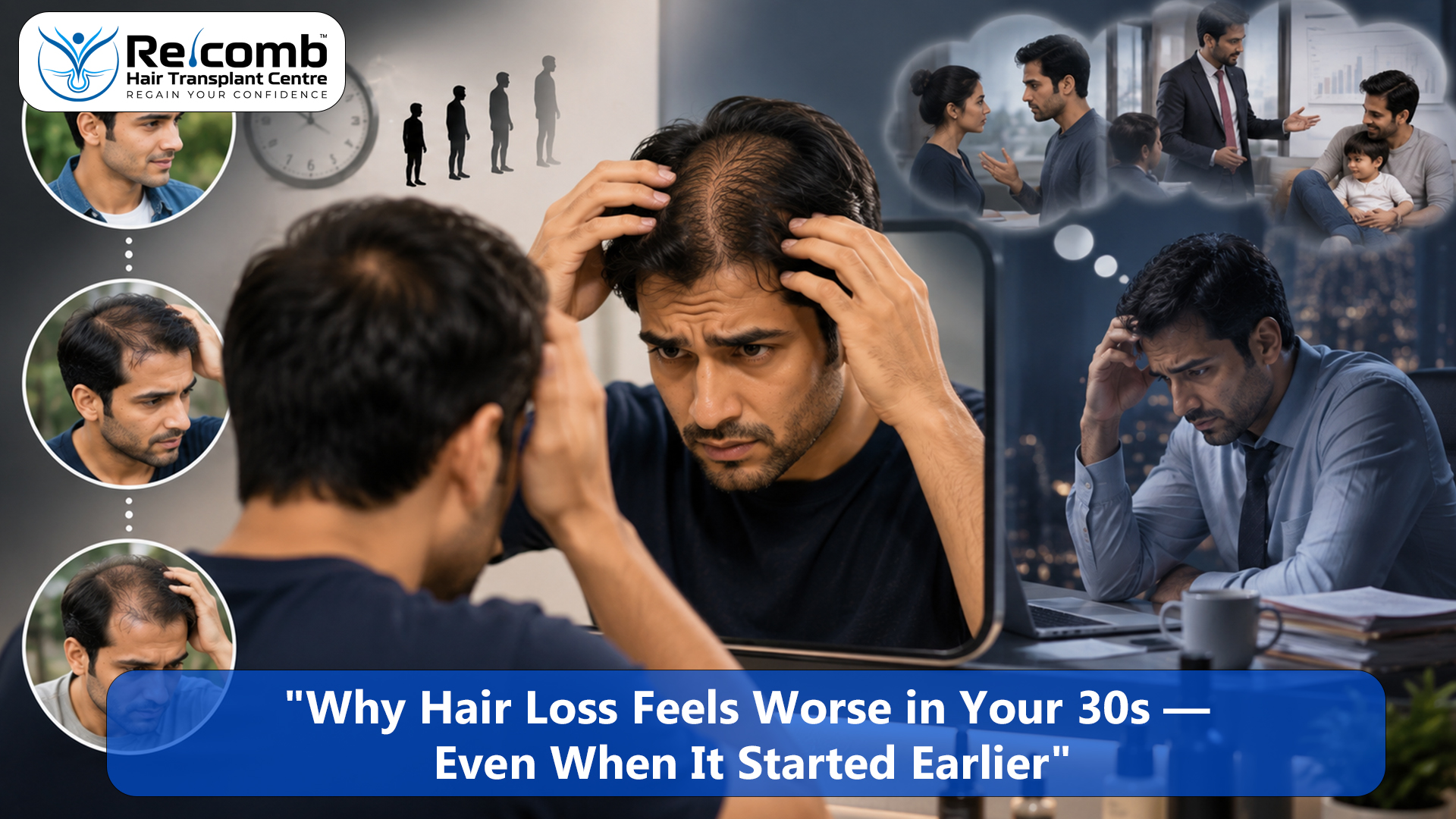
A patient sits down for a consultation and says something that comes up regularly: the hair loss started when he was 23, but it never really bothered him until now. He is 34. The loss has continued but not dramatically accelerated. Yet it feels, subjectively, significantly worse than it did a decade ago.
This experience is common enough to warrant a direct clinical explanation. Hair loss that began in the twenties often becomes psychologically and socially more weighted in the thirties, even when the objective rate of loss has not substantially changed. Understanding why this happens helps patients interpret what they are experiencing accurately, make better decisions about when and whether to act, and avoid either premature action driven by anxiety or unnecessary delay driven by rationalisation.
If you are in your thirties, have been watching your hair change since your twenties, and are now finding the situation more difficult to ignore, a consultation at RECOMB gives you a clear clinical picture of where you actually stand and what your options are.
Book a Hair Loss Assessment at RECOMB, Surat →
WhatsApp: +91 7624008000 | www.recombhair.com
The Biological Reality: Hair Loss Has Been Compounding
The first reason hair loss feels worse in the thirties is straightforward and clinical. It is worse.
Androgenetic alopecia is progressive. DHT acts on susceptible follicles continuously, shortening each successive anagen phase until the follicle stops producing visible hair. A patient who noticed early temple recession at 23 and assessed it as minor at 25 has typically experienced eight to twelve years of continuous DHT-driven miniaturisation by the time they are in their early thirties. What felt like early-stage thinning at 25 is now, in most cases, moderate to significant loss.
The rate of this progression varies between individuals but the direction does not. Loss that began early rarely stabilises completely without medical intervention. The patient sitting in the consultation at 34 is not imagining that things are worse than they were at 24. They are correct. The decade of progression has been real, even if the subjective perception of it fluctuated year to year.
Trichoscopy at this stage consistently reveals a higher proportion of miniaturised follicles in the affected zones than the patient's visual self-assessment would suggest, because the brain adapts to gradual change and loses its accurate baseline reference over time. Patients are frequently surprised by trichoscopy findings that show more advanced miniaturisation than they expected because they have been comparing their current state to a recent memory rather than to an accurate documented baseline.
The Life Context Has Changed
The second reason is not biological. It is contextual, and it is clinically relevant because it drives many of the decisions patients make about treatment timing.
At 23, most men are in university or early career stages where their social reference group is broad, their identity is still forming, and hair loss, while noticed, sits alongside many other concerns and transitions. The psychological weight it carries is distributed across a life that is changing rapidly in many directions simultaneously.
By 33 or 34, the context is different. Career identity is more established. Social comparison is more structured. Many patients in this age group are in relationships or married, have professional roles where appearance and confidence interact, attend weddings and social functions where photographs become records, and have parents and in-laws who comment on appearance with the directness common in Indian family culture.
The same degree of hair loss, or even a modestly greater degree, carries more psychological weight in this context because the stakes of appearance are differently framed. The patient is not just self-conscious about hair. They are self-conscious in specific, named social situations that matter to them in ways that generic social settings at 23 did not.
This shift in contextual weight is not vanity. It is a normal human response to the intersection of a progressive physical change with an increasingly defined social identity. Understanding it as such, rather than dismissing it as excessive concern, is important for having a useful clinical conversation about whether and when to act.
The Comparison Problem: Memory vs Mirror
By the time a patient reaches their mid-thirties having watched their hair loss since their early twenties, they have lost their accurate reference point. The memory of their hair at 20 is vivid but not reliable as a comparison baseline because memory of physical appearance is selective and often idealized.
The brain remembers the best version of what a person looked like at their peak rather than the accurate average. A patient who had naturally thick hair at 20 and began losing it at 22 or 23 carries a mental image of their hair that was captured at the moment before the loss began, which is also typically the best-looking period of that hair's natural life. Comparing the current, thinned scalp to this remembered ideal produces a perception of loss that exceeds what would be measured objectively between two accurate baseline photographs.
This is not a reason to dismiss the patient's concern. It is a reason to establish an objective baseline. Trichoscopy, standardised photographs, and Norwood staging give both the patient and the clinician a specific, measurable current picture rather than a comparison against a remembered ideal. Most patients find that the objective picture, while confirming that loss has progressed meaningfully, is less dramatic than the comparison to their mental reference image suggested.
The Accumulation of Small Declines
Hair loss progresses in ways that the individual often does not perceive in real time. Each month's change is too subtle to register consciously. The change over six months might be noticeable in side-by-side photographs but feels invisible day to day. The change over five years is significant but arrives gradually enough that the patient has adapted their self-image incrementally, never experiencing a clear before-and-after moment.
Then something breaks the incremental adaptation. A photograph at a wedding. A video call where the lighting or angle is unflattering. A comment from a relative. A mirror in a hotel bathroom that catches a perspective the patient does not usually see.
This moment does not represent an actual acceleration of loss. It represents the gap between the patient's gradually adapted self-image and an external representation that has not been subjected to the same gradual adaptation. The hair loss revealed by that photograph or comment is not new. It is the accumulated reality of years of incremental change seen all at once.
This experience, which patients often describe as suddenly noticing their hair loss or having it hit them for the first time, typically arrives in the mid-thirties for patients who began losing hair in their early twenties. It is clinically important to recognise it as an accurate perception of accumulated change rather than a sudden deterioration, because it changes both the urgency of the response and the realistic expectations of treatment.
The Window That Matters
For patients in their mid-thirties experiencing this moment of recognition, the clinical context is actually favourable in a specific sense. The pattern of hair loss is now established enough to plan around. Medical management started now, if it was not started earlier, can still meaningfully slow or stabilise further progression in follicles that are miniaturising but not yet completely inactive. Surgical planning at this stage has the benefit of a clearer loss pattern projection than planning in the early twenties would have had.
The loss that has already occurred cannot be recovered without surgery. But the loss that has not yet occurred can be substantially influenced by medical management and, where surgery is appropriate, by a carefully timed and planned procedure that addresses the current deficit while accounting for future progression.
The patients who look back at their thirties with the most satisfaction regarding their hair loss decisions are not those who acted most quickly. They are those who acted with the most accurate understanding of their clinical situation, at the right stage, with the right combination of medical management and surgical planning when indicated.
RECOMB's Approach (2026)
At RECOMB Hair Transplant Centre, Surat, patients presenting in their thirties with hair loss that has been progressing since their twenties receive a clinical assessment that separates what is measurable from what is psychological, and addresses both with equal seriousness.
Dr. Krishna Bhalala and Dr. Nilesh Kachhadiya establish an objective current baseline through trichoscopy, staging, and blood investigations. They give patients an accurate picture of how much actual loss has occurred, how much progression is likely, and what the realistic clinical options are at this stage. They do not minimise the psychological weight of the experience or dismiss it as vanity. They also do not allow that psychological weight to drive premature or poorly planned clinical decisions.
The goal is a patient who understands their situation accurately, knows what is reversible and what is not, has a specific medical management plan for the progressive component of their loss, and where surgery is appropriate, has a procedure planned with their 45-year-old face and donor area in mind rather than their current moment of frustration.
Get an Accurate Clinical Picture of Where You Actually Stand →
WhatsApp: +91 7624008000 | www.recombhair.com
Final Takeaway
Hair loss that feels worse in the thirties is usually genuinely worse in objective terms, compounded by a contextual shift in how appearance intersects with identity and social life, and intensified by the gap between a remembered ideal and an accumulated reality that arrives all at once.
The appropriate response is neither panic-driven action nor continued deferral. It is an accurate clinical assessment that establishes what has actually happened, what is likely to happen next, and what specific interventions at this stage will produce the best long-term outcome.
Dr. Krishna Bhalala and Dr. Nilesh Kachhadiya conduct a limited number of personal consultations each week at RECOMB, Surat. If your thirties have brought a clearer reckoning with hair loss that began earlier, this is where that reckoning produces a useful clinical plan rather than continued uncertainty.
Turn This Moment Into a Decision That Serves You for Decades →
WhatsApp: +91 7624008000
We respond within 24 hours, 6 days a week.
www.recombhair.com
Contact RECOMB Hair Transplant Centre
RECOMB Hair Transplant Centre
19, Ground Floor, Zenon Building, Opp. Unique Hospital, near Kiran Motors, Khatodara Wadi, Surat, Gujarat 395001
Phone: +91 7624008000
Website: www.recombhair.com