

Hair sprays, gels, styling serums, and many leave-in products contain alcohol. Most patients never check the label, and most never connect a dry, itchy scalp or increased shedding to the product they use every morning.
The honest clinical picture is more specific than the headline suggests. Alcohol does not directly destroy healthy follicles. But certain alcohols, used daily over months, can dry the scalp, weaken its barrier, and add inflammation to a follicle that is already under stress. In patients with hair loss, that matters.
If you have a dry, irritated scalp with ongoing hair fall, a scalp analysis at RECOMB will show whether your products are part of the problem.
Book a Scalp Assessment at RECOMB, Surat →
WhatsApp: +91 7624008000 | www.recombhair.com
Not All Alcohols Are the Same
This distinction is the most important point in the article.
Short-chain alcohols are drying. These include ethanol, alcohol denat, SD alcohol, and isopropyl alcohol. They evaporate fast, which is why they are used in sprays and quick-dry gels, but they pull moisture from the hair shaft and scalp surface as they go.
Fatty alcohols are gentle. Cetyl alcohol, stearyl alcohol, and cetearyl alcohol are emollients that soften hair and support the skin barrier. They are safe, and their name on a label is not a reason for concern.
Reading the ingredient list for the first group, not the second, is what matters.
What Drying Alcohols Do to the Scalp
The scalp has a thin protective barrier made of lipids and a slightly acidic surface. Drying alcohols strip part of this layer with repeated contact.
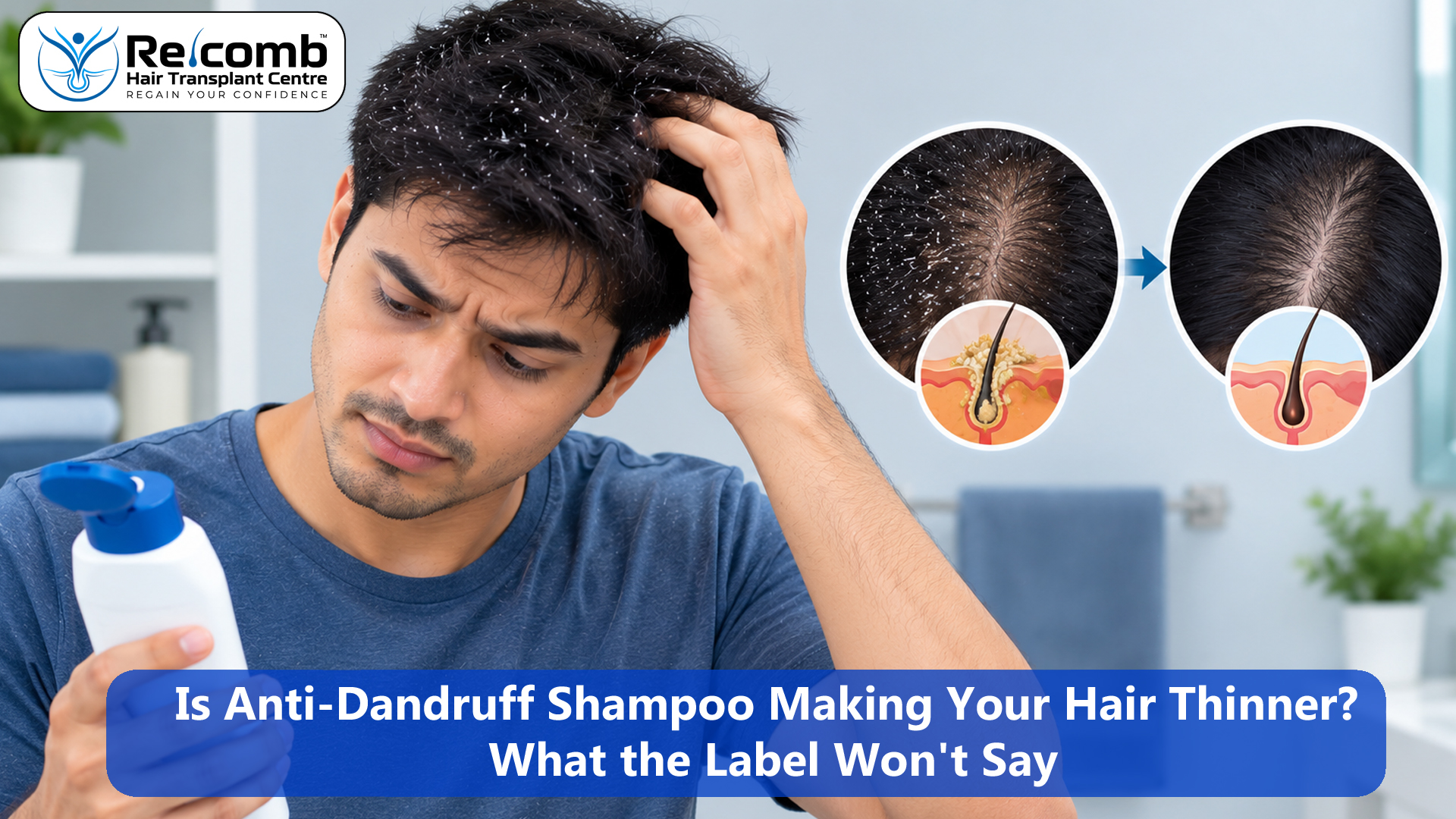
A weakened barrier loses water more easily, leaving the scalp tight, flaky, and sensitive. Irritation can follow, and an inflamed scalp sheds more. The scalp may also overproduce oil in response, which can worsen dandruff-type conditions in those prone to them.
None of this is dramatic after a single use. It builds slowly with daily application, which is why the damage is described as silent.
What They Do to the Hair Shaft
Drying alcohols also reduce moisture in the hair shaft. Dry, brittle hair breaks more easily during combing and styling.
This matters because breakage in the brush often looks like hair loss. It is shaft damage, not follicle loss, but it thins the appearance of the hair and can hide a genuine problem underneath. Hair that is already chemically treated or exposed to Surat’s hard water is more vulnerable.
Where the Real Risk Lies
For a healthy scalp, occasional use of an alcohol-containing styling product is unlikely to cause lasting harm. The concern is cumulative exposure in three groups.
Patients with androgenetic alopecia, where added inflammation can speed visible thinning.
Patients with seborrheic dermatitis or a sensitive scalp, where barrier damage worsens symptoms.
Patients using products directly on the scalp daily, such as scalp serums, dry shampoos, and sprays applied at the roots.
Alcohol-based products also interact with treatments. Minoxidil solutions contain alcohol or propylene glycol as a carrier, and some patients find these irritating. If a minoxidil solution causes scalp dryness, a foam form or a different vehicle may suit better, which is a decision worth making with a doctor.
Get Scalp Product Guidance Specific to Your Hair Loss at RECOMB →
WhatsApp: +91 7624008000 | www.recombhair.com
How to Reduce the Risk Without Giving Up Styling
You do not need to stop styling. A few changes are enough.
Check the first five ingredients for ethanol, alcohol denat, SD alcohol, or isopropyl alcohol. If one appears near the top, the product is alcohol-heavy.
Apply styling products to the hair length rather than directly on the scalp.
Choose alcohol-free or low-alcohol versions of gels and serums, and use water-based or fatty-alcohol formulas where possible.
Wash styling product out the same day rather than sleeping in it.
Support the scalp with a gentle, sulphate-free shampoo and, in Surat, a shower filter to reduce mineral residue that adds to dryness.
RECOMB’s Approach (2026)
At RECOMB Hair Transplant Centre, Surat, scalp products are reviewed as part of every hair loss assessment. Trichoscopy shows barrier damage, plugging, and inflammation, and product advice follows what is found rather than a generic list.
Dr. Krishna Bhalala’s dermatology background means scalp irritation is treated as part of the hair plan. For surgical patients, products that irritate the scalp are addressed before the procedure and during recovery.
Final Takeaway
Alcohol-based hair products do not destroy healthy follicles, but drying alcohols used daily can weaken the scalp barrier, add inflammation, and make an existing hair loss problem look worse. Fatty alcohols are not the concern.
The answer is a quick label check, not fear. Know which alcohol is on the list, and choose gentler products if your scalp is already dry, irritated, or thinning.
Dr. Krishna Bhalala and Dr. Nilesh Kachhadiya conduct a limited number of personal consultations each week at RECOMB, Surat. If your scalp is dry or irritated alongside hair fall, this is where the cause is identified.
Find Out If Your Products Are Affecting Your Scalp at RECOMB →
WhatsApp: +91 7624008000
We respond within 24 hours, 6 days a week.
www.recombhair.com
Contact RECOMB Hair Transplant Centre
RECOMB Hair Transplant Centre
19, Ground Floor, Zenon Building, Opp. Unique Hospital, near Kiran Motors, Khatodara Wadi, Surat, Gujarat 395001
Phone: +91 7624008000
Website: www.recombhair.com