
The donor area at the back and sides of the scalp is the primary source of grafts for every hair transplant procedure. For most patients, this zone provides sufficient follicular units to address their hair loss and support a satisfying long-term result. For a specific group of patients, it does not.
Patients with extensive Norwood Grade 6 or 7 hair loss, patients who had a previous procedure that aggressively depleted the scalp donor zone, and patients with naturally low scalp donor density relative to their coverage requirement face a clinical reality that scalp donor grafts alone cannot provide the density needed across the full area of hair loss. For these patients, body hair transplant offers a potential supplementary source of grafts that extends the available supply.
Body hair transplant is not a standard recommendation for most patients and it is not without its specific clinical considerations. This blog explains when it is appropriate, which donor sites are clinically suitable, what the specific characteristics of body hair grafts mean for results, and what realistic expectations look like.
If you are a patient with extensive hair loss or a depleted scalp donor area and want to understand whether body hair transplant is a viable option for your case, a consultation at RECOMB gives you a specific clinical assessment.
Book a Donor Assessment Consultation at RECOMB, Surat →
WhatsApp: +91 7624008000 | www.recombhair.com
Why Scalp Donor Supply Becomes Insufficient
Understanding why some patients exhaust or approach the limit of their scalp donor supply helps contextualise when body hair transplant becomes relevant.
The total scalp donor capacity for most patients falls between 4,000 and 6,000 grafts across a lifetime, as discussed in the unlimited grafts blog. Patients with Norwood Grade 5 or above require progressively more grafts to achieve satisfying coverage across their larger recipient area. At Grade 6 or 7, the total coverage requirement across the frontal zone, midscalp, and crown can approach or exceed 5,000 grafts for even moderate density across the full area.
When a single patient needs close to their entire lifetime scalp donor supply for comprehensive coverage, or when that supply has already been partially depleted by a previous procedure, the scalp alone cannot provide the total grafts needed. Body hair transplant supplementation allows the overall plan to achieve coverage that scalp grafts alone cannot deliver.
In revision cases where a prior procedure at another clinic over-harvested the scalp donor zone, body hair transplant is sometimes the only viable option for improving coverage without further stressing an already compromised scalp donor area.
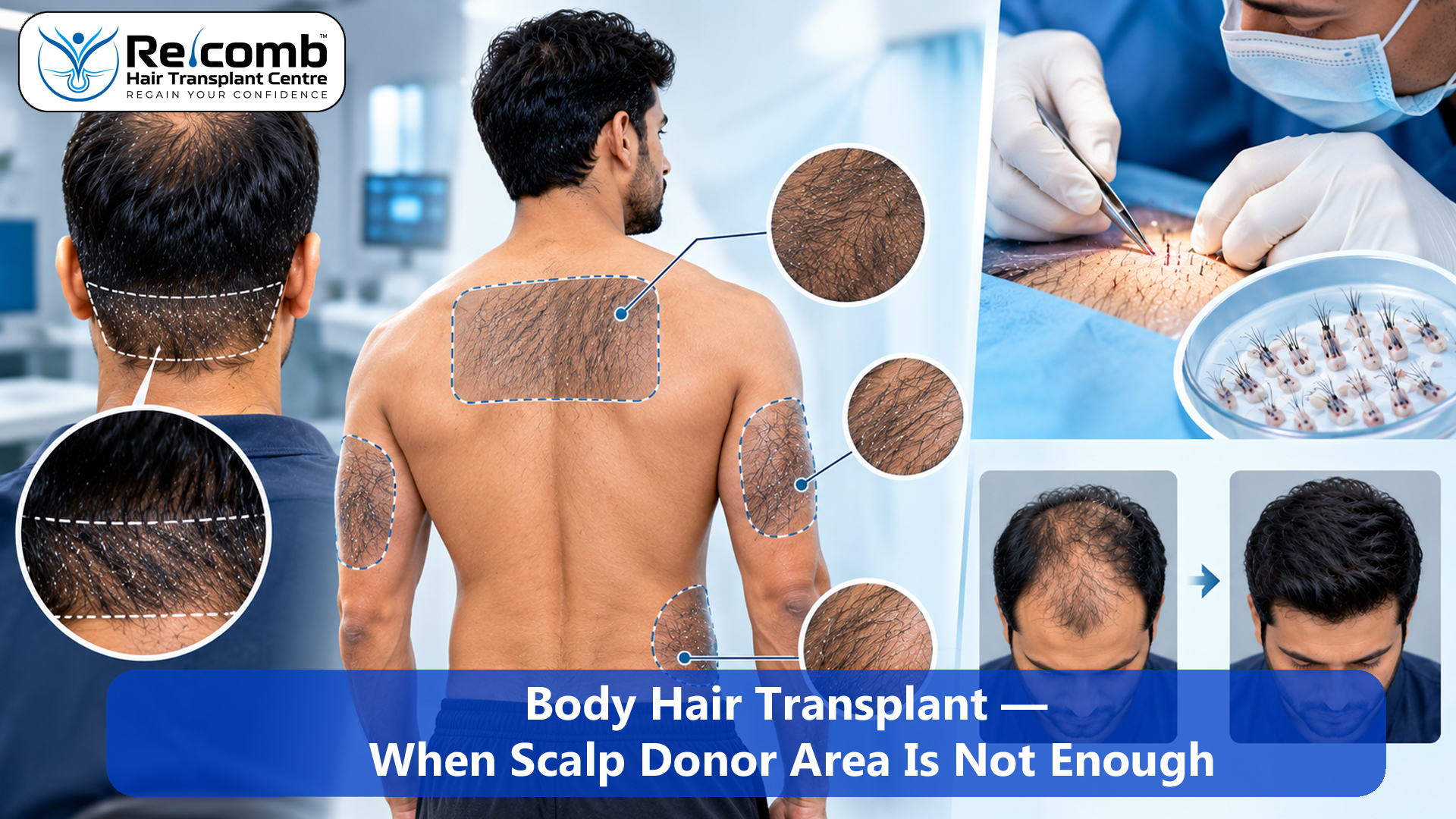
Which Body Hair Sites Are Clinically Suitable
Not all body hair is equivalent as a donor source. The clinical suitability of a body hair site depends on hair diameter, natural length of the anagen phase, and the degree of visual and textural match with scalp hair in the recipient zone.
Beard Hair
Beard hair is the most commonly used and most clinically appropriate body hair source for scalp hair transplant supplementation. Beard follicles produce hair shafts that are typically coarser and thicker than scalp hair, with a relatively long anagen phase that produces hair of meaningful length. Beard hair is DHT-resistant in the same way scalp donor area hair is resistant, which is essential for long-term viability of the transplanted grafts.
The beard donor area can provide 500 to 2,000 additional grafts in most men depending on beard density and distribution. For patients of South Asian heritage including the Gujarat population, beard density is generally sufficient to contribute meaningfully to supplementary graft supply.
The primary consideration with beard hair is textural match. Beard hair is typically coarser and curlier than scalp hair. When used in the frontal hairline where fine single-hair grafts are required for a natural transition, beard hair can create a visible textural inconsistency. Beard hair is better suited to the midscalp and crown where its coarser texture contributes to visual density without the fine transition requirements of the hairline zone.
Chest Hair
Chest hair has a shorter anagen phase than scalp or beard hair, which means it grows to a shorter maximum length before entering the resting phase. Transplanted chest hair grafts therefore produce hair that grows to a limited length, typically 2 to 4 centimetres, and then stops rather than continuing to grow as scalp hair would.
This characteristic makes chest hair useful for adding density in the crown zone where shorter, denser coverage across a large circular area is the priority rather than the longer, directional coverage needed in the frontal zone. It is less useful in the frontal zone where hair length is needed for styling.
Chest hair diameter varies considerably between individuals. Finer chest hair in patients with less body hair density matches scalp hair texture better than coarser chest hair, making patient selection important.
Leg and Arm Hair
Leg and arm hair has the shortest anagen phase of any common body hair site, producing hair that grows to only 1 to 2 centimetres in most individuals. Its utility in scalp hair transplant is therefore limited to very specific applications where short coverage across a limited area is the goal.
These sites are less commonly used than beard or chest and represent a minor supplementary contribution even in the most resource-constrained cases.
The Clinical Realities of Body Hair Transplant
Body hair transplant introduces specific clinical considerations that differ from scalp-to-scalp procedures and that patients must understand before committing to this approach.
Growth Cycle Difference
Body hair follicles retain their natural growth cycle characteristics after transplantation, just as scalp donor follicles retain their DHT resistance. A beard hair transplanted to the scalp will grow to beard length, then stop, shed, and regrow in cycles that reflect beard rather than scalp growth patterns. This means the growth behaviour of body hair grafts is different from scalp grafts placed in the same zone, and the mix of growth cycles in a combined scalp and body hair result must be accounted for in the plan.
Texture and Diameter Mismatch
Body hair is almost universally coarser, curlier, and of different diameter from scalp hair. When placed adjacent to scalp hair grafts in the recipient zone, this difference is visible under normal conditions and particularly in photographs. Skilled zone planning that places body hair grafts in areas where their characteristics are less conspicuous and scalp grafts in areas requiring fine, natural texture reduces but does not eliminate this mismatch.
Lower Survival Rate
Body hair grafts, particularly from chest and beard sites, have lower survival rates than scalp grafts in some published series. This reflects the adaptation challenge of follicles from a different body environment establishing in the scalp environment, including differences in skin thickness, blood supply characteristics, and the follicle’s acclimatisation to a different hormonal and microenvironmental context. Experienced surgeons with body hair transplant case volume have better survival rates than those performing it infrequently, making surgeon experience particularly relevant for this specific procedure.
Extraction Technique Modification
Body hair extraction requires technique modification from scalp FUE. Body skin, particularly at the chest, has lower laxity than scalp skin and different follicle angles, requiring adjusted punch depth, angle, and extraction approach. Beard hair extraction in the neck and submandibular zones requires specific technique awareness to avoid damaging the deeper structures in these areas.
When Body Hair Transplant Is and Is Not Appropriate
Body hair transplant is appropriate when scalp donor supply is genuinely insufficient for the coverage goal, when the patient understands and accepts the textural differences that body hair grafts introduce into the result, when the body hair sites being considered have adequate density and appropriate hair characteristics for the zones being planned, and when the procedure is performed by a surgeon with specific body hair transplant experience and case volume.
It is not appropriate as a first-line approach in patients with adequate scalp donor supply, where the textural inconsistency of body hair grafts would compromise a result that scalp grafts alone could achieve cleanly. It is not appropriate in patients with alopecia universalis affecting body hair as well as scalp hair, since body follicles are also affected by the autoimmune process. It is not appropriate where the body hair characteristics are so mismatched with scalp hair that the density contributed does not justify the textural compromise in the planned zones.
The honest clinical assessment for every patient considering body hair transplant must answer whether the density it adds justifies the textural tradeoff it introduces in the specific zones being treated.
RECOMB’s Approach (2026)
At RECOMB Hair Transplant Centre, Surat, body hair transplant is offered as a supplementary technique for patients with genuinely insufficient scalp donor supply rather than as a standard offering.
Dr. Nilesh Kachhadiya’s MCh Plastic and Reconstructive Surgeon background and his extensive experience with Grade 6 and 7 cases, the patient group most likely to require supplementary body hair grafts, provides the technical framework for planning and executing body hair transplant with an understanding of where it contributes most and where its limitations are most clinically significant.
Every patient for whom body hair transplant is considered receives a complete assessment of scalp donor capacity first. Body hair supplementation is planned only when that assessment confirms that scalp supply alone is insufficient for the agreed coverage goal and that the body hair sites available have appropriate characteristics for the planned zones.
Final Takeaway
Body hair transplant is a clinically valid technique that extends the available graft supply for patients whose scalp donor zone cannot meet their coverage requirements alone. Its appropriate use is specific: Grade 6 and 7 patients with large coverage requirements, revision cases with depleted scalp donor zones, and patients with low scalp donor density relative to their restoration goals.
It is not a substitute for careful scalp donor management in the first place. The patients who most need body hair transplant supplementation are frequently those whose scalp donor zone was inadequately managed or over-harvested in a prior procedure. Preventing the depletion that makes body hair transplant necessary is always the better clinical outcome than requiring it as a remedial measure.
Dr. Krishna Bhalala and Dr. Nilesh Kachhadiya conduct a limited number of personal consultations each week at RECOMB, Surat. If you have extensive hair loss or a prior procedure that depleted your scalp donor area and want to understand whether body hair transplant supplementation is viable and appropriate for your case, this is where that assessment starts.
Find Out Whether Body Hair Transplant Is Right for Your Case at RECOMB →
WhatsApp: +91 7624008000
We respond within 24 hours, 6 days a week.
www.recombhair.com
Contact RECOMB Hair Transplant Centre
RECOMB Hair Transplant Centre
19, Ground Floor, Zenon Building, Opp. Unique Hospital, near Kiran Motors, Khatodara Wadi, Surat, Gujarat 395001
Phone: +91 7624008000
Website: www.recombhair.com