
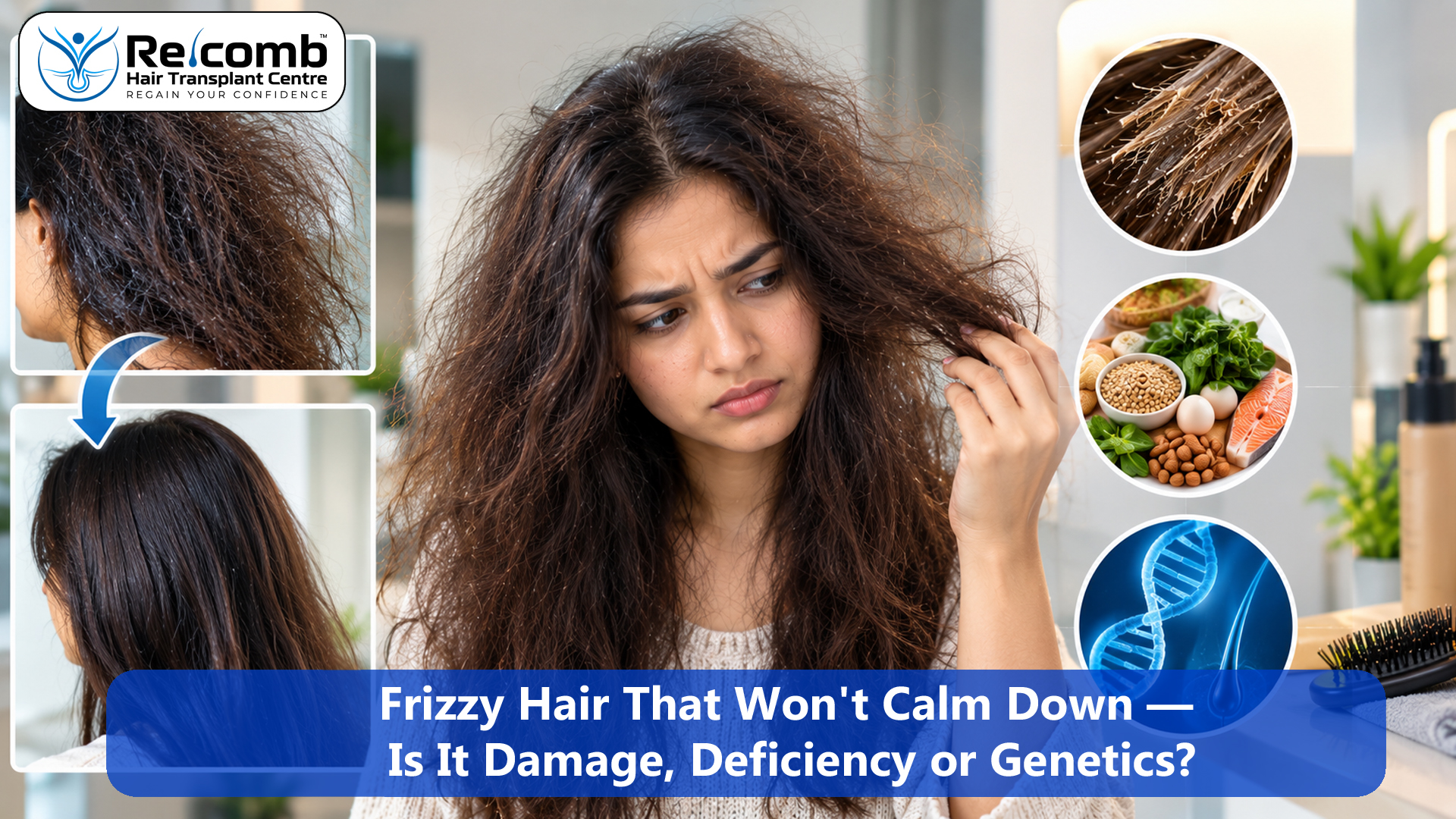
Frizzy hair is one of the most commonly complained-about hair concerns in India, and one of the most inconsistently managed. Patients try product after product, serums, oils, keratin treatments, leave-in conditioners, and find that the improvement is temporary at best. The frizz returns, sometimes within hours of styling, sometimes within days of a treatment.
The reason most interventions fail to provide lasting improvement is that they address the appearance of frizzy hair without identifying what is causing it. Frizzy hair is not a single condition. It is a presenting symptom that can arise from three completely different underlying causes, structural damage to the hair shaft, nutritional deficiency affecting hair quality, and genetic hair characteristics that determine the natural curl and porosity of the hair. Each requires a different approach. A treatment appropriate for one cause may be irrelevant or counterproductive for another.
This blog explains how to distinguish between the three causes clinically, what each one means for the hair shaft and follicle, and what interventions have a genuine biological basis for each.
If you have persistent frizzy hair alongside hair fall or scalp concerns that have not improved with standard products, a scalp and hair assessment at RECOMB gives you a specific clinical picture.
Book a Hair and Scalp Assessment at RECOMB, Surat →
WhatsApp: +91 7624008000 | www.recombhair.com
Understanding the Hair Shaft: Why Frizz Happens at All
Before distinguishing the three causes, understanding the basic structure of the hair shaft explains why frizz occurs in any of them.
The hair shaft has three concentric layers. The innermost is the medulla, present in coarser hairs. The middle layer, the cortex, contains the structural proteins that give the hair its strength, elasticity, and colour. The outermost layer, the cuticle, consists of overlapping scale-like cells that lie flat against the cortex when the hair is healthy, creating a smooth surface that reflects light and, critically, regulates moisture exchange between the hair shaft and the environment.
Frizz occurs when the cuticle scales are lifted rather than lying flat. Lifted cuticles allow moisture from the environment to penetrate the cortex, causing the hair shaft to swell unevenly. In humid conditions like those common in Surat during the monsoon, this moisture absorption is constant, which is why frizz is typically worse during and after the monsoon season. The swelling of the cortex that lifted cuticles allow is what produces the rough, expanded, undefined texture of frizzy hair.
What lifts the cuticle scales determines which of the three causes is at work.
Cause 1: Structural Damage
Structural damage to the hair shaft is the most common and most correctable cause of frizz in patients who previously had manageable hair and have noticed a change over recent months or years.
The most clinically significant sources of shaft damage in the Indian context are chemical processing including permanent hair dye, bleaching, relaxers, and keratin straightening treatments, heat styling with flat irons and blow dryers at high temperatures, and mechanical trauma from aggressive brushing of wet hair, tight hairstyles producing traction, and rough towel drying.
Each of these causes a specific type of structural disruption to the cuticle and cortex. Permanent hair dye uses alkaline chemistry and hydrogen peroxide to open the cuticle and alter the cortex. Repeated applications progressively lift and erode the cuticle scales, creating a permanently raised cuticle surface that allows constant moisture exchange with the environment. Heat styling at high temperatures denatures the structural proteins in the cortex and melts the lipid layer that cements cuticle scales together. Mechanical trauma chips and chips cuticle edges, producing an irregular surface that does not lie flat.
The clinical identification of damage-driven frizz is based on history and hair shaft examination. Patients who used to have smooth hair and now find it persistently frizzy, and whose hair care history includes regular chemical processing or daily heat styling, have damage-driven frizz with high probability. Under trichoscopy, damaged hair shafts show irregular cuticle margins, loss of the uniform reflective surface, and in severely damaged hair, visible cortex exposure where cuticle has been eroded entirely.
Damage-driven frizz improves with two parallel approaches. Stopping or significantly reducing the source of damage gives new growth the opportunity to emerge with an intact cuticle. Supportive treatments that restore the lipid layer and temporarily smooth the cuticle, including silicone-free bonding treatments, protein-based conditioning masks, and pH-balanced finishing products, improve the appearance of existing damaged hair while new growth develops.
The important clinical limitation is that the existing damaged hair cannot have its cuticle structure permanently restored. Products that claim to repair damage are filling in gaps and coating the surface, not restoring the original protein and lipid architecture. The only truly undamaged hair on a damaged shaft is the new hair growing from the follicle that has not yet been exposed to the damaging practices.
Cause 2: Nutritional Deficiency
Nutritional deficiency produces a subtler but clinically distinct form of frizzy hair that patients frequently miss because it develops gradually and is often attributed to environmental factors or product failures.
Hair shaft quality depends on the continuous availability of specific nutrients during the anagen phase of the hair cycle. The follicle is constructing a protein structure, primarily keratin, at the rate of approximately 1 centimetre per month. The quality of that structure depends directly on the availability of the amino acid building blocks, cofactor minerals, and vitamins that the synthesis process requires.
When these are deficient, the hair shaft produced has reduced structural integrity. The disulphide bonds that give the cortex its strength and elasticity are fewer, producing a shaft that is weaker, less resilient, and with a cuticle that does not form or adhere as tightly as a nutritionally supported shaft. This weaker cuticle is more susceptible to lifting in humid conditions, producing frizz that is diffuse across the entire hair length including new growth rather than concentrated in previously processed lengths.
The key nutritional deficiencies associated with reduced hair shaft quality and frizz in the Indian population are protein deficiency, which is common in predominantly vegetarian diets that do not actively manage protein intake, biotin deficiency from dietary inadequacy, iron deficiency and low ferritin which affects the follicle’s metabolic capacity during shaft construction, and zinc deficiency which is a cofactor in the enzymatic processes that regulate keratin synthesis.
The clinical identification of deficiency-driven frizz is through blood investigations and dietary history. A patient with generalised frizz across new and old hair growth, a dietary history suggesting nutritional gaps, and blood investigations confirming low ferritin, zinc, or vitamin deficiency has deficiency-driven frizz as a significant contributor.
Correction requires dietary and supplementation management rather than topical product intervention. Protein intake increased to 70 to 90 grams daily from appropriate sources, targeted supplementation for confirmed deficiencies, and three to six months for the improved nutritional status to translate into new hair growth of improved structural quality. Topical products during this period manage appearance but do not address the underlying nutritional cause.
Cause 3: Genetics
The third cause of frizzy hair requires a different clinical framing entirely, because it is not a problem to be corrected but a hair characteristic to be understood and appropriately managed.
Genetic hair type determines the natural cross-sectional shape of the hair shaft, which in turn determines its natural curl pattern. Straight hair has a round cross-section. Wavy and curly hair has an oval or asymmetric cross-section. The degree of asymmetry determines the degree of curl. This is entirely genetic and present from the first hair growth.
Genetically curly or wavy hair has a structural characteristic that makes it inherently more prone to frizz than straight hair: the cuticle scales on a curly shaft do not lie as uniformly flat as on a straight shaft because the spiraling of the shaft produces areas where scales are partially lifted by the geometry of the curl itself. This is not damage. It is the native architecture of the hair type.
Additionally, curly and wavy hair tends to be naturally drier than straight hair because sebum from the sebaceous glands has difficulty travelling down the spiraling shaft to coat its full length, leaving the mid-lengths and ends less lubricated and more susceptible to moisture exchange with the environment.
Patients with genetically curly or wavy hair who have always found their hair difficult to manage in humidity are experiencing a genetic characteristic, not a damaged or deficient hair condition. The appropriate response is not treatment but technique and product selection appropriate for their hair type.
This includes hydrating rather than clarifying cleansing that does not strip the limited natural moisture the curly shaft retains, leave-in hydrating products that replace the sebum distribution function the curl prevents, styling techniques that define and support the curl rather than fighting it, and humidity-blocking products in conditions like Surat’s monsoon season.
The clinical distinction from damage is based on history. A patient who has always had frizzy hair from childhood, whose family members have similar hair texture, and whose hair is frizzy even on new growth that has never been chemically processed has genetic frizz rather than damage-driven frizz.
Why Surat’s Environment Specifically Worsens Frizz
Surat’s climate creates specific conditions that amplify frizz from all three causes simultaneously.
The high humidity of the monsoon season means ambient moisture levels are consistently elevated for months at a time. Any hair with lifted cuticles, whether from damage, nutritional deficiency, or genetic curl, absorbs this atmospheric moisture rapidly and expands accordingly.
Hard water in many Surat zones deposits calcium and magnesium minerals on the hair shaft that roughen the cuticle surface further, increasing porosity and moisture absorption on top of whatever baseline frizz the patient’s hair characteristics produce.
The temperature variation between air-conditioned indoor environments and hot, humid outdoor conditions creates repeated cycles of moisture absorption and drying that stress the cuticle structure with every transition.
Patients in Surat therefore experience frizz that is typically more severe than their underlying cause alone would produce, because the local environmental conditions amplify whatever cuticle vulnerability is present.
How to Identify Which Cause You Have
The three causes can be distinguished through a combination of history and clinical examination.
Damage-driven frizz: hair that was previously manageable, frizz concentrated in older lengths with better-behaved new growth, history of chemical processing or heat styling, trichoscopic finding of irregular cuticle margins on older lengths.
Deficiency-driven frizz: frizz present across all hair lengths including new growth, diffuse across the whole head, concurrent hair fall, dietary history suggesting nutritional gaps, blood investigations confirming relevant deficiencies.
Genetic frizz: present since childhood, consistent family pattern, present on all hair lengths from first growth, no history of change in frizz severity associated with diet or chemical exposure.
Mixed presentations are common. A patient with genetically curly hair who also colour-treats regularly has both genetic and damage-driven components. A patient with genetic curl and low ferritin has all three. Identifying the proportion of each component determines where intervention will produce the most improvement.
Get a Clinical Assessment That Identifies Every Component of Your Hair Concern at RECOMB →
WhatsApp: +91 7624008000 | www.recombhair.com
RECOMB’s Approach (2026)
At RECOMB Hair Transplant Centre, Surat, hair and scalp concerns beyond the primary hair loss presentation are assessed as part of the complete clinical picture. Dr. Krishna Bhalala’s background as a DNB Dermatologist means that hair shaft quality concerns including frizz, breakage, and texture change are evaluated through the same trichoscopic and investigative lens as hair loss, producing specific clinical answers rather than generic product recommendations.
For patients presenting primarily with frizzy hair alongside hair fall, the distinction between damage, deficiency, and genetic characteristics is made through scalp analysis and targeted blood investigations before any treatment is recommended.
Final Takeaway
Persistent frizzy hair that does not respond to products is almost always the result of one of three causes that the products are not designed to address. Structural damage requires cessation of the damaging practice and time for new growth. Nutritional deficiency requires dietary and supplementation correction rather than topical intervention. Genetic curl requires appropriate management technique rather than treatment.
Identifying which cause is present, and in what combination, is the step that makes the difference between continuing to manage symptoms ineffectively and addressing the actual problem productively.
Dr. Krishna Bhalala and Dr. Nilesh Kachhadiya conduct a limited number of personal consultations each week at RECOMB, Surat. If you have persistent frizzy hair alongside scalp or hair fall concerns, a clinical assessment that addresses the complete picture is where lasting improvement starts.
Get a Specific Answer for Your Hair Concern at RECOMB →
WhatsApp: +91 7624008000
We respond within 24 hours, 6 days a week.
www.recombhair.com
Contact RECOMB Hair Transplant Centre
RECOMB Hair Transplant Centre
19, Ground Floor, Zenon Building, Opp. Unique Hospital, near Kiran Motors, Khatodara Wadi, Surat, Gujarat 395001
Phone: +91 7624008000
Website: www.recombhair.com