
When a patient is quoted 2,500 grafts for their procedure, they reasonably assume that 2,500 grafts will grow. The clinical reality is more nuanced. Graft survival is not guaranteed at 100 percent for any procedure, and the gap between the number extracted and the number that successfully establish and produce hair is one of the most clinically significant variables in determining whether the final result meets expectations.
Understanding what graft survival means, what determines it, and what realistic survival rates look like at different standards of care allows patients to evaluate clinic claims, understand why certain procedural choices matter, and know what questions to ask before committing to any procedure.
If you want to understand specifically what graft survival would look like for your case and what RECOMB does at every stage to maximise it, a consultation gives you that clinical picture directly.
Book a Graft Planning Consultation at RECOMB, Surat →
WhatsApp: +91 7624008000 | www.recombhair.com
What Graft Survival Actually Means
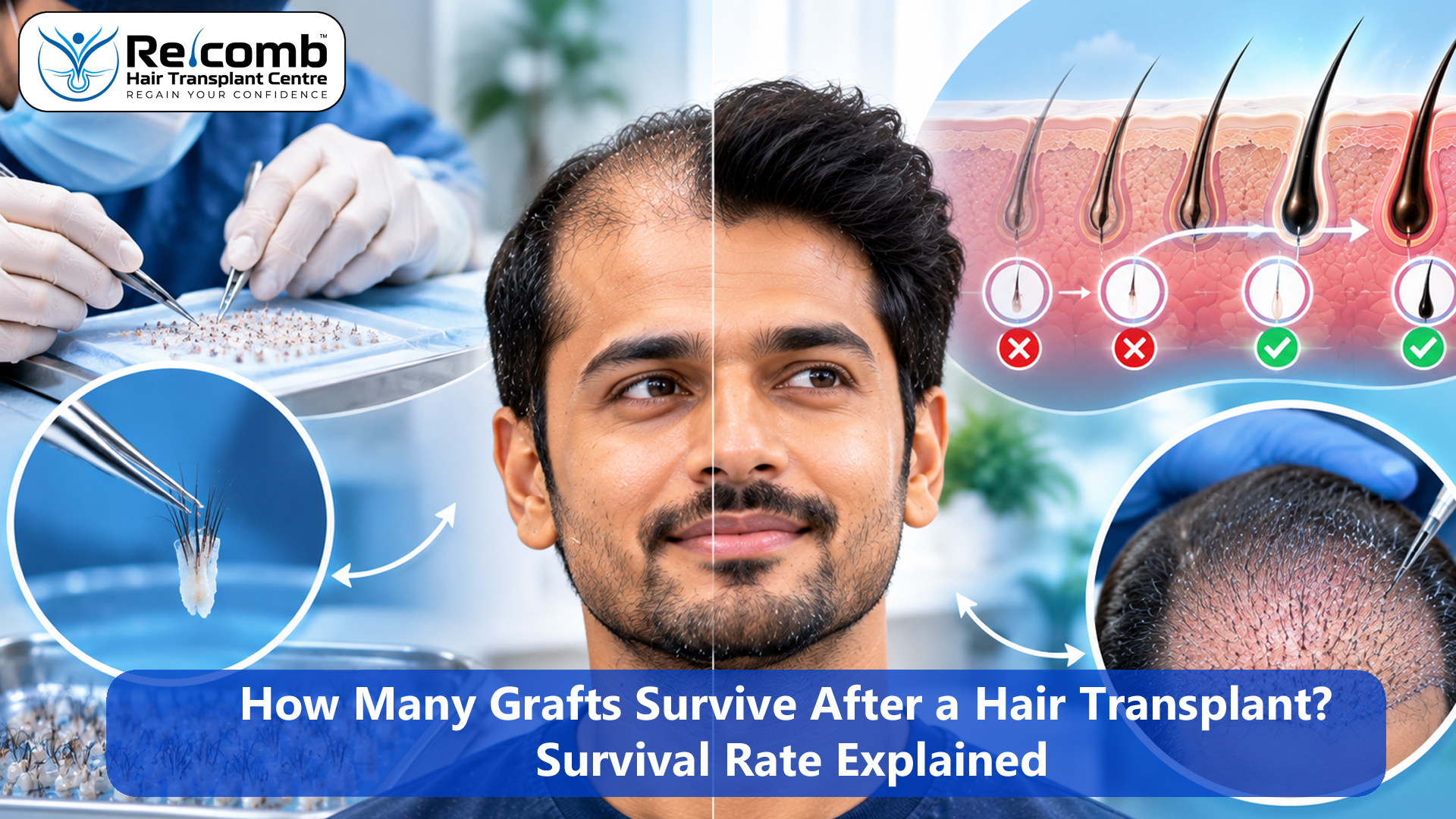
Graft survival refers to the proportion of transplanted follicular units that successfully establish in the recipient area and produce visible hair growth through at least one complete hair cycle.
It is measured not at the time of implantation but at the twelve-month result assessment, when the full growth cycle has been completed and the final density can be compared against the pre-surgical baseline and the planned graft allocation. A graft that was physically placed during the procedure but failed to establish, either because of extraction damage, handling errors, poor implantation depth, or inadequate scalp vascularity, does not count as a surviving graft regardless of whether it was successfully placed on the day.
The survival rate is expressed as a percentage of placed grafts that are confirmed growing at twelve months. At qualified surgeon-led clinics with proper technique and infrastructure, this figure typically falls between 85 and 95 percent. At poorly managed clinics with technician-led procedures, inadequate graft handling, or rushed high-volume sessions, survival rates can fall to 60 to 70 percent or lower.
The practical consequence of this difference is significant. A 2,500 graft procedure with 92 percent survival produces 2,300 growing grafts. The same count with 68 percent survival produces 1,700 growing grafts. The density difference between 2,300 and 1,700 grafts across a recipient area is visible and clinically meaningful. The patient with lower survival paid for 2,500 grafts and received the density of approximately 1,700.
Stage 1: Extraction — Where the First Losses Occur
Graft survival begins to be determined at the extraction stage, before a single graft has been implanted.
Transection is the primary extraction-related survival risk. It occurs when the cylindrical punch tool during FUE does not cleanly separate the follicular unit from surrounding tissue but instead cuts through the follicle shaft itself. A transected graft either fails to grow entirely or produces a significantly weaker hair than a cleanly extracted graft. Transection rates vary between surgeons and are one of the most direct measures of surgical extraction skill.
At qualified clinics with experienced surgeons, transection rates are typically below 5 percent. At high-volume clinics where technicians perform extraction without direct surgical supervision, transection rates of 10 to 20 percent are not uncommon. In a 2,500 graft procedure, the difference between 3 percent and 15 percent transection is the difference between approximately 75 damaged grafts and 375 damaged grafts before implantation has even begun.
Punch size calibration to individual follicle dimensions, extraction technique adapted to hair characteristics including curl and follicle angle, and direct surgeon involvement throughout extraction are the variables that determine transection rate.
Stage 2: Graft Handling and Storage — The Most Underappreciated Variable
Once extracted, grafts exist outside the body and are dependent entirely on the handling and storage conditions to maintain their viability. This stage receives less attention in patient-facing content than extraction or implantation, but its contribution to graft survival is substantial.
Follicles outside the body begin to deteriorate due to ischaemia, the absence of the blood supply that normally sustains them. The rate of deterioration depends on temperature, storage solution, and the time spent outside the body before implantation.
At body temperature, graft viability begins to decline within approximately 30 to 60 minutes and deteriorates rapidly beyond two hours. At four degrees Celsius in an appropriate physiological holding solution, viability is maintained for significantly longer, allowing safe management of the out-of-body time even in larger sessions.
Clinics that store grafts in saline at room temperature, or that allow grafts to sit for extended periods while the extraction phase is completed before implantation begins, produce lower survival rates than those with active temperature management. The difference in survival between appropriately chilled and room-temperature storage across a two to three hour extraction phase is measurable at the twelve-month result assessment.
At RECOMB, grafts are placed immediately into chilled physiological solution upon extraction and temperature is maintained throughout the procedure using a controlled cooling system. Implantation is staged to begin while extraction continues, minimising the out-of-body time for the earliest extracted grafts.
Stage 3: Recipient Site Creation — Setting the Environment for Survival
The recipient sites, the small incisions into which each graft is placed, determine the vascular environment each graft enters. Survival in the critical first 72 hours post-implantation depends on how quickly the graft can access the blood supply of the surrounding scalp tissue.
Site depth and size calibration affect this directly. A site that is the correct depth places the graft at the level where vascular reconnection occurs most efficiently. A site that is too deep buries the graft in avascular tissue. A site that is too shallow leaves the graft exposed with inadequate contact with surrounding vascularised tissue.
Site density is the other critical variable at this stage. Placing too many sites per square centimetre exceeds the blood supply capacity of the scalp tissue in that area. Grafts placed in an over-dense recipient zone compete for the same limited vascular territory, and a proportion fail to establish because the local blood supply cannot support all of them simultaneously. This is why maximum achievable density in a single session is capped by scalp vascularity rather than by technique alone, and why clinics that promise unusually high single-session density targets are compromising survival in the attempt to achieve them.
Stage 4: Implantation Technique — The Final Determinant
Implantation introduces grafts into their recipient sites. The variables at this stage that affect survival include graft orientation, depth consistency, and the care with which each graft is handled during placement.
A graft placed with its natural follicle orientation maintained, the same direction it grew in the donor zone, integrates more successfully than one rotated or compressed during placement. Each rotation or compression event creates microtrauma to the follicle that reduces its viability.
Direct forceps or implanter pen technique, where the graft is placed with minimal contact and handled only at the graft body rather than the follicle bulb, preserves follicle integrity better than techniques involving excessive manipulation. The number of times a graft is handled between extraction and final placement is itself a survival variable: each unnecessary manipulation adds microtrauma.
Implantation speed matters. A graft that has been correctly extracted, correctly stored, and is awaiting implantation continues to deteriorate while waiting. Efficient coordination between the extraction and implantation phases minimises this waiting time and maximises the survival rate of the final grafts placed.
What Realistic Survival Numbers Look Like
At RECOMB, and at qualified surgeon-led clinics with appropriate infrastructure, realistic graft survival rates by session size are as follows.
For sessions of 1,500 to 2,500 grafts performed with full surgeon involvement, temperature-controlled graft storage, calibrated recipient sites, and appropriate density targets, survival rates of 90 to 95 percent are achievable and expected. At 2,000 grafts, this means 1,800 to 1,900 growing grafts at twelve months.
For sessions of 2,500 to 3,500 grafts, the same standards produce survival rates of 88 to 93 percent. The modest decline at higher volumes reflects the longer procedure duration and greater demands on every stage of the process.
For sessions above 3,500 grafts, survival rates at even qualified clinics typically fall to 85 to 90 percent because the procedure duration, graft out-of-body time for early-extracted grafts, and vascular demands of a large recipient zone all create conditions less favourable than smaller sessions.
At technician-led budget clinics with room-temperature graft storage and without surgeon oversight, published observations and revision case assessments suggest survival rates of 60 to 75 percent regardless of session size, producing density outcomes that consistently disappoint relative to the quoted graft count.
What Patients Can Do to Maximise Their Own Graft Survival
Several patient-controlled factors in the pre-operative and post-operative period affect survival outcomes.
Nutritional status before surgery directly affects the follicular environment and healing capacity. Correcting ferritin deficiency, vitamin D deficiency, and optimising protein intake before the procedure improves the metabolic resources available for graft integration. At RECOMB, blood investigations and nutritional optimisation are part of the pre-surgical preparation protocol for this reason.
Smoking significantly impairs scalp microcirculation and increases oxidative stress at the implantation site. Patients who smoke are advised to stop at least two weeks before surgery and through the critical first two weeks of healing. The microvascular improvement from smoking cessation in this window meaningfully improves the vascular environment that newly placed grafts depend on.
Post-operative care compliance in the first 72 hours directly affects the proportion of grafts that remain undisturbed during the critical early anchoring period. Patients who follow the specific sleep position, activity restriction, and washing protocol instructions during this window protect grafts that a single moment of direct mechanical trauma could dislodge.
Starting finasteride before surgery reduces DHT activity in the recipient zone follicles, which reduces the inflammatory environment that compounds graft stress and improves the conditions under which shock loss recovery occurs in surrounding native follicles.
Post-operative GFC or PRP therapy introduced at three to four months supports graft growth during the active phase by delivering growth factor signals that favour anagen re-entry in the transplanted follicles.
Know Exactly How Your Graft Survival Will Be Maximised at RECOMB →
WhatsApp: +91 7624008000 | www.recombhair.com
RECOMB’s Approach (2026)
At RECOMB Hair Transplant Centre, Surat, every stage of the procedure described in this blog is managed specifically to produce and maintain high graft survival rates. Dr. Krishna Bhalala and Dr. Nilesh Kachhadiya perform extraction and implantation directly, maintaining the surgical judgment and technique consistency that technician-led procedures cannot replicate.
Graft handling follows a temperature-controlled protocol from extraction through implantation. Recipient site density is calibrated to scalp vascularity in each zone rather than to a uniform density target. Session volumes are planned to maintain the quality of each stage rather than maximising graft count at the expense of the conditions that determine survival.
Patients at RECOMB understand their expected survival rate as part of the pre-surgical consultation, not as a retrospective explanation for an outcome that falls short of the quoted graft count.
Final Takeaway
Graft survival is the bridge between the number quoted during a consultation and the density delivered in the final result. Every variable in the procedure, from extraction technique through storage conditions, site creation, and implantation care, contributes to where on the 60 to 95 percent spectrum a specific procedure falls.
The difference between the high and low ends of this spectrum, applied to 2,500 grafts, is the difference between a result the patient is genuinely satisfied with and one that raises questions about what went wrong. The answer in most cases is not what went wrong on a single day but what standards were or were not in place across every stage of the process.
Dr. Krishna Bhalala and Dr. Nilesh Kachhadiya conduct a limited number of personal consultations each week at RECOMB, Surat. If you want to understand specifically how each stage of your procedure would be managed to maximise your graft survival, this is where that conversation happens with complete transparency.
Understand What Determines Your Graft Survival at RECOMB →
WhatsApp: +91 7624008000
We respond within 24 hours, 6 days a week.
www.recombhair.com
Contact RECOMB Hair Transplant Centre
RECOMB Hair Transplant Centre
19, Ground Floor, Zenon Building, Opp. Unique Hospital, near Kiran Motors, Khatodara Wadi, Surat, Gujarat 395001
Phone: +91 7624008000
Website: www.recombhair.com