
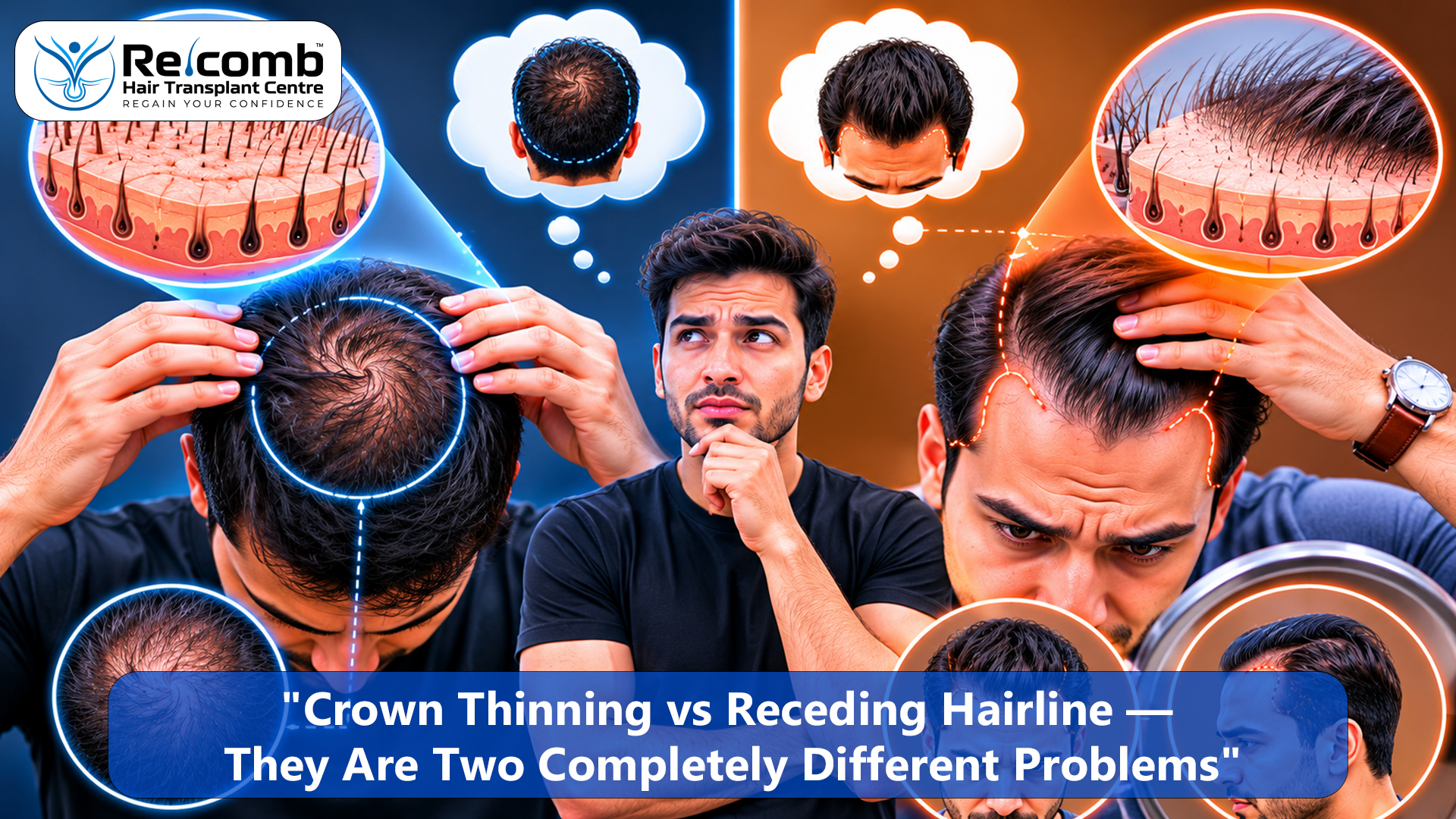
Patients presenting with hair loss frequently use the terms crown thinning and receding hairline interchangeably, as if they are two descriptions of the same problem at different locations on the scalp. Clinically, they are not. They progress differently, they require different graft allocations, they carry different risks in surgical planning, and the consequences of treating them with the same approach are significant.
Understanding the distinction before any treatment decision is made is not a technical detail. It is the foundation of a plan that will still look appropriate in 20 years.
If you have concerns about either crown thinning or a receding hairline and want a clinical assessment of which you are dealing with and what the right approach is, a consultation at RECOMB gives you that directly.
Book a Hair Loss Assessment at RECOMB, Surat → WhatsApp: +91 7624008000 | www.recombhair.com
The Receding Hairline: What It Is and How It Behaves
A receding hairline refers to the loss of hair at the frontal hairline and temporal zones. It is the first visible sign of androgenetic alopecia in most men and the change patients notice earliest because it directly affects the face-framing zone that is visible in every social interaction and every photograph.
The pattern of frontal recession follows the Norwood scale in a relatively predictable sequence. Recession typically begins at the temples, creating the characteristic M-shape with a central forelock maintained between two receding corners. As loss progresses, the temples deepen, the frontal hairline moves further back, and the forelock thins until the frontal zone connects with thinning at the midscalp.
Frontal recession is driven by DHT acting on genetically susceptible follicles in the frontal scalp. These follicles miniaturise progressively over years. Because the recession is visible from the front in all face-to-face interactions, it has the highest impact on perceived appearance and is usually the area patients prioritise for surgical restoration.
From a surgical planning perspective, the frontal hairline and frontal zone offer the best return on grafts invested. A well-designed hairline using 1,800 to 2,500 grafts in the frontal zone produces a dramatic improvement in appearance because it directly frames the face. Single-hair grafts at the hairline edge create a natural transition, and the result is visible to the patient and to others in every interaction.
Crown Thinning: What It Is and How It Behaves
Crown thinning, also called vertex thinning, refers to the gradual loss of density at the top rear of the scalp. It typically presents as a circular or oval area of diffuse thinning that expands outward over time. Unlike frontal recession, which follows a relatively predictable linear pattern, crown thinning is more variable and less predictable in its eventual extent.
Crown thinning is not visible to the patient in a standard mirror and is often first noticed in photographs taken from above or reported by others. This delayed self-awareness means patients frequently present with crown thinning that is already significantly advanced by the time they seek assessment.
The crown behaves differently from the frontal zone in several clinically important ways.
It is a vortex zone. Hair in the crown grows outward from a central point in a circular swirl pattern. Covering this zone requires grafts to be placed following this radial pattern with precise angulation at every site, not in uniform rows. This is technically more demanding than frontal zone implantation.
It is a bottomless zone. The crown has no defined boundary in the way the frontal hairline does. As androgenetic alopecia progresses, crown thinning can expand significantly, merging with midscalp thinning to produce extensive loss across the top of the scalp. This unpredictability makes aggressive crown coverage in a first session clinically risky: grafts placed in the centre of the crown may look appropriate initially but become surrounded by expanding thinning as the loss continues, creating an isolated dense patch in the middle of a larger bald area.
It requires more grafts per visual unit of improvement than the frontal zone. Because the crown is not directly face-framing, the perceptual return on grafts invested is lower than in the frontal zone. Filling the crown requires a high number of grafts to achieve visible density across a wide circular area, and the result is less dramatically transformative in face-to-face interactions than the same number of grafts placed in the frontal zone.
Why They Cannot Be Treated with the Same Plan
The clinical differences between frontal recession and crown thinning mean that the same surgical approach cannot serve both effectively.
A patient who presents with both frontal recession and crown thinning at Norwood Grade 4 to 5 has a total restoration requirement that may exceed 4,000 to 5,000 grafts across both zones. Most patients have a lifetime donor supply of 4,000 to 6,000 grafts. Attempting to address both zones comprehensively in a single session risks depleting the donor area and leaving nothing for future sessions as loss continues to progress.
The standard clinical approach is zone prioritisation. The frontal zone and hairline are addressed first because they deliver the highest visual impact, require a lower graft count relative to effect, and establish the frame within which all future restoration work will sit. The crown is addressed in a subsequent session once the frontal result has matured and the extent of crown progression is clearer.
This sequence also serves the patient's long-term interest by preserving donor grafts. A first session using 2,000 to 2,500 grafts in the frontal zone leaves 1,500 to 2,500 grafts for a second session addressing the crown or midscalp, depending on how the loss has progressed in the intervening period.
Treating both zones simultaneously in a first session without adequate donor reserves inverts this logic. It delivers incomplete coverage in both zones and leaves nothing for correction or future needs.
The Crown-First Mistake and Why Patients Make It
Some patients specifically request crown coverage as their priority. The reason is usually that crown thinning is what prompted them to seek treatment and it is the change they feel most self-conscious about, often because it was pointed out by someone else.
The instinct to address the most noticed problem first is understandable but it is not good surgical planning. Covering the crown at the expense of the frontal zone produces a result where the back of the head has improved density but the frontal hairline remains receded. This is the opposite of what delivers optimal appearance in face-to-face interactions, which constitute the vast majority of social situations.
It also poses a specific long-term risk. If crown coverage is prioritised using a significant portion of the donor budget, and frontal recession subsequently advances further, the patient may find they have insufficient donor grafts to address the frontal zone in a future session. They have a denser crown surrounded by a receded, untreated frontal zone, which is a result that neither looks natural nor can be easily corrected.
What Each Condition Actually Needs
Frontal recession needs a well-designed, age-appropriate hairline with a natural transition zone, appropriate temporal angles, and a frontal zone density that complements the face. Grafts are used with high visual efficiency because every graft placed in the frontal zone directly improves face-framing appearance.
Crown thinning needs a staged approach that accounts for the unpredictable expansion of the zone. The first priority is to avoid placing too many grafts in the central crown before the full extent of loss is clear. Coverage is planned conservatively, addressing the areas of highest cosmetic priority within the crown while leaving donor grafts for future expansion. Medical management with finasteride and minoxidil is particularly important in the crown zone to slow the rate of expansion and preserve the surrounding native hair that supports transplanted density.
Both conditions benefit from a lifetime graft budget assessment before any grafts are committed to either zone. Knowing how many grafts are available and how they should be distributed across a projected 20-year loss trajectory prevents the most common planning errors.
RECOMB's Approach (2026)
At RECOMB Hair Transplant Centre, Surat, every patient presenting with hair loss involving both frontal recession and crown thinning receives a specific assessment of each zone separately before any procedure is planned.
Dr. Krishna Bhalala and Dr. Nilesh Kachhadiya map the current extent of both zones, project the likely progression of each based on Norwood staging and family history, calculate the donor budget required for a full lifetime restoration plan, and present the patient with a staged approach that prioritises zones in the sequence that serves their long-term appearance and preserves their options.
We do not treat crown thinning and frontal recession as the same problem because they are not. And we do not recommend addressing both simultaneously without a clear plan for what remains available afterward.
Get a Zone-by-Zone Assessment of Your Hair Loss at RECOMB → WhatsApp: +91 7624008000 | www.recombhair.com
Final Takeaway
Crown thinning and a receding hairline are both manifestations of androgenetic alopecia but they behave differently, require different graft allocations, carry different planning risks, and respond differently to surgical intervention.
The patient who understands this distinction before walking into a consultation is the patient who asks better questions, makes a more informed decision about sequencing and staging, and ends up with a result that serves them across their lifetime rather than one that looked complete at 35 and increasingly wrong at 45.
Both conditions are treatable. Neither is simple. Both require a plan that accounts for where the loss is going, not just where it is today.
Dr. Krishna Bhalala and Dr. Nilesh Kachhadiya conduct a limited number of personal consultations each week at RECOMB, Surat. If you are experiencing either crown thinning, frontal recession, or both, and want a clinical assessment of what the right approach is for your specific pattern, this is where that conversation starts.
Get a Clinical Plan for Your Specific Hair Loss Pattern at RECOMB → WhatsApp: +91 7624008000 We respond within 24 hours, 6 days a week. www.recombhair.com
Contact RECOMB Hair Transplant Centre
Phone: +91 7624008000
Website: www.recombhair.com