
Most hair loss clinics operate in silos. The surgical team recommends surgery. The non-surgical team recommends PRP or mesotherapy. The two rarely communicate, and the patient receives whichever treatment the first clinician they encounter happens to offer.
The result is that patients who need a coordinated plan receive a single tool instead. A patient who would benefit from pre-surgical mesotherapy to prepare the scalp goes directly to surgery. A patient who needs medical management alongside GFC therapy gets GFC alone. A patient who has undergone a transplant receives no guidance on protecting the surrounding native hair that will determine how the result looks in ten years.
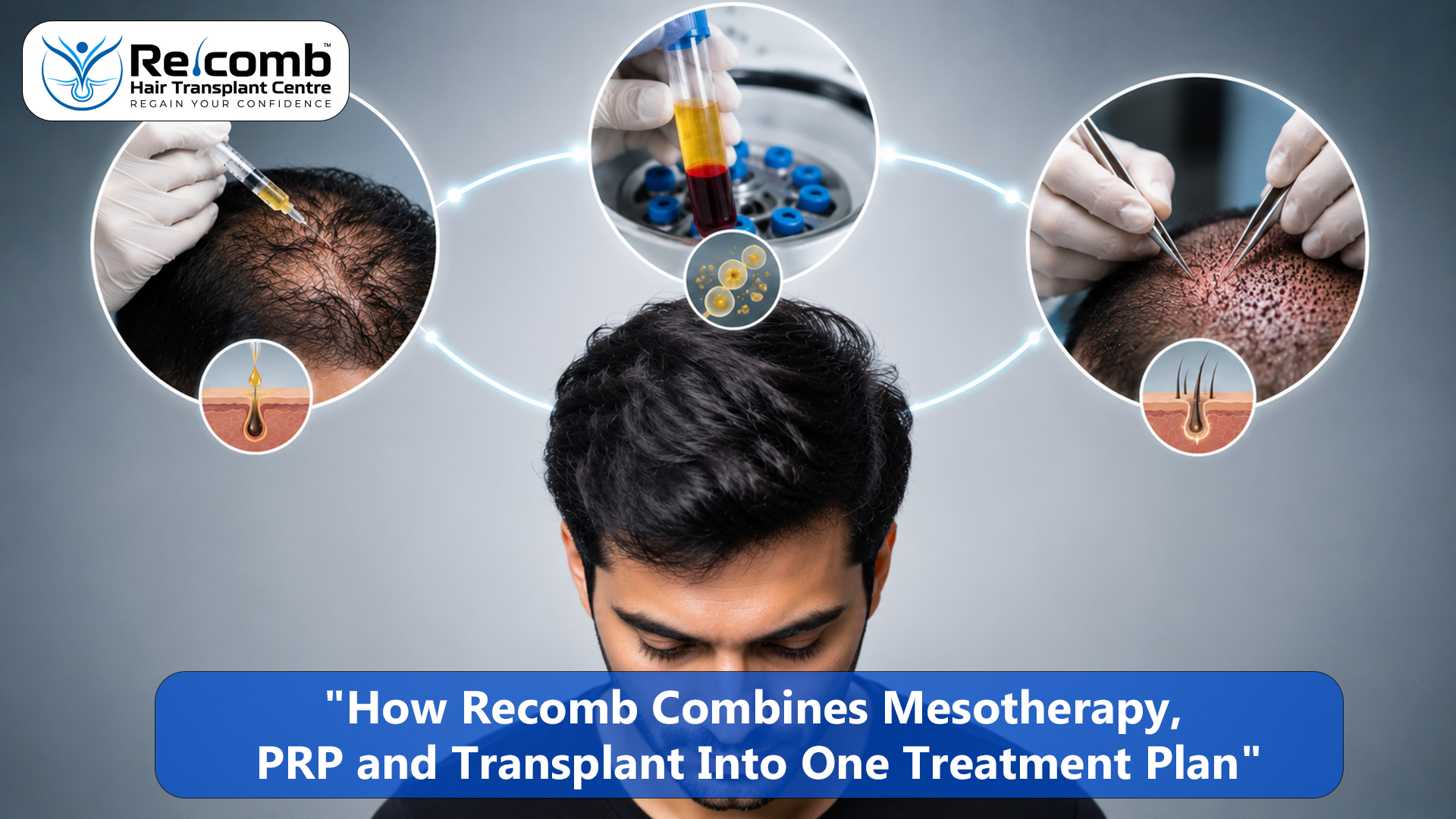
At RECOMB, treatment planning works differently. Every patient receives a plan that integrates the full range of available treatments in a specific sequence determined by their clinical assessment, with each treatment introduced at the point in the timeline where it contributes most to the long-term result.
This blog explains how that integrated plan is built, what each treatment contributes at each stage, and why the sequence matters as much as the selection.
If you want to understand what an integrated treatment plan would look like for your specific hair loss case, a consultation at RECOMB is where that plan is built.
Book an Integrated Hair Loss Treatment Consultation at RECOMB →
WhatsApp: +91 7624008000 | www.recombhair.com
Why Integration Matters More Than Individual Treatment Selection
Before explaining how the treatments are combined, it is worth establishing why integration produces outcomes that individual treatments cannot achieve in isolation.
Hair loss in most patients is a multi-mechanism problem. Androgenetic alopecia involves DHT-driven follicle miniaturisation, reduced scalp microcirculation, follicular inflammation, and eventual structural loss of follicles in affected zones. Each of these mechanisms is a distinct clinical target. No single treatment addresses all of them simultaneously.
Finasteride targets DHT production. Minoxidil targets circulation and anagen prolongation. Mesotherapy targets follicular nutrition, local DHT activity, and scalp inflammation directly at the tissue level. PRP and GFC target growth factor signalling and perifollicular inflammation through biological mechanisms. Surgery targets the structural loss of follicles where miniaturisation is already complete and restoration is the only option.
When these treatments are used in isolation, each addresses one dimension of the problem while leaving the others unmanaged. When they are sequenced in an integrated plan, each treatment addresses its specific dimension at the point in the timeline where it is most effective and where the other treatments create the conditions for it to work best.
Stage 1: Diagnosis and Baseline Assessment
Every integrated plan at RECOMB begins with a complete scalp analysis and clinical assessment before any treatment is recommended. Trichoscopy establishes the degree and pattern of follicle miniaturisation, donor density, and the presence of any scalp condition requiring specific treatment. Blood investigations establish nutritional and hormonal status. Norwood or Ludwig staging documents the current extent of loss and informs the projection of future progression.
From this assessment, the patient's treatment landscape becomes specific. Which zones are losing hair and how rapidly. Which follicles are miniaturising but salvageable. Which zones have already lost follicles beyond recovery without surgery. What the donor area can support across a lifetime. Whether any scalp conditions need to be addressed before any restorative treatment begins.
This baseline is the architecture on which every subsequent treatment decision is made. Without it, treatment selection is commercial rather than clinical.
Stage 2: Medical Foundation and Scalp Preparation
For most patients with androgenetic alopecia, the integrated plan begins with establishing the medical management foundation: finasteride to reduce DHT and slow ongoing miniaturisation, and minoxidil to improve scalp circulation and extend the anagen phase.
This foundation is started at the outset for two reasons. First, it addresses the ongoing DHT mechanism that continues to drive loss in untreated zones regardless of what other treatments are used. Second, it creates a better scalp environment for every subsequent treatment by reducing the hormonal driver of follicular inflammation and improving the blood supply that supports follicle health and graft survival.
For patients where the scalp assessment reveals significant inflammation, nutritional deficiency, or poor microcirculation that would compromise subsequent treatments, mesotherapy is introduced at this stage as a preparation phase. As discussed in the pre-surgical mesotherapy blog, four to six sessions of targeted mesotherapy can correct nutritional deficits at the follicular level, reduce inflammatory burden, and prime the scalp microcirculation before any biological or surgical treatment is layered on top.
Patients without these preparatory indications proceed directly from the medical foundation to the next stage.
Stage 3: Biological Support — PRP or GFC
Once the medical foundation is established and any preparatory scalp work is complete, PRP or GFC therapy is introduced as the biological support layer. The timing is typically three to four months after starting finasteride and minoxidil, when the hormonal environment has begun to stabilise and the scalp is responding to improved circulation.
At this stage, PRP or GFC delivers concentrated growth factors to the follicular environment, targeting the perifollicular inflammation and growth factor signalling deficits that the medical foundation does not directly address. This biological layer produces several effects relevant to the integrated plan.
In follicles that are miniaturising but still active, GFC or PRP growth factor signalling can partially extend the anagen phase and improve hair shaft quality, producing modest density improvement in these zones. This improvement reduces the area that will ultimately require surgical coverage, making the surgical plan more efficient.
In patients who are not surgical candidates at this stage because their loss has not yet stabilised, GFC or PRP maintains the health of salvageable follicles during the stabilisation period, preserving more of them for the point at which surgery becomes appropriate.
The standard course is four sessions of GFC or PRP spaced four weeks apart, followed by maintenance sessions every four to six months while the medical foundation continues.
Stage 4: Surgical Restoration
For patients who are surgical candidates, surgery is planned after the previous stages have produced a stabilised scalp environment. The timing typically falls six to twelve months into the integrated plan, once trichoscopy confirms reduced shedding rate, improved follicle response to medical management, and a clear pattern against which surgical planning can be made with confidence.
The surgical procedure at RECOMB is not planned in isolation from the rest of the treatment plan. It is designed specifically within the context of the lifetime graft budget, the medical management that will continue post-operatively, and the zones where biological support will be maintained after surgery.
The graft plan allocates grafts to the zones where structural follicle loss is already complete, specifically because those zones cannot respond to medical or biological treatment and surgery is the only remaining option. Zones where follicles are still present but miniaturising are left to medical and biological management where possible, conserving donor grafts for future sessions.
The hairline is designed with the understanding that medical management post-operatively will preserve surrounding native hair, which means the hairline does not need to compensate for aggressive native hair loss in the adjacent zones because that loss is being actively managed.
Stage 5: Post-Operative Integration
Surgery day does not end the integrated plan. It is a transition point within it.
In the immediate post-operative period, the focus is on graft survival and healing, managed through the post-operative care protocol described in the post-operative care blog. Medical management continues uninterrupted through this period because the DHT mechanism does not pause during surgical recovery.
At the three to four month post-operative mark, GFC or PRP therapy is reintroduced as a post-surgical biological support layer. At this point it serves a dual purpose: supporting the active growth of transplanted grafts during the peak growth phase, and maintaining the follicle health of the surrounding native hair that medical management is protecting but that benefits additionally from biological growth factor support during the high-demand growth period.
Mesotherapy, where it was used in the preparatory phase, may be reintroduced at six to eight months post-operatively for patients with ongoing nutritional or inflammatory considerations, delivering localised support to the recipient zone during the late growth phase when shaft diameter and density refinement are still occurring.
Stage 6: Long-Term Maintenance
The integrated plan does not end when the twelve-month result photograph is taken. For most patients with androgenetic alopecia, hair loss is a lifelong condition that requires ongoing management to preserve the result achieved through the integrated plan.
Long-term maintenance typically involves continued finasteride and minoxidil as the ongoing medical foundation, GFC or PRP maintenance sessions every four to six months to sustain biological support for remaining native hair, and scheduled trichoscopy assessments annually to monitor whether new zones are beginning to miniaturise and whether the timing for a planned second surgical session is approaching.
This long-term view is built into the plan from the outset at RECOMB, because a result achieved with an integrated approach that is then abandoned without maintenance will progressively deteriorate as the underlying androgenetic process continues in unmanaged zones.
How the Plan Differs Between Patients
The framework described above is the full integrated plan for a patient with moderate to advanced androgenetic alopecia who is a surgical candidate with a complete clinical profile. Not every patient follows this exact sequence.
A patient with early loss who is not yet a surgical candidate may follow only stages one through three indefinitely, with surgery discussed at the point their candidacy is established. A patient with purely non-surgical needs may follow stages one through three as a complete plan without ever reaching surgery. A patient who presents post-transplant from another clinic may enter the integrated plan at stage five, receiving biological support and medical management for a result that was achieved without prior preparation.
The plan is built from the clinical assessment findings upward, not applied as a fixed protocol downward. Every component is justified by a specific finding in the patient's assessment.
Get an Integrated Treatment Plan Built From Your Clinical Assessment →
WhatsApp: +91 7624008000 | www.recombhair.com
RECOMB's Approach (2026)
At RECOMB Hair Transplant Centre, Surat, the integrated plan is not a marketing framework. It is a clinical workflow that reflects the multi-mechanism nature of hair loss and the specific contribution each available treatment makes at each stage of managing it.
Dr. Krishna Bhalala and Dr. Nilesh Kachhadiya bring complementary expertise to every integrated plan. Dr. Bhalala's background as a DNB Dermatologist means the medical, nutritional, and scalp health dimensions of the plan are evaluated and managed with the same rigour as the surgical components. Dr. Kachhadiya's MCh Plastic and Reconstructive Surgeon background ensures that the surgical stage is planned and executed to the technical standard required for the entire integrated plan to achieve its intended result.
The two clinical perspectives are applied to every patient's plan simultaneously, not sequentially, because the surgical and non-surgical components of an integrated plan inform each other from the outset.
Final Takeaway
Mesotherapy, PRP, and hair transplant surgery are not competing options between which a patient must choose. They are complementary tools that address different dimensions of the same multi-mechanism problem, and they produce better outcomes together in a planned sequence than any of them achieves individually.
The integrated plan that combines them is not more complex for the patient. It is more deliberate. Each step has a specific clinical rationale, a specific timing, and a specific contribution to the long-term result that the patient can understand and evaluate. That transparency is what makes the difference between a treatment plan that serves the patient and a treatment menu that serves the clinic.
Dr. Krishna Bhalala and Dr. Nilesh Kachhadiya conduct a limited number of personal consultations each week at RECOMB, Surat. If you want a treatment plan that integrates every available tool in the sequence that produces the best long-term result for your specific case, this is where that plan is built.
Build Your Complete Hair Restoration Plan at RECOMB, Surat →
WhatsApp: +91 7624008000
We respond within 24 hours, 6 days a week.
www.recombhair.com
Contact RECOMB Hair Transplant Centre
RECOMB Hair Transplant Centre
19, Ground Floor, Zenon Building, Opp. Unique Hospital, near Kiran Motors, Khatodara Wadi, Surat, Gujarat 395001
Phone: +91 7624008000
Website: www.recombhair.com