
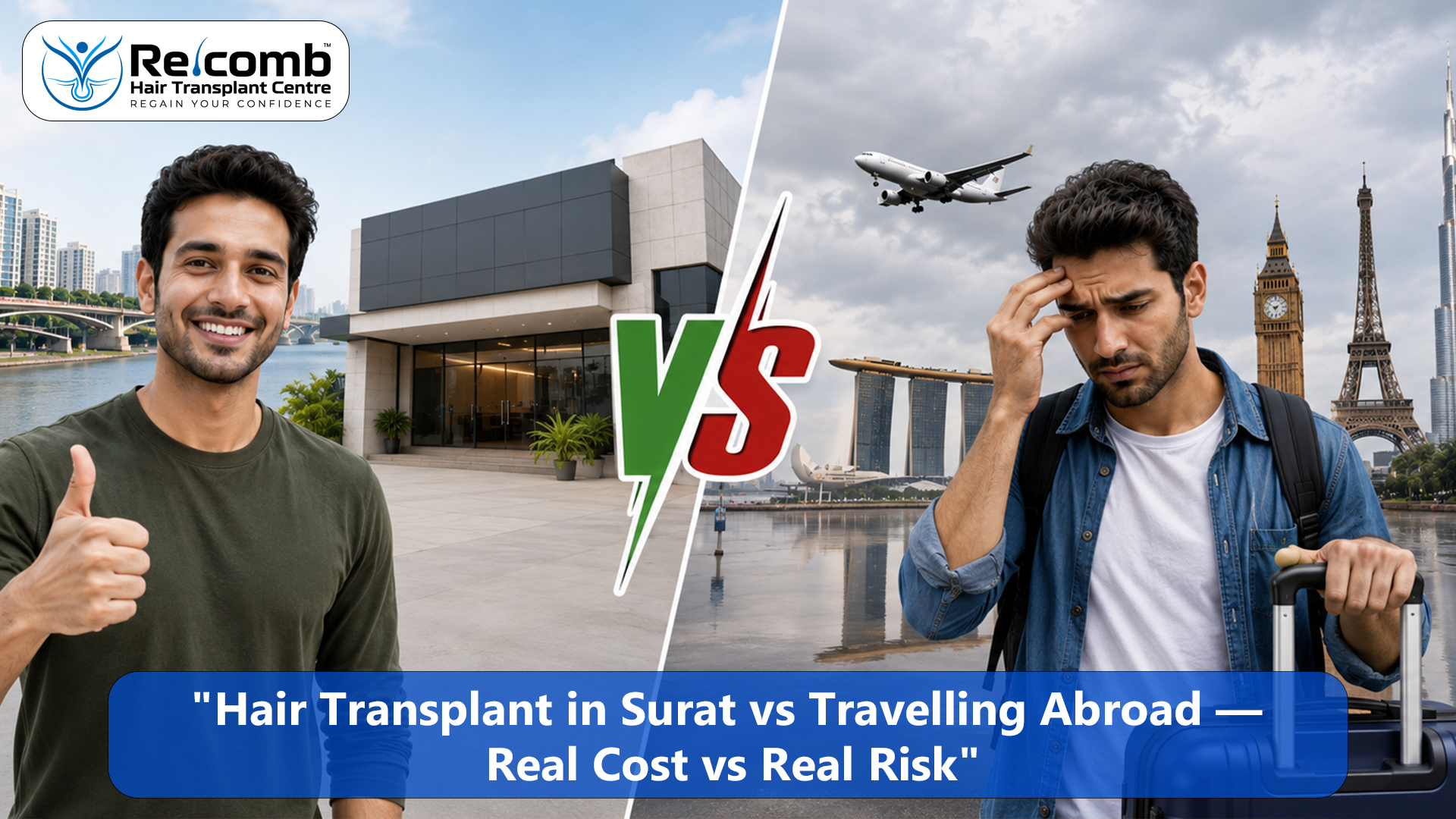
Every few months a patient walks into RECOMB having seriously considered, or already booked, a hair transplant abroad. Turkey is the most common destination. Thailand occasionally. Some patients have seen advertisements for clinics in Eastern Europe offering procedures at prices that appear to be a fraction of what Indian clinics charge.
The question they are asking, usually without framing it this way, is whether the price difference justifies the travel, the unfamiliarity, and the distance from follow-up care. It is a reasonable question and it deserves a direct answer rather than a defensive one.
This blog does not argue that every clinic abroad is poor or that every Indian clinic is superior. It breaks down what the real cost comparison looks like when all factors are counted, what the specific risks of travelling abroad for a hair transplant are, and what the advantage of having an experienced surgical team accessible for the full 12 to 18 month recovery period actually means in practice.
If you are currently comparing options and want to understand what a properly planned procedure at RECOMB would cost and deliver for your specific case, a consultation is the right starting point.
Book a Consultation and Cost Assessment at RECOMB, Surat → WhatsApp: +91 7624008000 | www.recombhair.com
Why the Headline Price Abroad Is Misleading
The most common reason patients consider travelling abroad for a hair transplant is the advertised price. A clinic in Istanbul may advertise 4,000 grafts for the equivalent of Rs 80,000 to Rs 1,00,000 all-inclusive, which appears to undercut Indian clinic pricing significantly.
This comparison breaks down immediately when the full cost is calculated honestly.
Return airfare from Surat or Ahmedabad to Istanbul typically costs Rs 35,000 to Rs 60,000 depending on season and booking timing. Hotel accommodation for the recommended minimum stay of five to seven days adds Rs 15,000 to Rs 30,000. Local transport, meals, and incidentals add Rs 8,000 to Rs 15,000. Travel insurance with medical coverage for a surgical procedure abroad costs Rs 5,000 to Rs 12,000 for a week. Lost income from a minimum of eight to ten days away from work is a real cost that most patients do not quantify but should.
Adding these figures conservatively, the actual cost of a Rs 90,000 advertised procedure abroad is closer to Rs 1,55,000 to Rs 2,00,000 before a single graft is placed. A well-planned procedure at a qualified clinic in Surat at Rs 90,000 to Rs 1,20,000 is, on a true cost comparison, less expensive than most abroad options once all factors are counted.
What the Advertised Package Abroad Actually Includes
The all-inclusive pricing model used by high-volume clinics in Turkey and similar destinations deserves specific scrutiny. All-inclusive typically means accommodation, airport transfers, and a graft count. It does not always mean surgeon-performed extraction and implantation.
The volume model in many overseas hair transplant hubs involves a surgeon who designs the hairline and oversees the procedure while technician teams perform the extraction and implantation. This is not unique to abroad, it exists in low-cost Indian clinics too, but it is common enough in high-volume overseas operations to warrant direct attention.
Patients travelling abroad cannot easily verify surgeon involvement in advance. They cannot meet the operating surgeon before travelling, cannot see the facility in person, and cannot assess the actual standard of care until they are already there, having spent on flights and accommodation, with limited leverage to change their decision.
The same caution about technician-performed procedures that applies to budget clinics in India applies with equal force to high-volume overseas operations, with the additional complication that the patient is far from home and without their usual support network when they discover a problem.
The Follow-Up Problem Nobody Discusses Honestly
A hair transplant is not a single event. It is the beginning of a 12 to 18 month process during which the result develops, complications can arise, and clinical decisions need to be made.
In the weeks immediately after surgery, patients may experience unexpected swelling, signs of infection, abnormal shedding patterns, or questions about aftercare that require clinical assessment. These are not rare complications. They are normal parts of the post-operative course that an experienced surgeon manages as a matter of routine.
When the operating clinic is in Istanbul and the patient is back in Surat, these situations are managed over WhatsApp photographs and video calls with a team that may speak limited English, has hundreds of other international patients, and has no ability to physically examine the patient. The local doctor the patient visits for assessment has no relationship with the operating clinic, no access to the surgical records, and limited context for interpreting what they see.
The same applies to the assessment that determines whether growth is progressing normally at four months, whether a specific area requires additional attention at six months, and whether a second session is indicated and at what timing. All of these require clinical judgement from someone who knows the patient, knows the plan, and can physically examine the scalp. None of that is available when the surgery happened in a different country.
At RECOMB, every patient who undergoes a procedure has direct access to Dr. Krishna Bhalala and Dr. Nilesh Kachhadiya throughout the full growth period. Scheduled follow-up appointments at one month, three months, six months, and twelve months are part of the treatment plan, not an optional add-on.
Language, Communication, and Informed Consent
Informed consent is not a form. It is a process of genuine understanding between the patient and the surgeon about what will be done, why, what the risks are, and what the realistic outcomes look like.
This process is difficult enough in a patient's native language with a surgeon who has examined them in person. It is significantly harder when conducted through a translator or a clinic coordinator whose role is partly to facilitate bookings. Patients travelling abroad for hair transplants frequently report that their pre-surgical consultation was brief, that the hairline design discussion was limited, and that the long-term planning conversation about future hair loss and donor preservation did not happen in any meaningful depth.
These are not small omissions. They are the conversations that determine whether a procedure serves the patient for 20 years or creates a problem that becomes visible in five.
Hair Transplant in India vs Turkey: The Clinical Reality in 2026
India's hair transplant sector has changed significantly in the past decade. Surgeons with fellowship training in FUE techniques, international conference presentations, and case volumes comparable to the best clinics abroad are practising across major Indian cities including Surat.
The perception that abroad means better is a relic of a time when training and infrastructure gaps between India and international centres were larger. That gap has closed substantially. What has not changed is that quality varies enormously within India, as it does within Turkey, and the variables that determine outcome, surgeon involvement, planning quality, graft handling, and follow-up commitment, are clinic-specific rather than country-specific.
Choosing a qualified clinic in Surat over a high-volume clinic in Istanbul is not settling for second best. For most patients, it is the more clinically rational decision when the full picture is assessed honestly.
When Travelling Abroad Might Make Sense
This blog is not an argument that travelling abroad for a hair transplant is never appropriate. There are circumstances where it may be reasonable.
A patient who has identified a specific internationally recognised surgeon with a verifiable case record, who can meet that surgeon in person before committing, who has a plan for follow-up care with a qualified local clinician, and who has done a genuine full-cost comparison may have a reasonable basis for their decision. This is different from booking a package based on an Instagram advertisement and an all-inclusive price.
The standard patients should apply is identical whether the clinic is in Surat or Istanbul: who specifically will operate, what does the pre-surgical assessment involve, what is the follow-up protocol, and what happens if there is a complication.
RECOMB's Approach (2026)
At RECOMB Hair Transplant Centre, Surat, patients considering options abroad are given the same honest comparison this blog provides. We do not compete on price with high-volume overseas operations. We compete on what the full clinical picture looks like over 18 months.
Dr. Krishna Bhalala and Dr. Nilesh Kachhadiya bring over 14 years of combined surgical experience and more than 10 million follicles implanted to every procedure. Every patient receives a pre-surgical assessment, a specific graft plan, a hairline designed for their face and their future hair loss trajectory, direct surgeon involvement throughout the procedure, and structured follow-up for the full growth period.
Patients from Ahmedabad, Vadodara, Rajkot, and Mumbai travel to RECOMB in Surat specifically because the combination of surgical standard and follow-up accessibility is not matched by what they found elsewhere, including abroad.
Final Takeaway
The decision between a hair transplant in Surat and travelling abroad should be made on complete information, not on headline price comparisons. When the full cost is calculated, the real cost gap is smaller than it appears and in many cases does not exist. When the clinical factors are assessed, the advantages of a qualified local surgeon with full follow-up access are significant and concrete.
The right question is not where is cheapest. It is where the surgical standard, the planning process, the follow-up commitment, and the total cost of the complete treatment journey are best aligned with a result that will still look good in 15 years.
Dr. Krishna Bhalala and Dr. Nilesh Kachhadiya conduct a limited number of personal consultations each week at RECOMB, Surat. If you are comparing options and want a transparent conversation about what a procedure at RECOMB would involve, cost, and deliver for your specific case, this is where that conversation happens.
Compare Your Options With Full Information at RECOMB → WhatsApp: +91 7624008000 We respond within 24 hours, 6 days a week. www.recombhair.com
Contact RECOMB Hair Transplant Centre
Phone: +91 7624008000
Website: www.recombhair.com