
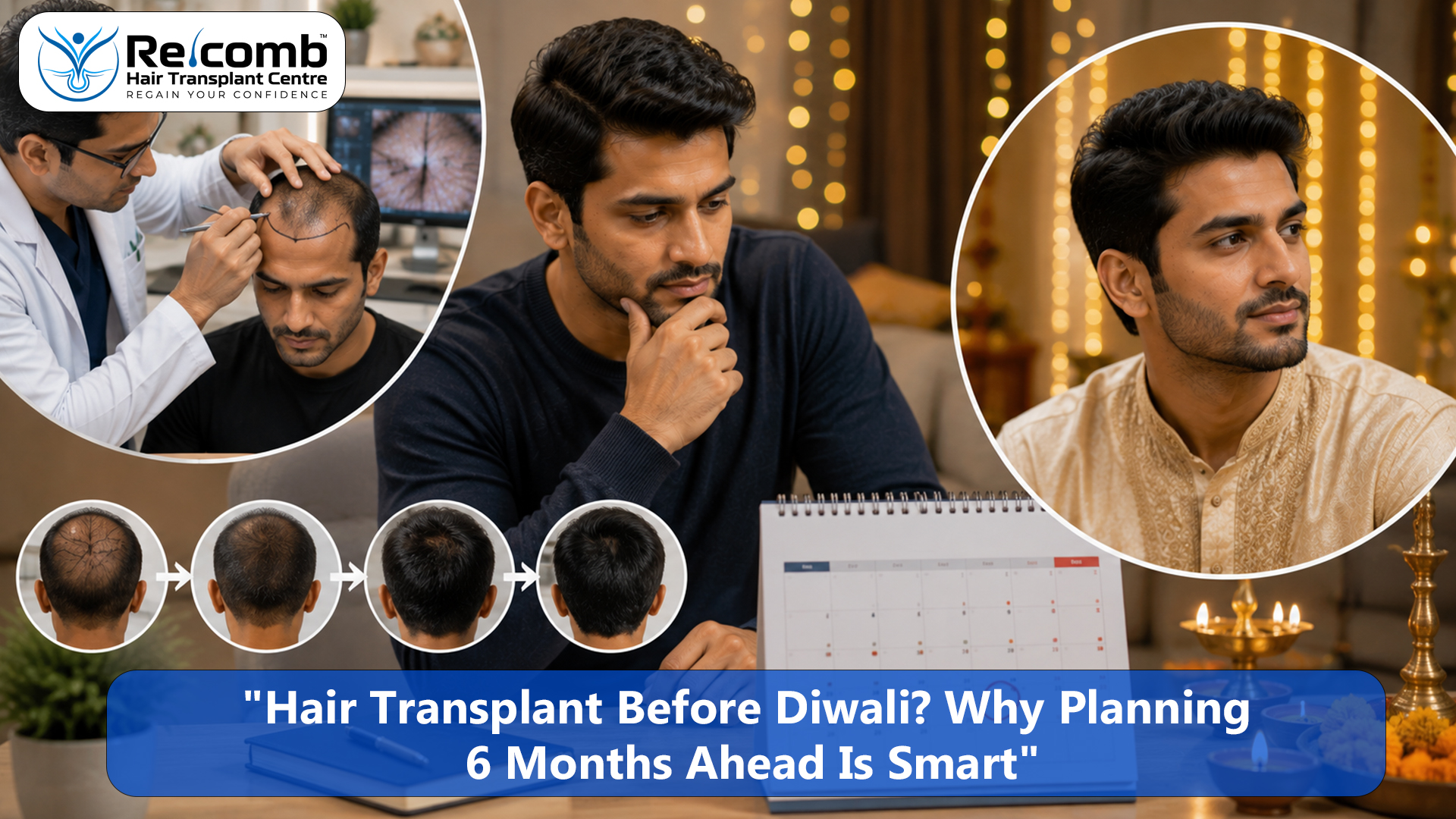
Every year, in the months leading up to Diwali, enquiries at hair transplant clinics across Gujarat and India increase noticeably. The pattern is consistent and understandable. Diwali is the most significant social event of the year for most families in the region. Family gatherings, photographs, social functions, and the general visibility that accompanies the festival create a natural motivation to look one's best.
For patients who have been thinking about a hair transplant for months or years, Diwali becomes a deadline. They want results by the festival. The instinct is to book as soon as possible and expect the procedure to produce a visible improvement in time.
The clinical reality of hair transplant timelines makes this instinct accurate only when the planning happens early enough. This blog explains exactly what the post-operative timeline looks like, why six months is the minimum advance planning window for any visible result by Diwali, and what the realistic outcome is for patients who plan at different points in that window.
If Diwali 2026 is your target and you want to understand whether the timing still works for your case, a consultation at RECOMB gives you a specific answer based on your current hair loss stage.
Book a Diwali Planning Consultation at RECOMB, Surat →
WhatsApp: +91 7624008000 | www.recombhair.com
The Hair Transplant Growth Timeline: What Actually Happens Month by Month
Understanding why advance planning matters requires understanding what happens to transplanted hair after the procedure.
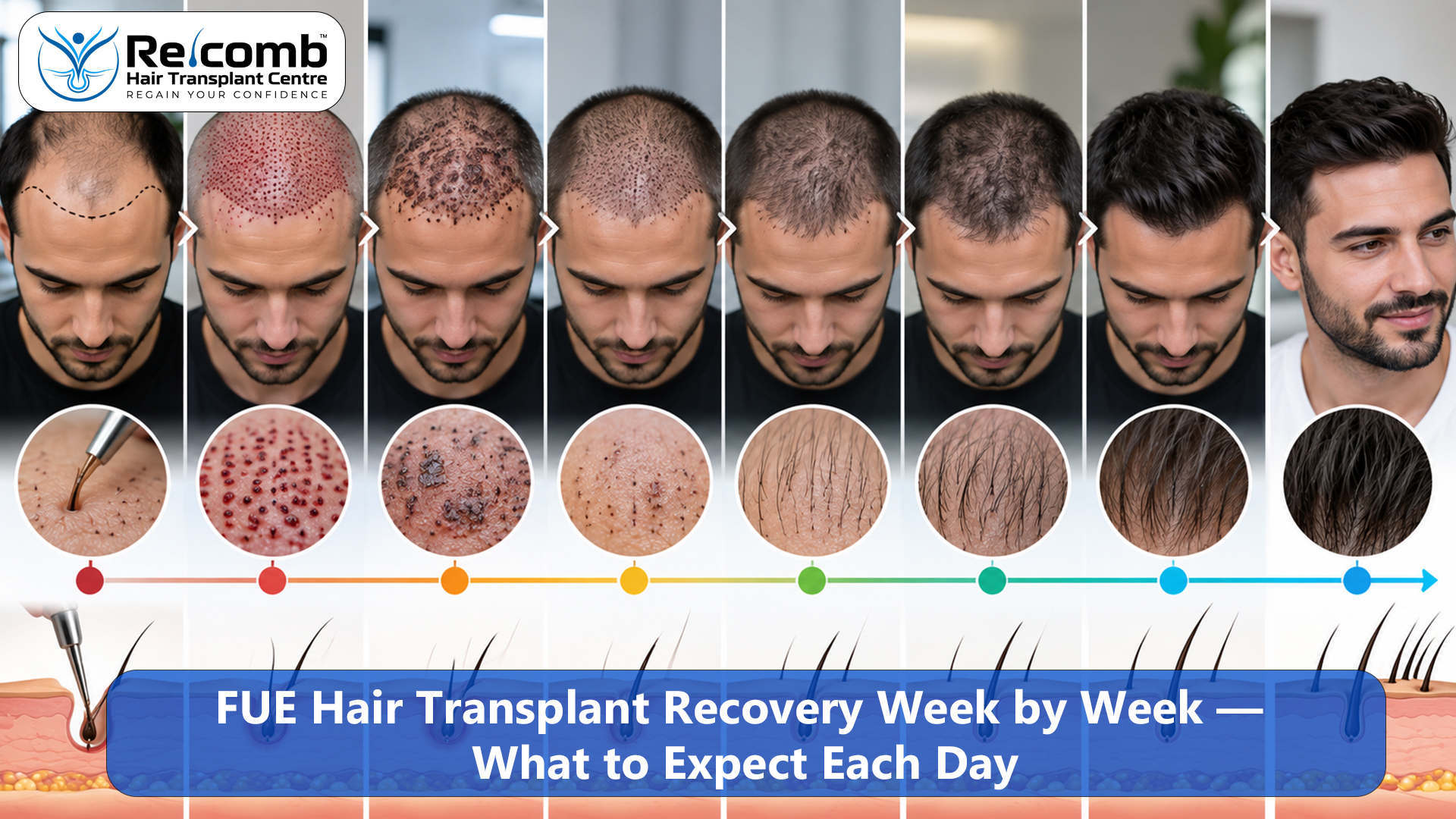
In the first two weeks, the transplanted grafts settle into their recipient sites. Small scabs form around each graft and shed naturally by approximately day ten to fourteen. The scalp looks largely normal externally by week two, which means this period is the most manageable socially and requires only approximately one week away from normal activity.
Between weeks three and eight, the transplanted hairs shed. This is called the telogen effluvium of the transplanted hair and it is entirely normal and expected. The hair shaft falls but the follicle beneath the scalp remains intact and resting, preparing for the new growth cycle. During this period the result looks no different from, and sometimes slightly thinner than, the pre-surgical baseline. Patients who are not prepared for this phase find it alarming.
Between months two and four, the scalp is in its resting period. Visible growth has not yet begun for most patients. This is the quiet phase where patience is required and where proactive patient communication from the clinic is important.
From month four onward, new hair growth becomes visible. The growth is initially fine and thin, gaining shaft diameter and density progressively over the following months.
At six months, most patients have achieved 50 to 65 percent of their final result in terms of density. The improvement is visible and meaningful at this stage, though the result continues to develop.
At nine to twelve months, 80 to 90 percent of the final density is visible. For most patients this is the stage where the result is clearly satisfying and photographs well.
The final result, including the full shaft diameter and maximum density, is assessable at 12 to 18 months.
What Six Months Ahead Actually Means for Diwali
Diwali in 2026 falls in late October. Working backward from this date:
A procedure performed in late April or early May 2026 would be approximately six months before Diwali. At this point, a patient would be at the five to six month post-operative stage by Diwali, where 50 to 65 percent of the final result is visible. The improvement is meaningful and noticeably better than pre-surgical appearance. Photographs at family functions would show a clear positive change from a year earlier.
A procedure performed in late May or June would place the patient at four to five months post-operative by Diwali. Visible growth has begun but density at this stage is lower than at six months. The improvement is noticeable to the patient and to close family members, but may not be dramatic enough for the photographs and social visibility associated with the festival.
A procedure performed in July or August would place the patient at two to three months post-operative by Diwali. At this stage the patient may still be in or emerging from the shedding phase, and visible new growth is limited. This timing produces disappointment because the festival arrives during the quiet period before results become satisfying.
A procedure performed in September or later produces a Diwali experience during the first month of recovery, with active scabbing resolved but shedding beginning. This is the worst timing relative to a Diwali target and should be avoided specifically for patients who want visible improvement by the festival.
Why Earlier Planning Produces Better Results Beyond Just Timing
The six-month timeline is the minimum for visible results by Diwali, but earlier planning produces better outcomes for reasons beyond the growth calendar.
Proper pre-surgical assessment takes time. A trichoscopy-based scalp analysis, blood investigations, and the clinical staging required for accurate graft planning are not completed in a single visit at the level of thoroughness described in the pre-surgery protocol blog. Patients who arrive two months before their target date are typically assessed and booked within a compressed timeline that may not allow for pre-surgical mesotherapy where indicated, correction of identified nutritional deficiencies before operating, or the waiting period that allows medical management to begin stabilising active hair loss before surgery commits donor grafts to an incompletely stable pattern.
Patients who contact RECOMB six months before their target date have time for the full pre-surgical assessment, a course of preparatory mesotherapy if indicated, blood investigation results and correction of any identified deficiencies, and where appropriate six to eight weeks of stabilisation on finasteride before the procedure is performed on a better-prepared scalp.
The surgical result of a procedure performed on an optimally prepared scalp is consistently better than one performed on a scalp that has been assessed and operated on within the same month.
Realistic Expectations by Festival Target
For patients with a Diwali target, the following represents a realistic picture of what different planning timelines produce.
Six or more months before Diwali: a visible, meaningful improvement in hairline and density that photographs well at social functions and represents a clear positive change from the previous year. Not the final complete result, but a result that achieves what most patients want for a festival appearance.
Four to five months before: an early but perceptible improvement that is noticeable to close observers and in direct comparison with the previous year. Photography in good lighting shows clear improvement. Photography in less flattering conditions may show the result as still developing.
Three months or less before: a result that is not meaningfully visible by Diwali. The patient may be in the shedding phase or the very early growth phase. The festival experience is not significantly different from the pre-surgical appearance, and the full result remains months away.
The honest advice for patients in the latter two categories is to plan for the following year's festival with enough lead time, or to reframe the goal as having a result that is at its best by the following spring rather than the current Diwali.
What About Patients Who Had a Transplant Last Year
Patients who had a procedure approximately 10 to 14 months before Diwali 2026 are in an excellent position. Their result is at or near its full development by the time the festival arrives. The shaft diameter has matured, the density is at maximum, and the result photographs at its best.
For these patients, the Diwali of the year following their procedure is when the investment is most visibly rewarding. This is the timing outcome that patients who planned well the previous year experience, and it is the argument for making a considered decision with adequate lead time rather than rushing into surgery close to a target date.
RECOMB's Approach (2026)
At RECOMB Hair Transplant Centre, Surat, patients who contact the clinic with a festival-related target date are given an honest assessment of what their specific hair loss stage and the remaining timeline can realistically produce. Dr. Krishna Bhalala and Dr. Nilesh Kachhadiya do not book procedures they know will not achieve meaningful results by a patient's stated target, because the disappointment that follows serves neither the patient nor a long-term clinical relationship.
For patients with adequate lead time, the procedure is planned with the pre-surgical preparation that produces the best outcome: thorough assessment, preparatory treatment where indicated, and a surgical plan built for the long term, not just for the six-month photograph.
For patients whose remaining time does not support a satisfying result by the current Diwali, the honest recommendation is to plan for next year, to use the intervening period for scalp preparation, medical management stabilisation, and complete pre-surgical assessment, so the procedure that follows is performed on the best possible foundation with the result at its most impressive for the following festival season.
Start Planning for the Best Diwali Result at RECOMB →
WhatsApp: +91 7624008000 | www.recombhair.com
Final Takeaway
A hair transplant before Diwali is a realistic goal when the planning begins at least six months before the festival. At that timeline, the result at Diwali represents 50 to 65 percent of the final density, a visible and meaningful improvement that achieves what patients want for family gatherings and photographs.
Planning at three months or less before Diwali produces a result that is still developing at the festival, with the best outcome arriving months after the target date. The growth timeline is biological and cannot be accelerated by any technique or technology.
The smartest approach is to treat Diwali as the motivation to start planning now, not as a deadline to rush toward. The patients who are happiest with their results at the festival are those who made a considered decision with enough lead time for proper assessment, preparation, and a procedure performed under the best possible conditions.
Dr. Krishna Bhalala and Dr. Nilesh Kachhadiya conduct a limited number of personal consultations each week at RECOMB, Surat. If Diwali is your target and you want to know specifically what is achievable given the current date, this is where that conversation starts.
Find Out What Is Achievable for Your Diwali Target at RECOMB →
WhatsApp: +91 7624008000
We respond within 24 hours, 6 days a week.
www.recombhair.com
Contact RECOMB Hair Transplant Centre
RECOMB Hair Transplant Centre
19, Ground Floor, Zenon Building, Opp. Unique Hospital, near Kiran Motors, Khatodara Wadi, Surat, Gujarat 395001
Phone: +91 7624008000
Website: www.recombhair.com