
A common question patients ask is:
“If my hair loss continues, how many times can I do a hair transplant?”
The answer is not fixed. It depends on one critical factor:
Your donor area capacity.
At RECOMB Hair Transplant Centre, we plan every procedure keeping long-term donor preservation in mind, because hair transplant is not a one-time cosmetic decision—it’s a lifelong resource management strategy.
Understanding the Donor Area
The donor area (back and sides of the scalp):
- Contains genetically permanent hair
- Does not regrow once extracted
- Has a limited lifetime supply of grafts
This means every surgery uses a portion of a non-renewable resource.
How Many Grafts Can Be Used in a Lifetime?
On average, most individuals have:
4,000 – 6,000 safe grafts available in a lifetime
This depends on:
- Donor density
- Hair thickness
- Scalp elasticity
- Baldness progression
Once this limit is reached, further extraction can damage the donor area.
Number of Surgeries: The Practical Reality
Most patients undergo:
1 Surgery
- Mild to moderate baldness
- Complete coverage achieved
2 Surgeries
- Moderate to advanced baldness
- First session for front, second for crown
3 Surgeries (Selected Cases)
- Advanced baldness (Grade 6–7)
- Long-term staged restoration
More than this is uncommon and usually not recommended.
Why Multiple Surgeries May Be Needed
Hair loss is progressive.
Even after a transplant:
- Native hair may continue to thin
- New bald areas may develop
This may require additional sessions in the future.
Minimum Gap Between Surgeries
Safe interval between procedures:
6–12 months
This allows:
- Complete healing
- Assessment of growth
- Better planning for next session
Rushing into repeat surgery can compromise results.
Risks of Doing Too Many Surgeries
Excessive or poorly planned procedures can lead to:
Donor Depletion
- Patchy back of scalp
- Visible thinning
Reduced Graft Survival
- Scar tissue formation
- Poor blood supply
Unnatural Results
- Uneven density
- Imbalance between areas
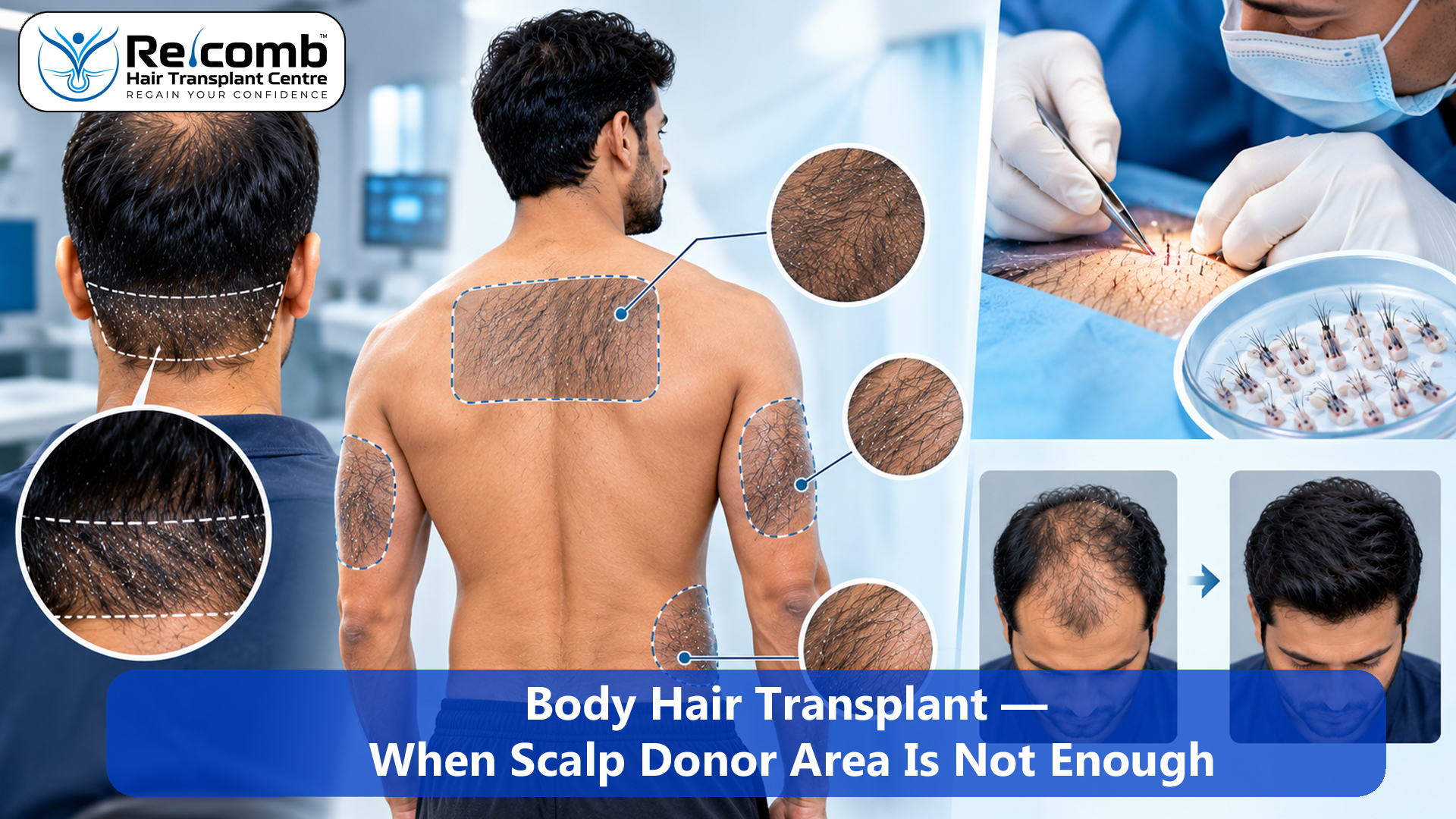
Can Body Hair Be Used?
In selected cases, body hair (beard or chest) may be used as an additional source.
However:
- It has different texture
- Growth cycle differs
- Limited cosmetic use
It is considered a supplementary option, not a primary solution.
Importance of Long-Term Planning
A well-planned first surgery reduces the need for multiple procedures.
Good planning includes:
- Conservative hairline design
- Strategic graft distribution
- Predicting future hair loss
- Preserving donor for future use
Hair transplant is a long-term investment.
Who Needs Multiple Surgeries?
Patients more likely to need staged procedures:
- Advanced baldness (Grade 5–7)
- Young patients with ongoing hair loss
- Patients seeking higher density
RECOMB’s Long-Term Strategy (2026)
At RECOMB:
- Donor capacity is calculated scientifically
- Grafts are used conservatively
- Future hair loss is predicted
- Staged planning is done when required
The aim is to ensure that you never run out of donor hair prematurely.
Final Medical Takeaway
Most people can safely undergo:
- 1 to 2 hair transplant surgeries
- 3 in selected advanced cases
The real limit is not the number of surgeries—but the available donor grafts.
Proper planning ensures:
- Natural results
- Donor preservation
- Long-term satisfaction
Contact RECOMB Hair Transplant Centre
Phone: +91 7624008000
Website: www.recombhair.com