
The donor area plays the most critical role in determining the success and naturalness of a hair transplant. Whether you undergo FUE or Sapphire FUE, the outcome depends on the donor area's strength, density, and extraction method.
At Recomb Hair Transplant Centre, Surat, donor analysis is the first and most important step in planning any transplant. This ensures graft safety, natural density, and long-lasting results.
What Is the Donor Area?
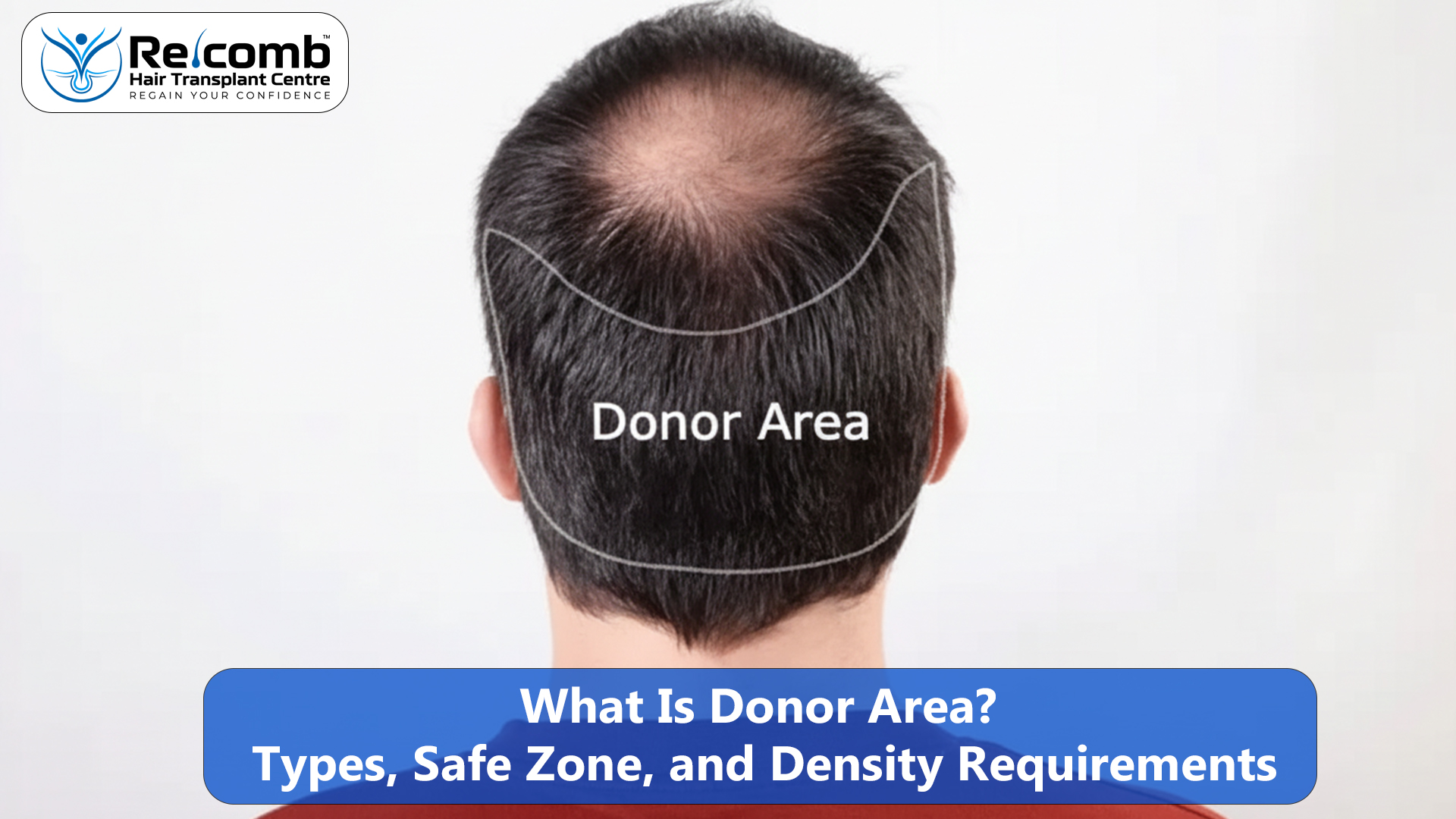
The donor area refers to regions of the scalp or body where hair follicles are genetically resistant to DHT (dihydrotestosterone). These hairs do not fall out even in advanced baldness, making them ideal for transplantation.
Main Characteristics
-
Permanent and genetically stable hair
-
Strong root structure
-
Low sensitivity to DHT
-
High survival rate when transplanted
Types of Donor Areas
1. Primary Scalp Donor Area
Located at the back and sides of the scalp. This is the most stable and reliable source for graft extraction.
2. Extended Scalp Donor Area
Used when more grafts are required due to advanced baldness (Grade 6–7). Includes slightly upper and lower regions beyond the safe zone.
3. Beard Donor Area
Resistant, thick, and ideal for adding volume in crown or mid-scalp.
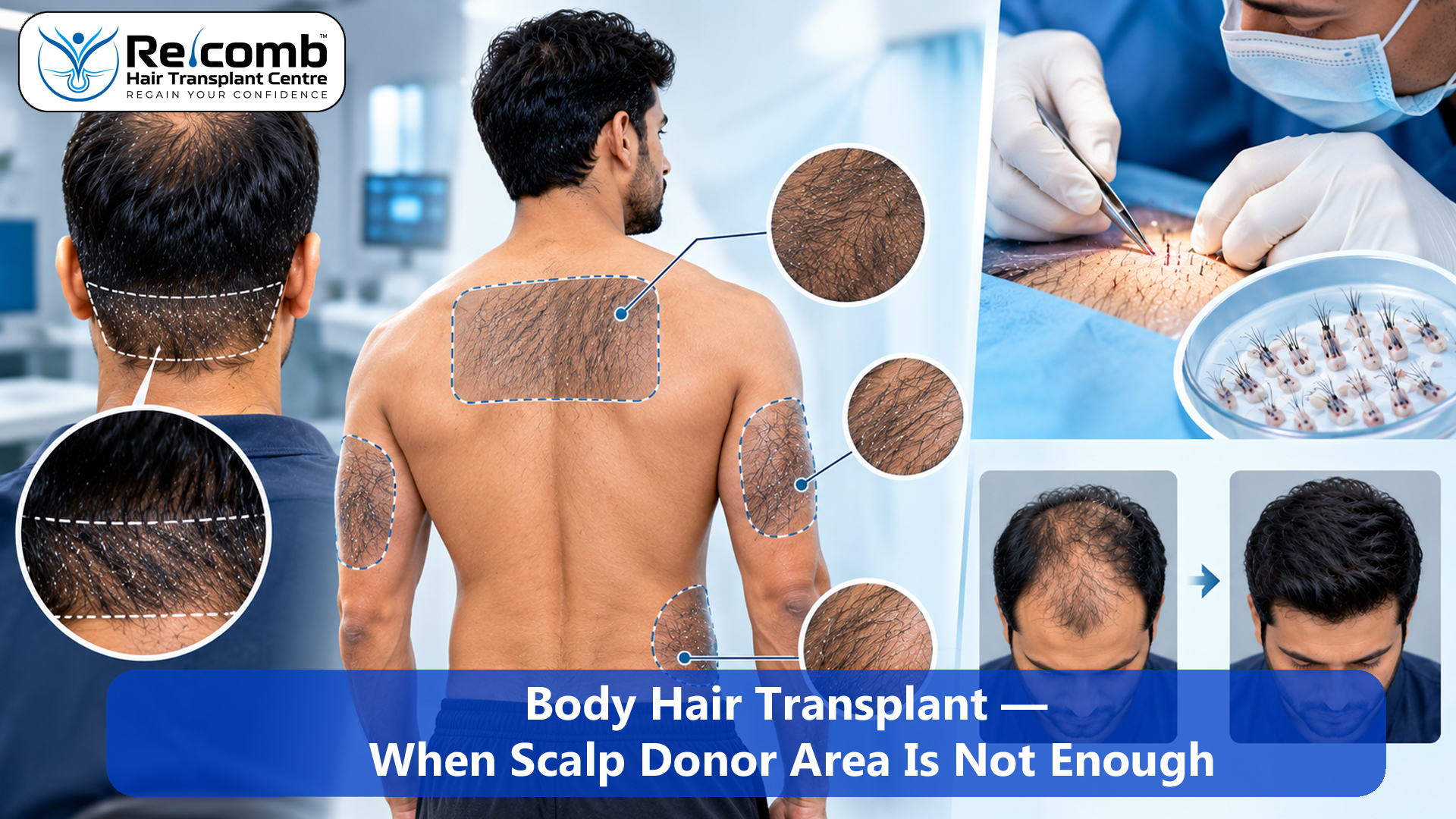
4. Body Donor Area
Used only when scalp donor is extremely limited. Includes chest and under-chin areas.
What Is the Safe Donor Zone?
The Safe Donor Zone (SDZ) is the region on the back of the scalp where hair follicles remain permanent for life, even in severe baldness (Norwood Grade 7).
Safe Zone Boundaries
-
Upper boundary: Below the occipital bone
-
Lower boundary: Above the nape hairline
-
Side boundaries: Between the ears, extending 4–5 cm above the ear line
This region provides the highest quality grafts for consistent, lifelong results.
At Recomb, grafts are extracted only from this safe zone to ensure long-term stability and prevent visible thinning.
Donor Density Requirements
Donor density determines how many grafts can be safely extracted without leaving visible gaps.
Normal Density
-
50–80 follicular units/cm²
Minimum Density Needed for Transplant
-
40 follicular units/cm²
Safe Extraction Limit
-
20–30% of the donor area can be extracted without affecting appearance.
Ideal Donor for High-Density Hairline
-
Thick hair shafts
-
High density (60+ grafts/cm²)
-
Low contrast with skin tone
How Many Grafts Can Be Taken From the Donor Area?
| Baldness Grade | Usable Grafts (Average) |
|---|---|
| Grade 3 | 1500–2500 |
| Grade 4 | 2500–3500 |
| Grade 5 | 3500–4500 |
| Grade 6–7 | 4500–6000 (with beard/body grafts) |
Graft count depends on density, scalp laxity, hair thickness, and technique used.
Donor Area in FUE vs Sapphire FUE
FUE
-
Uses steel punches
-
Extracts grafts with slightly wider incisions
-
Good for basic cases
Sapphire FUE
-
Uses sapphire blades with finer incisions
-
Better healing, less trauma
-
Higher graft survival
-
Ideal for high-density requirements
At Recomb, Sapphire FUE ensures smoother extraction, reduced scarring, and faster healing of the donor area.
Signs of a Healthy Donor Area
-
Uniform hair thickness
-
No miniaturization
-
High-density growth
-
No scarring or prior over-harvesting
-
Good elasticity
Contact Recomb Hair Transplant Centre
Phone: +91 7624008000
Website: www.recombhair.com