
Most patients who contact RECOMB for the first time have the same question underneath whatever specific query they send: what actually happens when I come in? They have read about hair transplants, researched treatments, seen before-and-after results. What they have not seen is what a first visit at a clinical hair restoration centre actually involves and what they will know by the end of it.
This blog answers that question directly. Not in general terms about what good clinics do, but specifically what happens when you book a hair analysis at RECOMB Surat, from the moment you make contact to the moment you leave the first consultation.
How to Book
Booking a first visit at RECOMB is straightforward. The most direct route is WhatsApp, where the team responds within 24 hours six days a week. Patients can also call directly or use the contact form on the website.
When you reach out, you will be asked for your name, a brief description of your hair loss concern, and your preferred appointment time. No medical history form, no photograph requirement, and no commitment to any treatment before the visit. The booking is for an assessment, not a procedure.
For patients travelling from Ahmedabad, Vadodara, Rajkot, or other cities, it helps to mention this at the time of booking so the consultation can be scheduled with adequate time and any preparatory guidance relevant to travel can be provided in advance.
WhatsApp: +91 7624008000
Website: www.recombhair.com
What Happens When You Arrive
RECOMB Hair Transplant Centre is located at 19, Ground Floor, Zenon Building, Opp. Unique Hospital, near Kiran Motors, Khatodara Wadi, Surat, Gujarat 395001. Parking is available in the vicinity.
When you arrive, you are not handed a form and left in a waiting room for twenty minutes. The consultation begins promptly with a structured intake that covers your hair loss timeline, the rate of progression you have observed, treatments you have already tried, family history on both maternal and paternal sides, medications, and any scalp symptoms that have accompanied the hair loss.
This intake is not a formality. It is the clinical history that shapes everything that follows in the examination. A detail in the history, such as hair loss beginning shortly after starting a medication, or accelerating significantly following a period of weight loss, changes the clinical picture and the investigation priorities entirely. Time spent on history is not time away from the assessment. It is the foundation of it.
The Scalp Analysis
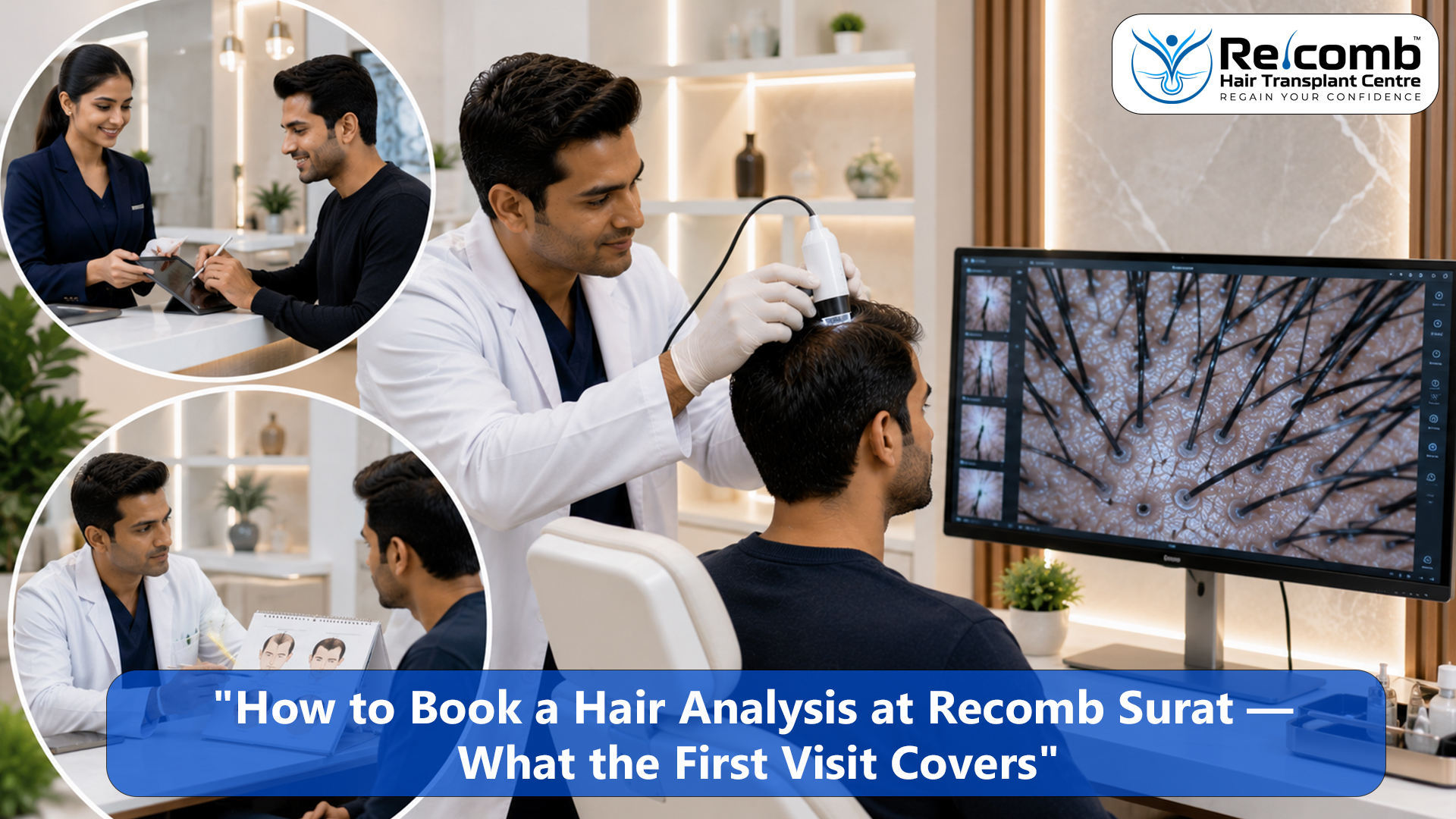
After the clinical history, the trichoscopy-based scalp analysis is performed. This is the component that most patients who have consulted elsewhere have never experienced.
A dermatoscope is used to examine the scalp at 10 to 70 times magnification across both the recipient zones, the areas where hair loss is visible, and the donor zone, the back and sides of the scalp where grafts would be sourced if surgery is eventually planned.
In the recipient zones, the examination identifies the degree and pattern of follicle miniaturisation, hair shaft diameter variation that confirms or excludes androgenetic alopecia, the proportion of follicles in active versus resting phases, any perifollicular inflammation, and early signs of scarring conditions that would significantly change the treatment approach.
In the donor zone, follicular unit density per square centimetre is measured along with average hair count per follicular unit. This measurement is the foundation of any graft plan and cannot be estimated from visual inspection alone. A donor zone that looks full may have lower measured density than expected. One that appears average may have superior density that allows a more ambitious plan. Without this measurement, any graft recommendation is a commercial estimate rather than a clinical calculation.
The scalp surface condition is assessed across both zones for seborrheic scaling, follicular plugging from hard water mineral deposits or product buildup, barrier disruption, or any active dermatological condition requiring treatment before any restorative intervention begins.
Staging and Projection
Using the trichoscopy findings and clinical history, the current extent of hair loss is formally staged using the Norwood scale for men or the Ludwig scale for women. This is not a rough categorisation. It involves mapping the specific boundaries of recession and thinning in each zone to establish a precise current baseline.
Combined with the family history, the patient's age, and the rate of progression documented in the history, a projection is made of the likely trajectory over the next 10 to 20 years. This projection directly shapes every treatment decision. A 29-year-old at Norwood Grade 3 whose father reached Grade 6 is planned for differently than a 35-year-old at the same grade whose family history suggests a limited eventual pattern, even though their current presentation is identical.
Blood Investigation Guidance
Based on the scalp findings and clinical history, specific blood investigations are recommended where indicated. For most patients presenting with active ongoing hair loss, this includes serum ferritin, thyroid function tests, vitamin D, and a complete blood count. For patients with hormonal symptoms or specific clinical indications, additional panels are discussed.
If you have had blood investigations performed recently, bringing the results to the first visit allows this component to be addressed immediately rather than requiring a separate step. If investigations have not been done, you will leave the first visit with a specific, targeted blood test request that covers what the clinical picture has identified as relevant, not a generic panel.
The Treatment Discussion
After the examination and staging, the findings are discussed with you directly. This is not a sales presentation. It is a clinical debrief that covers what the scalp analysis found, what it means for your diagnosis, what the realistic treatment options are given your specific clinical picture, and what would not be appropriate for your case and why.
If surgery is appropriate, the discussion covers what a graft plan would look like for your specific donor density and recipient area, what the realistic density outcome would be given your hair characteristics, what the lifetime graft budget is, and how a staged approach would be structured if relevant. You leave with a specific graft number range, a zone allocation, and a cost estimate. Not a brochure.
If surgery is not yet appropriate, the discussion covers why, what the right first steps are, and when reassessment for surgical candidacy would be meaningful. Patients who are told they are not yet candidates at RECOMB leave with a clear understanding of what needs to happen before surgery serves their interest, not with a vague recommendation to think about it and come back.
If non-surgical treatment is the primary recommendation, the specific treatment or combination is explained with its clinical rationale, the expected timeline for results, and how response will be monitored and adjusted.
Book Your First Visit at RECOMB and Leave With Real Answers →
WhatsApp: +91 7624008000 | www.recombhair.com
What You Will Know by the End of the First Visit
This is the part most patients want to know before they book. By the end of the first consultation at RECOMB, you will have a specific answer to each of the following.
What type of hair loss you have and what is driving it, not a generalised statement about hair loss but a specific diagnosis based on trichoscopy findings and clinical history.
How advanced your hair loss is on a formal scale, and where it is likely to progress given your age, family history, and rate of change.
What your donor density is and what it means for your lifetime graft budget, including how many grafts you have available across a lifetime and what percentage any proposed procedure would use.
Whether you are a good surgical candidate right now, or whether preparation is needed before surgery serves your interest.
What a realistic treatment plan looks like for your specific case, including which treatments are indicated, in what sequence, with what timeline and expected outcomes.
What the estimated cost of the recommended treatment is, including the procedure if surgery is planned, with a clear explanation of what is included and what is not.
What happens next, whether that is a blood test referral, a mesotherapy course, a surgical booking, or a medical management prescription, with a specific next step rather than an open-ended recommendation to think about your options.
RECOMB's Approach (2026)
At RECOMB Hair Transplant Centre, Surat, the first visit is designed to give patients what no amount of online research can provide: a specific clinical picture of their own hair loss, their own donor capacity, and their own treatment options, derived from their own scalp rather than from generalised information.
Dr. Krishna Bhalala and Dr. Nilesh Kachhadiya personally conduct consultations. Patients do not see a coordinator or a junior team member for the clinical assessment. The doctors who would operate are the doctors who assess. The plan discussed at the first visit is the plan that will be executed, not a handoff to a different team at a different stage.
The first visit takes the time it needs to take. It is not compressed to fit a booking schedule that accommodates volume at the expense of thoroughness. Patients from outside Surat are particularly encouraged to contact via WhatsApp before travelling so the visit can be planned with appropriate time.
Final Takeaway
A first visit at RECOMB is not a sales consultation. It is a clinical assessment that produces a specific, individually derived picture of your hair loss, your treatment options, and your realistic outcomes. You are not being prepared to buy a procedure. You are being given the information you need to make the right decision, whatever that decision turns out to be.
If you have been researching hair loss treatment in Surat or Gujarat and have not yet had a proper scalp analysis, this is the visit that gives you the clinical foundation every subsequent decision should rest on.
Dr. Krishna Bhalala and Dr. Nilesh Kachhadiya conduct a limited number of personal consultations each week. Slots are limited and fill consistently. If you are ready to get a specific clinical picture of your hair loss rather than more generalised information, the next step is straightforward.
Book Your Hair Analysis at RECOMB Surat Today →
WhatsApp: +91 7624008000
We respond within 24 hours, 6 days a week.
www.recombhair.com
Contact RECOMB Hair Transplant Centre
RECOMB Hair Transplant Centre
19, Ground Floor, Zenon Building, Opp. Unique Hospital, near Kiran Motors, Khatodara Wadi, Surat, Gujarat 395001
Phone: +91 7624008000
Website: www.recombhair.com