
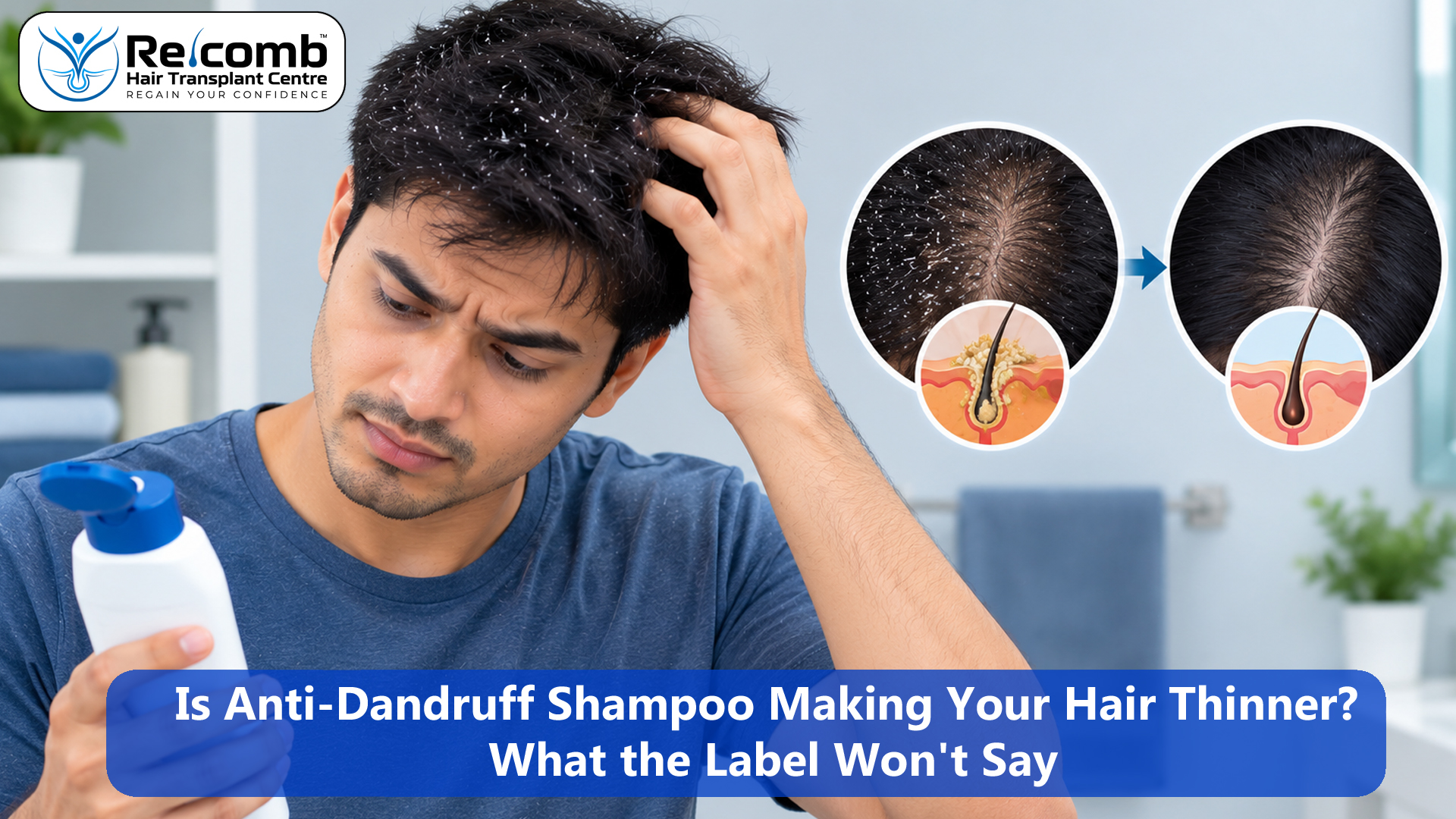
Many patients notice the same pattern. They start using an anti-dandruff shampoo, the flaking improves, but the hair seems to be thinning. The natural conclusion is that the shampoo is the cause.
The clinical answer is more specific. Anti-dandruff shampoos rarely cause true hair loss on their own. But the way they are used, and the condition they are used for, can both contribute to thinning. This blog explains which is which.
If you have dandruff and hair thinning together, a scalp analysis at RECOMB will show which problem is driving which.
Book a Scalp Assessment at RECOMB, Surat →
WhatsApp: +91 7624008000 | www.recombhair.com
What Anti-Dandruff Shampoos Actually Contain
Most anti-dandruff shampoos rely on one of five active ingredients.
Ketoconazole and zinc pyrithione are antifungals that reduce Malassezia, the yeast that drives dandruff. Selenium sulphide slows skin cell turnover and also has antifungal action. Salicylic acid loosens and removes scale. Coal tar slows cell turnover but is more irritating.
Of these, ketoconazole has the strongest evidence of benefit for the scalp and may even offer a modest supportive effect in androgenetic alopecia. None of the active ingredients is known to damage follicles when used as directed.
How a Dandruff Shampoo Can Still Contribute to Thinning
The problem is rarely the active ingredient. It is usually one of three things.
First, overuse and the wrong frequency. Using a medicated shampoo daily when twice weekly is enough can dry the scalp, disrupt its barrier, and cause irritation. An irritated scalp sheds more and flakes more, which looks like the dandruff is getting worse.
Second, the base formula. Many budget anti-dandruff shampoos use strong sulphate cleansers that strip the scalp’s protective lipids. Selenium sulphide and coal tar products can also dry the hair shaft, making it brittle and prone to breakage. Breakage in the brush looks like hair fall but is shaft damage, not follicle loss.
Third, hard water. In Surat, mineral deposits combine with harsh surfactants and leave residue on the scalp, which adds to dryness and irritation.
The More Common Explanation: The Dandruff Itself
Often the shampoo is a bystander. Active seborrheic dermatitis causes perifollicular inflammation that shortens the growth phase. In someone with androgenetic alopecia, this inflammation can speed up visible thinning.
So the patient may notice thinning after starting a shampoo simply because the underlying condition was already progressing. The shampoo got the blame for what the scalp disease and the genetics were doing.
Another common scenario is mistaken diagnosis. Dry scalp flaking looks like dandruff but is a different condition. An antifungal shampoo on a dry scalp can strip an already weak barrier and make shedding worse.
How to Use Anti-Dandruff Shampoo Safely
A few clinical rules reduce the risk without giving up treatment.
Use a medicated shampoo two to three times a week during active flaking, then taper to once a week for maintenance. On other days, use a gentle, sulphate-free shampoo.
Apply it to the scalp, leave it for three to five minutes, then rinse well. The contact time matters more than daily use.
Do not use it on the hair length. Focus on the scalp, and use a conditioner on the lengths.
If the scalp feels tight, itchy, or more flaky after two to three weeks, stop and get the scalp examined rather than switching products repeatedly.
In Surat, a shower filter and a weekly chelating wash help reduce mineral residue.
Get the Right Shampoo Plan for Your Scalp Type at RECOMB →
WhatsApp: +91 7624008000 | www.recombhair.com
When Thinning Needs More Than a Shampoo Change
If thinning continues after the dandruff is controlled, the likely cause is not the shampoo. Persistent hair loss in a recognisable pattern, finer shed hairs, or thinning that continues for more than three months needs trichoscopy, and often blood investigations, to check for androgenetic alopecia, telogen effluvium, or nutritional and thyroid causes.
Stopping the dandruff treatment is not the answer. Untreated seborrheic dermatitis adds to the inflammation that worsens hair loss.
RECOMB’s Approach (2026)
At RECOMB Hair Transplant Centre, Surat, dandruff and hair loss are assessed together. Trichoscopy distinguishes seborrheic dermatitis from dry scalp, shows whether miniaturisation is present, and identifies barrier damage from products or hard water.
Dr. Krishna Bhalala’s dermatology background means the scalp condition is treated as part of the hair plan. Shampoo advice follows the findings, not a generic product list.
Final Takeaway
Anti-dandruff shampoos do not usually cause permanent hair thinning. Overuse, harsh bases, hard water, a wrong diagnosis, and the underlying dandruff can all make thinning look worse, which is why the answer is the right diagnosis and the right frequency, not simply a different bottle.
Dr. Krishna Bhalala and Dr. Nilesh Kachhadiya conduct a limited number of personal consultations each week at RECOMB, Surat. If your dandruff and thinning are happening together, this is where the cause is identified.
Find Out What Is Really Thinning Your Hair at RECOMB →
WhatsApp: +91 7624008000
We respond within 24 hours, 6 days a week.
www.recombhair.com
Contact RECOMB Hair Transplant Centre
RECOMB Hair Transplant Centre
19, Ground Floor, Zenon Building, Opp. Unique Hospital, near Kiran Motors, Khatodara Wadi, Surat, Gujarat 395001
Phone: +91 7624008000
Website: www.recombhair.com