
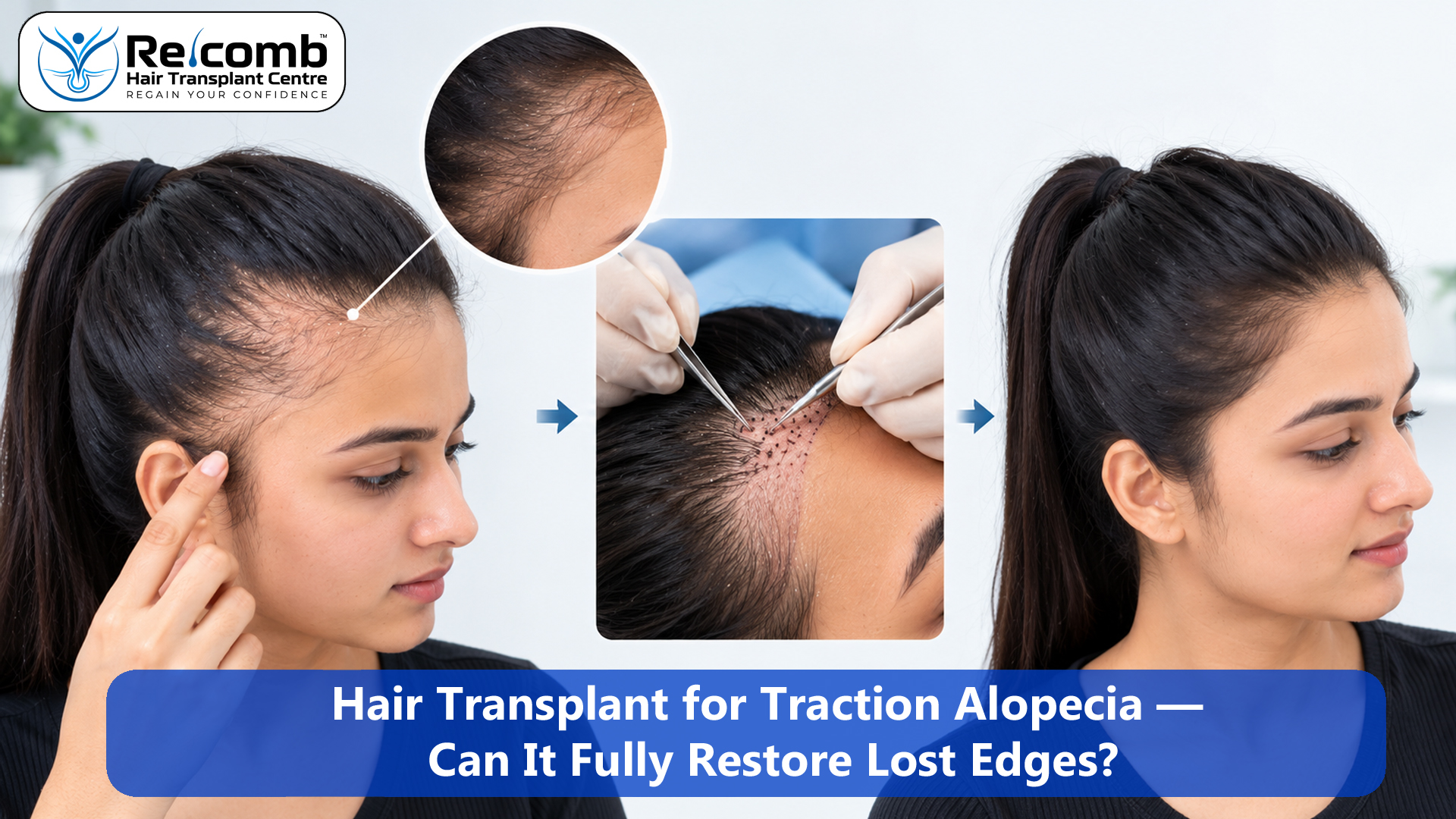
Traction alopecia is hair loss caused by years of constant pulling on the hair, from tight ponytails, braids, buns, hair extensions, or heavy head coverings. It usually shows up along the hairline, at the temples and sides, which is why patients often describe it as losing their edges.
The question patients ask is direct: if the hair is gone, can a transplant bring it back? The honest answer is that it often can, but only when the condition is at the right stage and the cause has been removed. This blog explains when a transplant works, when it does not, and what a realistic result looks like.
If you have thinning or lost edges from tight hairstyles, a scalp assessment at RECOMB will show whether the loss is still reversible or already permanent.
Book a Hairline Assessment at RECOMB, Surat →
WhatsApp: +91 7624008000 | www.recombhair.com
Early Traction Alopecia Is Reversible Without Surgery
In the early stage, the follicles are stressed and inflamed but not destroyed. Hair is thinner, there may be small bumps or tenderness along the hairline, and the pull test is positive. At this point, stopping the traction allows the follicles to recover, and hair often regrows within six to twelve months.
This is why surgery is never the first step. A transplant placed into a scalp that is still being pulled will fail in the same way the original hair did. Early cases need the hairstyle changed, the scalp inflammation treated, and time.
When Traction Alopecia Becomes Permanent
With years of sustained pulling, chronic inflammation around the follicle leads to scarring. Under trichoscopy, the follicle openings disappear and the skin looks smooth and shiny. Once follicles are replaced by scar tissue, they cannot regrow on their own, and no medicine or shampoo will bring them back.
This is the stage where a hair transplant becomes the only way to restore hair. It is also the stage where careful assessment matters most.
When a Transplant Works Well
A hair transplant is a good option when the following conditions are met.
The traction has stopped. The patient has permanently changed the hairstyle or practice that caused the loss, at least for the transplanted zone. Without this, the new grafts are at risk.
The disease is inactive. There should be no ongoing inflammation, and the hairline should have been stable for at least 6 to 12 months. A pull test and trichoscopy confirm this.
The donor area is healthy. Because traction alopecia is not driven by DHT, the donor area is usually intact, and the grafts are not at risk of the genetic hair loss that affects the frontal scalp in other patients.
The scarred skin can support grafts. Scarred tissue has a weaker blood supply. A surgeon may use lower density in the first session and place grafts more gently so survival remains acceptable.
What Is Different About This Type of Transplant
Restoring traction alopecia is technically different from a standard hairline transplant.
The hairline is usually not receding in a pattern. It is irregular, with patches of loss along the sides and temples. The surgeon rebuilds the natural edge, using fine single-hair grafts and the correct direction of growth for each area.
Survival in scarred skin can be lower than in healthy skin. Some surgeons plan a staged approach, placing grafts at moderate density first and adding more in a second session once the scalp has healed.
Chemically treated hair, extensions, and tight styles are the most common reason for repeat damage. The post-operative plan must include a clear instruction on hairstyle, because the transplanted hair can be pulled out in the same way as the original.
What a Realistic Result Looks Like
For the right patient, a transplant can restore a natural-looking hairline edge with soft, fine hair that blends with the surrounding hair. In most cases the result is clearly visible at 9 to 12 months.
Full density equal to untouched hair is not always possible in scarred areas. A first session often gives a clear improvement, and some patients benefit from a second session. The edge will always depend on how the patient treats the hairline in the future.
A transplant also does not replace the need to protect the hairline. Patients who return to very tight styles may lose the transplanted hair again.
Book a Candidacy Assessment for Traction Alopecia at RECOMB →
WhatsApp: +91 7624008000 | www.recombhair.com
RECOMB’s Approach (2026)
At RECOMB Hair Transplant Centre, Surat, every patient with suspected traction alopecia receives trichoscopy to confirm whether the follicles are still alive, inflamed, or scarred. Dr. Krishna Bhalala and Dr. Nilesh Kachhadiya do not recommend surgery for early, reversible cases, and do not operate while the traction is continuing.
For suitable patients with permanent loss, the plan uses conservative density, careful single-hair grafting at the edge, and a clear hairstyle and maintenance plan to protect the result.
Final Takeaway
Traction alopecia is reversible in its early stage and permanent in its late stage. A hair transplant can restore lost edges once the loss is permanent, the disease is inactive, and the traction has stopped. The result is natural and lasting only if the cause is removed.
Dr. Krishna Bhalala and Dr. Nilesh Kachhadiya conduct a limited number of personal consultations each week at RECOMB, Surat. If your hairline edges have thinned from tight hairstyles, this is where you find out whether they can still recover or need restoration.
Find Out If Your Lost Edges Can Be Restored at RECOMB →
WhatsApp: +91 7624008000
We respond within 24 hours, 6 days a week.
www.recombhair.com
Contact RECOMB Hair Transplant Centre
RECOMB Hair Transplant Centre
19, Ground Floor, Zenon Building, Opp. Unique Hospital, near Kiran Motors, Khatodara Wadi, Surat, Gujarat 395001
Phone: +91 7624008000
Website: www.recombhair.com