
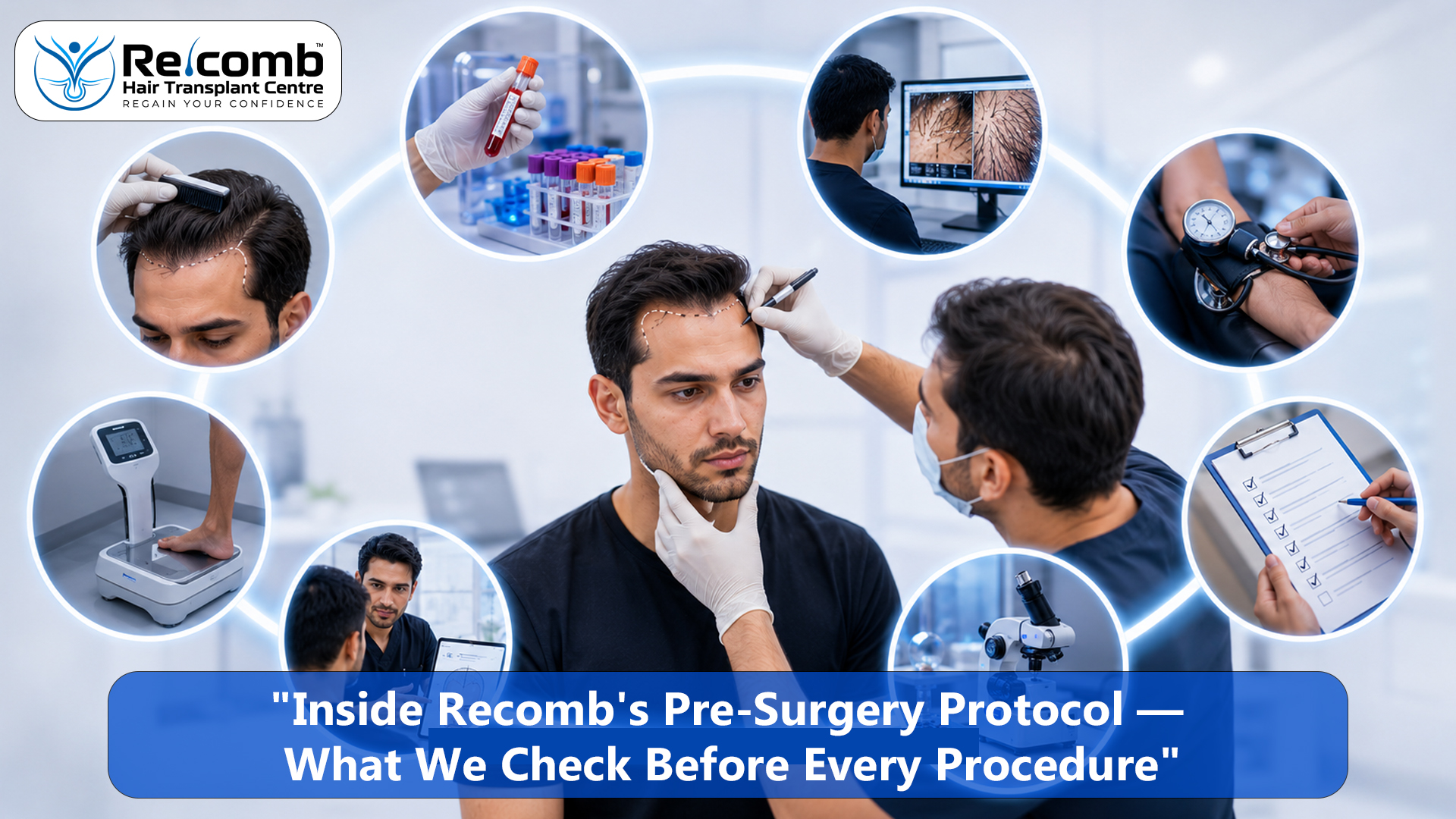
Patients researching hair transplant clinics typically focus on the procedure itself: the technique used, the graft count, the price. Very few ask what happens before the procedure date is even set, and this is precisely where the outcome of a hair transplant is largely determined.
A poorly assessed patient who undergoes a technically competent procedure can still end up with a disappointing result, because the wrong graft count was planned, an undiagnosed medical condition affected healing, or the hairline was designed without accounting for future progression. The pre-surgical protocol is not a formality before the real work begins. It is the foundation the real work depends on.
This blog details exactly what RECOMB checks before confirming any procedure, so patients understand what a thorough assessment actually involves and can use this as a benchmark when evaluating any clinic.
If you want to go through this exact assessment process for your own case, a consultation at RECOMB is the place to start.
Book a Complete Pre-Surgical Assessment at RECOMB, Surat →
WhatsApp: +91 7624008000 | www.recombhair.com
Step 1: Detailed Clinical History
Before any physical examination begins, a structured history establishes the context for everything that follows.
This covers the timeline of hair loss, specifically when it was first noticed, how it has progressed over months and years, and whether the rate of loss has been steady or has accelerated at any point. A patient who lost hair gradually over eight years presents a different clinical picture than one who lost the same amount of hair in eighteen months.
Family history is documented on both the maternal and paternal sides, since androgenetic alopecia is inherited from both lineages, not solely through the maternal grandfather as commonly believed. The pattern and extent of hair loss in close relatives, and the age at which it became significant, helps project the patient's own likely trajectory.
Medical history is reviewed for conditions that affect hair growth or surgical candidacy, including thyroid disorders, diabetes, autoimmune conditions, bleeding disorders, and any history of keloid scarring, which affects both donor area healing and recipient site outcomes.
Current medications are reviewed specifically for those known to cause or contribute to hair loss, including certain blood pressure medications, retinoids, and some antidepressants, as well as blood thinners that affect surgical planning and recovery.
Previous hair loss treatments are documented, including any past use of finasteride, minoxidil, PRP, or previous transplant procedures elsewhere, since prior procedures directly affect donor area assessment and surgical planning.
Step 2: Trichoscopy
Trichoscopy is a magnified examination of the scalp and individual hair follicles using a dermatoscope, and it provides information that cannot be obtained through visual inspection alone.
In the recipient zones, trichoscopy identifies the degree of follicular miniaturisation present, showing variation in hair shaft diameter that confirms androgenetic alopecia and indicates how advanced the process is in each specific area. This distinguishes follicles that are still active but thinning from those that have effectively stopped producing hair, information that directly affects whether medical management alone might still be effective in certain zones or whether surgical restoration is the only remaining option.
In the donor zone, trichoscopy measures follicular unit density per square centimetre, the average number of hairs per follicular unit, and assesses whether the donor zone itself shows any signs of thinning, which can occur in certain diffuse hair loss patterns and would significantly affect the lifetime graft budget calculation.
Trichoscopy also identifies any scalp conditions present, including seborrheic dermatitis, early scarring processes, or signs of inflammatory conditions that would need to be addressed before any surgical procedure, since operating on an inflamed or actively diseased scalp compromises both safety and outcome.
Step 3: Norwood or Ludwig Staging
Using the findings from history and trichoscopy, the current extent of hair loss is formally staged using the Norwood scale for men or the Ludwig scale for women. This is not a casual visual assessment. It involves mapping the specific boundaries of recession at the frontal hairline, the temples, the midscalp, and the crown, documenting precisely which areas are affected and to what degree.
This staging serves two purposes. It establishes the current baseline against which any future change can be measured, and it forms the basis for projecting where the loss is likely to progress given the patient's age, family history, and progression rate documented in the history.
Step 4: Donor Area Density and Safe Zone Mapping
The donor area assessment goes beyond the density measurement taken during trichoscopy. The full extent of the safe donor zone is mapped on the patient's scalp, identifying the boundaries within which extraction can occur without risking the harvest of follicles that are not genetically resistant to DHT.
This safe zone varies between patients based on the pattern and likely future extent of their hair loss. A patient whose family history suggests likely progression to Norwood Grade 6 or 7 has a narrower safe donor zone than one whose pattern is likely to remain limited to Grade 3 or 4, because the boundary of permanent, resistant hair sits differently for different eventual loss patterns.
Scalp laxity, the looseness or tightness of the scalp skin, is also assessed at this stage, since this affects how comfortably grafts can be extracted and how the donor area heals.
Step 5: Blood Investigations
For patients presenting with hair loss, baseline blood investigations are recommended to identify any contributing or confounding factors before treatment is planned.
This typically includes a complete blood count, serum ferritin to assess iron stores, thyroid function tests including TSH, vitamin D levels, and where clinically indicated, a hormonal panel. These investigations identify nutritional deficiencies or medical conditions that may be contributing to hair loss independently of, or alongside, androgenetic alopecia.
For patients proceeding to surgery specifically, additional pre-operative investigations are conducted to confirm surgical fitness, including assessment of bleeding and clotting parameters and screening for any condition that would affect anaesthesia or healing.
Correcting an identified deficiency before surgery, such as a significant ferritin deficiency, improves the patient's baseline scalp health and can improve graft survival and healing outcomes.
Step 6: Hair Characteristics Assessment
The physical characteristics of the patient's hair are documented, including shaft diameter, degree of curl or waviness, and the contrast between hair colour and scalp skin tone. These characteristics directly affect the graft plan, since the same number of grafts produces different visual density depending on these factors. A patient with thick, dark, straight hair and high colour contrast with their scalp requires fewer grafts per square centimetre to achieve a satisfying visual density than a patient with fine, light-coloured hair.
Step 7: Future Progression Projection
Combining the staging, family history, age, and progression rate, a projection is made of the patient's likely hair loss trajectory over the next 10 to 20 years. This is not a precise prediction, since individual progression varies, but it provides a clinically reasonable estimate that directly informs how conservatively the current procedure should be planned and how much donor budget should be reserved for future sessions.
Step 8: Lifetime Graft Budget Calculation
Using the donor density measurement, the safe zone mapping, and the future progression projection, an estimated lifetime graft budget is calculated for the patient. This number represents the realistic total grafts available across the patient's lifetime accounting for their specific donor characteristics and projected need.
This budget is then allocated across the planned current procedure and any anticipated future sessions, ensuring that grafts are not over-committed to the current session at the expense of areas likely to need coverage later.
Step 9: Hairline and Zone Design
With all clinical information gathered, the specific hairline position, zone priorities, and graft type distribution are designed for the individual patient. This includes the exact hairline shape and position accounting for facial structure and projected ageing, the sequencing of frontal, midscalp, and crown coverage if multiple zones are involved, and the specific follicular unit type allocation by zone.
This design is discussed in detail with the patient, including the clinical reasoning behind the hairline position and any recommendation to be more conservative than the patient's initial preference.
Step 10: Suitability Determination
The final step of the protocol is an honest determination of whether surgery is the right recommendation for this patient at this time. This is not assumed at the outset of the consultation. It is the conclusion drawn from everything assessed above.
Patients for whom surgery is not yet appropriate, due to unstable active loss, insufficient donor capacity relative to need, unaddressed medical conditions, or unrealistic expectations relative to what the donor area can deliver, are told this directly along with a clear explanation of what should happen instead and when reassessment would be appropriate.
Why This Protocol Exists
Every step in this protocol exists because skipping it has a specific, documented consequence. Skipping trichoscopy means operating without knowing the true extent of follicular miniaturisation. Skipping blood investigations means missing a correctable medical contributor to the patient's hair loss. Skipping future progression projection means designing a hairline or graft plan that looks complete today and inadequate in a decade. Skipping the lifetime graft budget calculation means risking donor depletion before the patient's hair loss has finished progressing.
A clinic that moves directly from a brief visual assessment to a graft quote and a surgery date has skipped most or all of these steps. The result of that shortcut is not always immediately visible. It often becomes apparent only years later, when the donor area cannot support a needed second session, or the hairline looks inappropriate for the patient's now older face.
RECOMB's Approach (2026)
At RECOMB Hair Transplant Centre, Surat, this ten-step protocol is completed for every patient before any procedure date is confirmed. Dr. Krishna Bhalala and Dr. Nilesh Kachhadiya personally conduct this assessment, bringing complementary clinical perspectives, dermatological expertise in follicle biology and medical management, and surgical expertise in technical planning and execution, to every patient's evaluation.
Patients leave their initial consultation with a complete picture: their current stage, their projected trajectory, their lifetime graft budget, their specific surgical plan if surgery is recommended, and a transparent explanation if it is not yet the right time.
See What a Complete Assessment Looks Like for Your Case →
WhatsApp: +91 7624008000 | www.recombhair.com
Final Takeaway
The quality of a hair transplant result is determined long before the first graft is extracted. It is determined in the thoroughness of the assessment that precedes it: the history taken, the trichoscopy performed, the blood work reviewed, the staging documented, the donor budget calculated, and the honest determination of whether surgery is actually the right next step.
A patient who has gone through a protocol like this understands their own case in detail and can evaluate any treatment recommendation against what they now know about their own hair loss pattern and donor capacity. This is the standard every patient should expect, and the standard worth asking about directly before committing to any clinic.
Dr. Krishna Bhalala and Dr. Nilesh Kachhadiya conduct a limited number of personal consultations each week at RECOMB, Surat. If you want this complete assessment for your own case before making any decision, this is where it starts.
Start With a Complete Clinical Assessment, Not a Quote →
WhatsApp: +91 7624008000
We respond within 24 hours, 6 days a week.
www.recombhair.com
Contact:
RECOMB Hair Transplant Centre
Phone: +91 7624008000
Website: www.recombhair.com