
Patients in Surat who complain of dry, brittle hair, persistent scalp irritation, and hair fall that does not respond to standard treatments are often surprised when the conversation turns to their water supply. Hard water is not a topic that features prominently in most hair loss consultations, yet for patients in Surat it is a contributing factor in a meaningful proportion of scalp and hair complaints that present at the clinic.
This blog explains what hard water actually does to the scalp and hair at a biological level, how it interacts with other hair loss conditions to worsen outcomes, and what interventions have genuine clinical rationale for patients in Surat's water environment.
If you have ongoing scalp or hair concerns that have not responded adequately to treatments you have tried, and you have not considered the role of water quality in your case, a consultation at RECOMB includes scalp assessment that evaluates this dimension specifically.
Book a Scalp and Hair Assessment at RECOMB, Surat →
WhatsApp: +91 7624008000 | www.recombhair.com
What Hard Water Actually Is
Water hardness is determined by the concentration of dissolved minerals, primarily calcium and magnesium ions, that water picks up as it passes through geological formations before reaching the supply network. In Surat and across much of Gujarat, the water supply draws from sources including the Tapi river and local groundwater, both of which pass through limestone and mineral-rich geology that produces water with elevated calcium and magnesium content.
Hard water is measured in milligrams per litre of calcium carbonate equivalent. Water below 60 mg/L is considered soft. Water between 60 and 120 mg/L is moderately hard. Water above 180 mg/L is considered very hard. In many areas of Surat, measurements fall in the moderately to very hard range, meaning residents are washing their hair and scalp with water that carries a significant mineral load with every exposure.
Chlorine, added during municipal water treatment to control microbial contamination, is an additional chemical present in Surat's tap water. Its concentration is regulated but sufficient to affect scalp skin barrier function over cumulative exposure, particularly in patients who wash their hair daily.
What Hard Water Does to the Hair Shaft
The hair shaft, despite appearing solid and inert, has a complex surface structure. The outermost layer, called the cuticle, consists of overlapping scale-like cells that lie flat when the hair is healthy, creating a smooth surface that reflects light, retains moisture within the shaft, and protects the inner structural proteins from environmental damage.
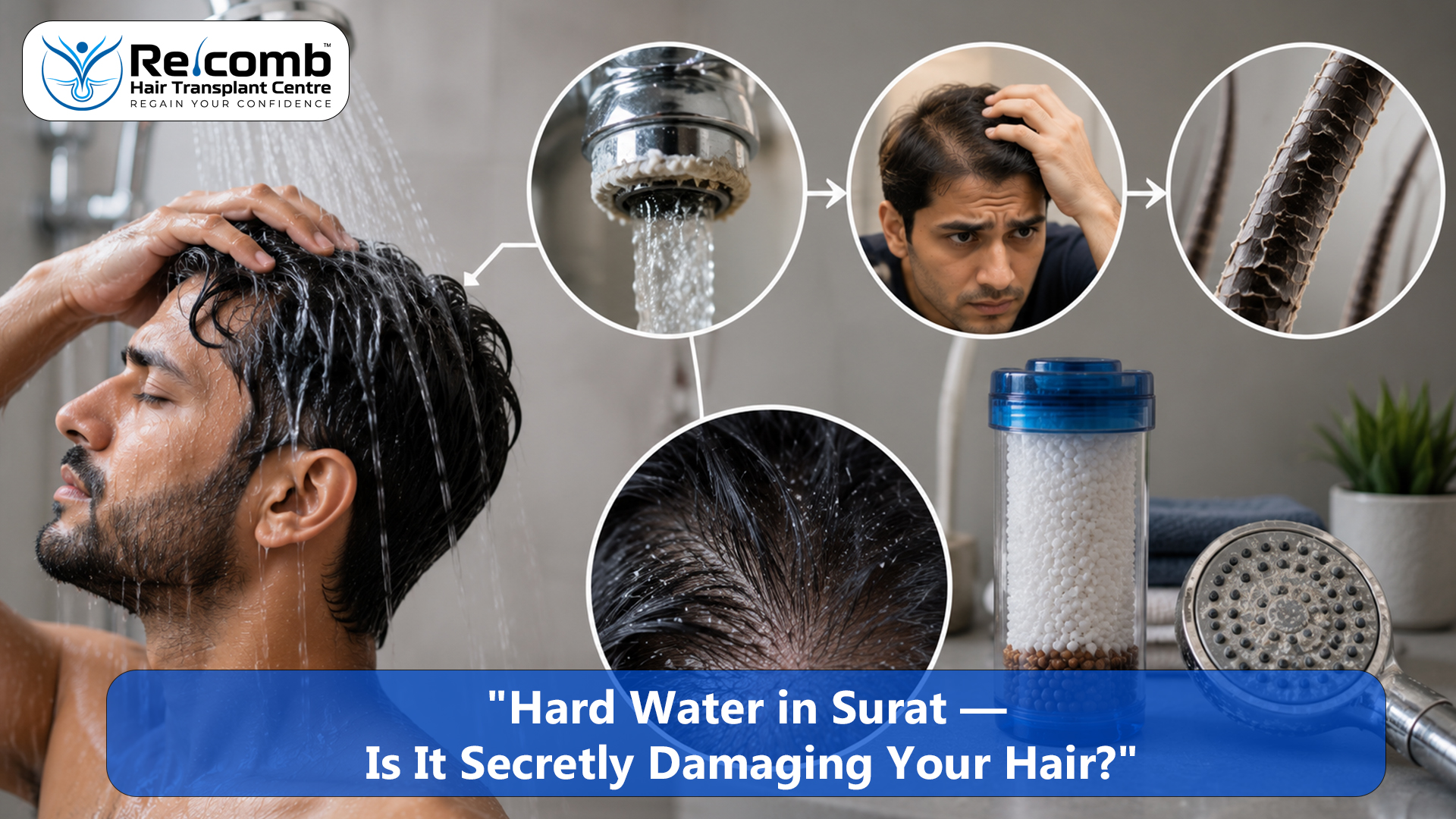
When hard water contacts the hair shaft, calcium and magnesium ions bind to the negatively charged cuticle surface and to the proteins within the shaft. This mineral binding disrupts the cuticle scale alignment, causing the scales to lift rather than lie flat. The result is hair that feels rough and dry to the touch, loses its natural shine, and is significantly more prone to friction-related breakage.
This cuticle disruption also reduces the hair shaft's ability to retain moisture. A hair shaft with lifted cuticles loses water more rapidly to the environment, producing the dry, brittle texture that many Surat patients describe as worsening during summer and improving, partially, during the monsoon when ambient humidity is higher.
Over time, mineral accumulation within the hair shaft increases shaft rigidity and fragility. Hairs in this state break more easily at the shaft rather than shedding at the root, which means the breakage is often not associated with the follicle but is counted in the shower drain or pillow alongside genuine shedding hairs, causing patients to overestimate their true hair loss rate.
What Hard Water Does to the Scalp
The scalp consequences of hard water exposure are clinically more significant than the hair shaft effects because they affect the follicular environment directly.
Calcium and magnesium deposits accumulate on the scalp surface with repeated hard water washing. These mineral deposits create a physical barrier on the skin surface that interferes with the natural scalp barrier function, reduces the effectiveness of shampoos and conditioners by preventing their active components from reaching the scalp tissue, and creates a mineral film over follicle openings that contributes to follicular plugging.
Follicular plugging from mineral accumulation reduces the oxygen availability within the follicle micro-environment and creates a substrate for microbial overgrowth, particularly Malassezia, the fungus responsible for seborrheic dermatitis. Patients with a genetic predisposition to oily scalp find that hard water worsens their seborrheic dermatitis significantly because the mineral deposits combined with excess sebum create a more favourable environment for Malassezia than either factor alone.
The disruption of the scalp skin barrier by mineral deposits increases transepidermal water loss from the scalp surface and sub-surface tissue, creating a chronically dehydrated scalp environment even in patients who drink adequate water. This dehydration affects the dermal papilla environment around each follicle, reducing the optimal conditions for follicle cycling and contributing to premature entry into the resting phase.
Hard water also affects scalp pH. Healthy scalp skin is slightly acidic, with a pH of approximately 4.5 to 5.5. This acidity supports the skin microbiome, maintains cuticle scale alignment on individual hairs, and provides an unfavourable environment for pathogenic microorganisms. Hard water is alkaline, with a typical pH of 7 to 8.5. Repeated alkaline water exposure shifts the scalp pH upward, disrupting the microbiome balance, allowing pathogenic bacteria and Malassezia to proliferate more readily, and lifting hair cuticle scales.
How Hard Water Interacts With Existing Hair Loss Conditions
Hard water does not cause androgenetic alopecia. It does not produce pattern hair loss in patients who do not have a genetic predisposition to it. What it does is worsen every hair loss condition that already exists, acting as an accelerating factor rather than a primary cause.
In patients with androgenetic alopecia, the follicular inflammation and plugging caused by hard water mineral deposits add a secondary inflammatory load on top of the DHT-driven miniaturisation already in progress. Follicles that are already miniaturising due to androgenetic alopecia miniaturise faster in a chronically inflamed, poorly hydrated follicular environment.
In patients with seborrheic dermatitis, hard water worsens the scalp condition by enhancing Malassezia proliferation and creating mineral-sebum complexes that are more adherent to the scalp surface and harder to remove with standard shampooing.
In patients who have undergone a hair transplant, hard water exposure in the post-operative period affects both graft survival and healing. Mineral deposits on healing recipient sites can impede the normal wound healing process and increase the risk of folliculitis. This is why the post-operative washing protocol at RECOMB specifically addresses water quality for Surat patients.
In patients using topical minoxidil, hard water reduces the effectiveness of the treatment by interfering with its penetration through the mineral-loaded scalp surface. The medication is applied but cannot reach the follicular level efficiently when the scalp surface is coated with mineral deposits.
What Interventions Actually Help
The clinical rationale for interventions aimed at reducing hard water impact on hair and scalp is straightforward: reduce mineral exposure, restore scalp pH, and support barrier function.
Shower Filters
A shower filter specifically designed to reduce water hardness is the most impactful single intervention for patients in Surat with significant scalp concerns. Filters using ion exchange resin technology exchange calcium and magnesium ions for sodium or potassium ions, reducing water hardness at the point of use. Filters with activated carbon additionally remove chlorine.
The clinical benefit of shower filtration for hair and scalp health in hard water areas is supported by emerging evidence and consistent with the mechanisms described above. Patients who install shower filters frequently report improvement in hair texture, reduced scalp irritation, and reduced shedding within four to eight weeks of consistent use.
Shower filters require cartridge replacement every three to six months to maintain effectiveness. Their cost in India ranges from Rs 1,500 to Rs 6,000 for the unit and Rs 500 to Rs 1,500 for replacement cartridges, making them a relatively accessible intervention with a meaningful clinical rationale.
pH-Balanced and Chelating Shampoos
A chelating shampoo contains ingredients such as EDTA or citric acid that bind to and remove mineral deposits from the hair shaft and scalp surface. Used once weekly or fortnightly, chelating shampoos reduce the mineral accumulation between regular washes without the daily stripping effect that overuse would produce.
The daily shampoo should be sulphate-free with a slightly acidic formulation to counteract the alkaline shift produced by hard water exposure. This combination of a chelating treatment periodically and an acidic daily cleanser addresses both the mineral accumulation and the pH disruption simultaneously.
Scalp Acidification Rinse
A diluted apple cider vinegar rinse, typically one tablespoon in 250ml of water applied after shampooing and rinsed off after one to two minutes, is a simple, inexpensive intervention that restores scalp pH after alkaline hard water exposure. The acidity helps close lifted cuticles and counteracts the alkaline film left by hard water. This is not a substitute for other interventions but a useful addition for patients wanting low-cost scalp pH management.
Scalp Hydration and Barrier Support Through Mesotherapy
For patients with clinically significant scalp barrier disruption from hard water exposure, mesotherapy formulations containing hyaluronic acid and barrier-supporting nutrients delivered directly to the scalp tissue address the dehydration and barrier damage that topical interventions cannot reach. This is most relevant for patients where scalp analysis reveals significant barrier disruption alongside their other hair loss findings.
RECOMB's Approach (2026)
At RECOMB Hair Transplant Centre, Surat, hard water impact on scalp health is assessed as part of every new patient consultation. Dr. Krishna Bhalala's dermatological background means that the scalp condition examination specifically looks for the trichoscopic signs of mineral accumulation, barrier disruption, and hard water-related follicular plugging that distinguish this contributing factor from other scalp conditions with similar presentations.
For patients where hard water is identified as a significant contributing factor to their scalp and hair loss presentation, specific intervention recommendations are made as part of the treatment plan, not as an afterthought. This includes guidance on shower filtration, appropriate shampoo selection, and where clinically indicated, mesotherapy to address scalp barrier damage directly.
For patients planning or recovering from a hair transplant at RECOMB in Surat, specific water quality guidance for the post-operative washing protocol is provided, because the stakes of unmanaged mineral exposure during graft integration are higher than at any other point in the patient's hair restoration journey.
Final Takeaway
Hard water in Surat is a real and clinically relevant contributing factor to hair shaft damage, scalp barrier disruption, follicular plugging, and the worsening of existing hair loss conditions including androgenetic alopecia and seborrheic dermatitis. It is not the primary cause of pattern hair loss but it accelerates and compounds every hair loss process already in progress.
For patients in Surat who have tried standard hair loss treatments without adequate response, water quality is a variable worth specifically assessing before attributing treatment failure to other causes. A shower filter, an appropriate shampoo protocol, and where indicated mesotherapy for barrier support represent a clinically rational response to a locally specific problem that most clinic consultations never address.
Dr. Krishna Bhalala and Dr. Nilesh Kachhadiya conduct a limited number of personal consultations each week at RECOMB, Surat. If you want a scalp assessment that accounts for the specific environmental factors in Surat's water supply as part of your hair loss evaluation, this is where that conversation starts.
Get a Scalp Assessment That Accounts for Surat's Water Quality →
WhatsApp: +91 7624008000
We respond within 24 hours, 6 days a week.
www.recombhair.com
Contact RECOMB Hair Transplant Centre
RECOMB Hair Transplant Centre
19, Ground Floor, Zenon Building, Opp. Unique Hospital, near Kiran Motors, Khatodara Wadi, Surat, Gujarat 395001
Phone: +91 7624008000
Website: www.recombhair.com