
Scalp type is one of the most overlooked variables in hair loss conversations. Patients focus on the hair, the density, the hairline, the shedding rate, without considering that the scalp on which that hair grows is itself a clinical environment that directly influences follicle health.
An excessively oily scalp and a chronically dry scalp are not merely cosmetic inconveniences. Both create conditions at the follicular level that can accelerate hair loss, worsen androgenetic alopecia progression, and reduce the effectiveness of treatments that would otherwise work. Understanding which scalp type you have and what it means for your hair is a useful diagnostic step before committing to any treatment.
If you have ongoing hair fall alongside scalp concerns and want a clinical assessment of how your scalp condition is contributing to your hair loss, a consultation at RECOMB gives you a specific answer.
Book a Scalp and Hair Loss Assessment at RECOMB, Surat →
WhatsApp: +91 7624008000 | www.recombhair.com
How the Scalp Environment Affects Hair Follicles
The hair follicle does not exist in isolation. It sits within a skin environment that affects it at every stage of the hair growth cycle. The sebaceous glands attached to each follicle produce sebum, a natural oil that lubricates the hair shaft and protects the scalp surface. The balance of this sebum production, too much or too little, directly affects the follicle's operating environment.
The scalp also hosts a microbiome, a community of microorganisms including bacteria and fungi that exist in balance on healthy skin. When this balance is disrupted, whether by excess oil, dryness, environmental factors, or hormonal changes, the resulting inflammation at the follicular level can contribute meaningfully to hair loss, both directly and by worsening the effects of androgenetic alopecia.
The Oily Scalp: What Is Actually Happening
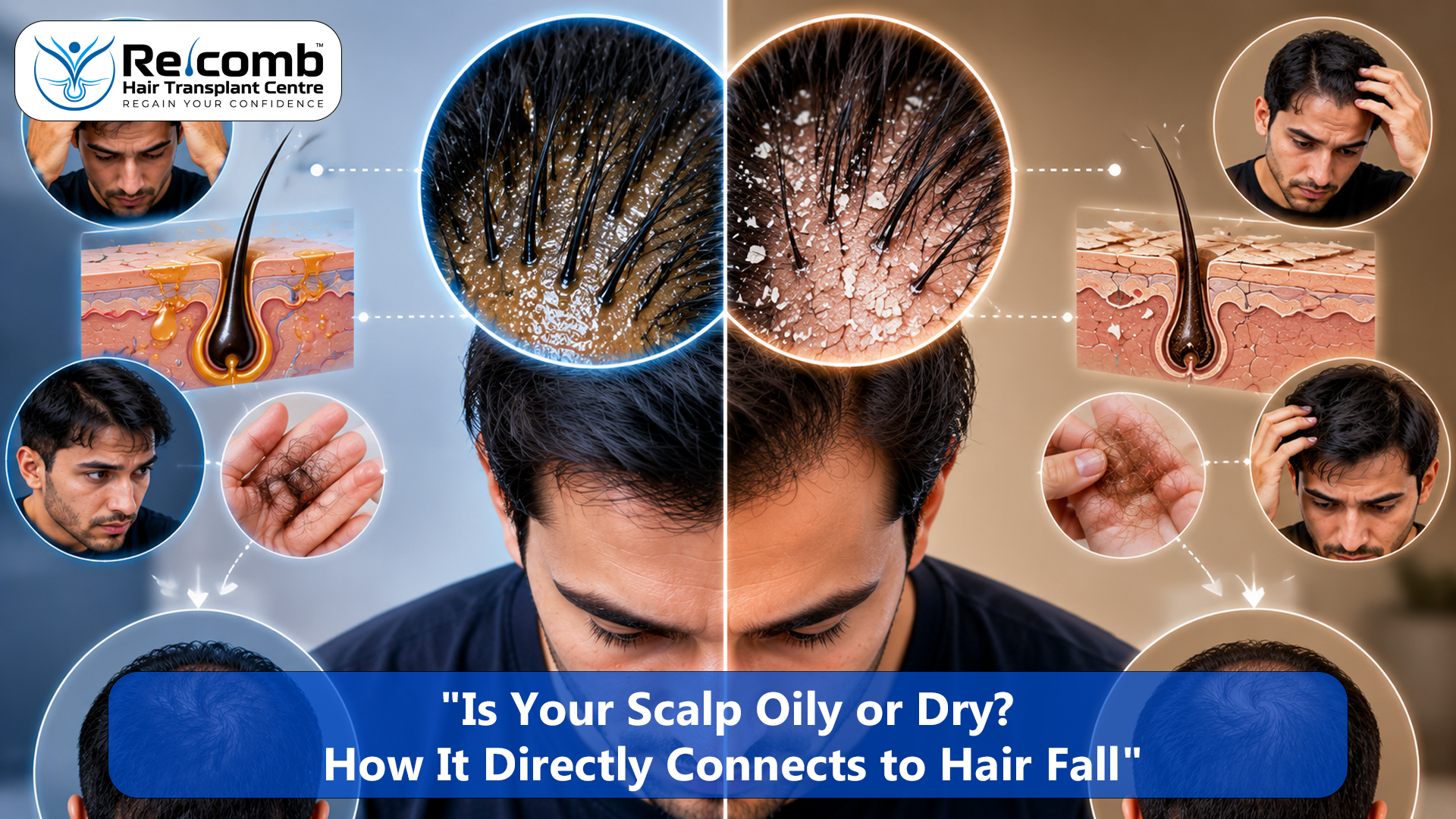
An oily scalp results from overactive sebaceous glands producing excess sebum. This overproduction is driven primarily by androgens, the same hormonal group that includes DHT, which is the central driver of androgenetic alopecia. This connection is clinically significant: a patient with an oily scalp often has elevated androgenic activity, which means the same hormonal environment driving scalp oiliness is also accelerating follicle miniaturisation.
Excess sebum on the scalp does not directly destroy hair follicles, but it creates a cascade of secondary effects that do.
Sebum accumulation at the follicle opening creates a favorable environment for Malassezia, a naturally occurring fungus present on all human scalps. When sebum levels are high, Malassezia proliferates and produces inflammatory byproducts including oleic acid, which penetrates the follicular opening, triggers an immune response, and creates chronic low-grade inflammation around the follicle. This inflammation, over time, disrupts the hair growth cycle, shortens the anagen phase, and in patients already genetically susceptible to androgenetic alopecia, accelerates the miniaturisation process.
The follicular inflammation caused by Malassezia overgrowth is the same mechanism responsible for seborrheic dermatitis, a condition characterised by greasy scales, scalp redness, and itching that is extremely common in India, particularly in Gujarat's warm and humid climate. Patients with seborrheic dermatitis who also have androgenetic alopecia lose hair faster than patients with androgenetic alopecia alone because the two processes compound each other at the follicular level.
Excess sebum also contributes to follicular plugging. When sebum mixes with dead skin cells and environmental debris, it can partially obstruct the follicle opening, creating a microenvironment with reduced oxygen and increased bacterial load. This does not cause permanent follicle damage in most cases but contributes to suboptimal follicle function and reduced hair quality over time.
Signs Your Scalp Oiliness Is Affecting Your Hair
Several patterns suggest that scalp oiliness is contributing to or worsening hair loss beyond a simple cosmetic concern.
Hair that becomes visibly greasy within 24 hours of washing indicates significant sebum overproduction. Persistent scalp itching, particularly in the frontal and crown zones where androgenetic alopecia also tends to be most active, suggests Malassezia-related inflammation. Visible yellowish or greasy scaling at the base of hair shafts indicates active seborrheic dermatitis. Hair shedding that is consistently higher after periods of not washing the scalp, when sebum and debris have accumulated, points toward follicular inflammation as a contributing factor.
The Dry Scalp: What Is Actually Happening
A dry scalp results from insufficient sebum production or impaired skin barrier function, meaning the scalp cannot retain adequate moisture at the surface. The consequences for hair follicles are different from those of an oily scalp but equally relevant to hair loss.
A compromised skin barrier allows increased transepidermal water loss, meaning the scalp surface and the tissue immediately beneath it are chronically underhydrated. The dermal papilla at the base of each follicle, which regulates the growth cycle, depends on an adequate tissue hydration environment. Chronic dryness creates physical stress at the follicular level that can prematurely push follicles into the resting phase, contributing to increased shedding.
Dry scalp is also associated with chronic low-grade inflammation of a different character from oily scalp inflammation. Rather than fungal-driven inflammation, dry scalp inflammation tends to be driven by barrier disruption and the exposure of sub-surface tissue to environmental irritants. This type of inflammation is less commonly associated with androgenetic alopecia acceleration but is a significant contributor to hair shaft fragility and breakage, which compounds the appearance of thinning even when the follicles themselves are not permanently affected.
Dry scalp also causes visible flaking that patients frequently confuse with dandruff. The distinction matters clinically: true dandruff is seborrheic dermatitis driven by Malassezia on an oily scalp. Dry scalp flaking is a different process requiring a different approach. Treating dry scalp flaking with antifungal shampoos designed for seborrheic dermatitis can worsen the condition by further stripping the already compromised scalp barrier.
The Role of Hard Water in Surat
This is a factor specific to the region that deserves mention in any scalp health discussion for Gujarat patients. Surat's water supply in many areas has elevated hardness due to high calcium and magnesium content. Hard water interferes with the scalp and hair in ways that affect both oily and dry scalp patients.
For oily scalp patients, hard water minerals interact with sebum and product residue to create deposits on the scalp surface and within follicle openings, worsening the plugging effect described above and increasing the inflammatory load.
For dry scalp patients, hard water strips the already compromised scalp barrier further by forming an insoluble film on the skin surface that blocks moisture retention. The result is a scalp that is both dry and coated with mineral deposits, a combination that reduces follicle health and hair shaft quality significantly.
A water softening filter for shower use is a practical and underused intervention for Gujarat patients with scalp concerns, particularly in areas of Surat with known water hardness.
How Both Connect to Hair Fall: The Clinical Summary
Oily scalp drives hair fall primarily through Malassezia-driven follicular inflammation that shortens the anagen phase, and through the hormonal connection between excess sebum production and elevated androgenic activity. In patients with androgenetic alopecia, the two processes amplify each other.
Dry scalp drives hair fall primarily through increased follicle stress from poor hydration environment and barrier disruption inflammation, contributing to premature resting phase entry and hair shaft fragility. In patients with nutritional deficiencies, which are common in Gujarat, dry scalp often co-occurs with low ferritin and vitamin D, compounding the hair loss picture further.
In both cases the scalp condition is not the primary cause of pattern hair loss, which remains androgenetic in origin for most patients. But it is a modifiable contributor that, when addressed, improves the overall hair health environment and enhances the effectiveness of medical and surgical treatments.
What Can Be Done
For oily scalp with seborrheic dermatitis, a zinc pyrithione or ketoconazole-based shampoo used two to three times per week reduces Malassezia load and follicular inflammation. Scalp treatments targeting sebum regulation, delivered through mesotherapy or topical formulations, can reduce overproduction from the sebaceous gland level. Medical management of androgenetic alopecia with finasteride addresses the underlying androgenic driver of both the hair loss and the excess sebum production simultaneously.
For dry scalp, a gentle, sulphate-free shampoo that does not strip the skin barrier is the starting point. Scalp moisturising treatments, including certain mesotherapy formulations with hyaluronic acid, support barrier function and improve the hydration environment around the follicle. Identifying and correcting concurrent nutritional deficiencies through blood testing addresses the internal factors compounding scalp dryness.
In both cases, a clinical assessment that evaluates the scalp condition alongside the hair loss type produces a treatment plan that addresses both layers of the problem rather than treating the hair loss in isolation from the scalp environment it exists in.
Get a Scalp-Specific Assessment That Addresses Root Causes at RECOMB →
WhatsApp: +91 7624008000 | www.recombhair.com
RECOMB's Approach (2026)
At RECOMB Hair Transplant Centre, Surat, scalp health is assessed as part of every new patient evaluation, not as a separate dermatology concern. Dr. Krishna Bhalala's background as a DNB Dermatologist means that scalp conditions including seborrheic dermatitis, barrier disruption, and follicular inflammation are evaluated and treated as part of the integrated hair restoration plan, not referred out or ignored.
Patients presenting with hair loss alongside scalp symptoms receive a treatment sequence that addresses the scalp environment first, since operating on or treating a scalp with active inflammation or significant dermatological pathology reduces the effectiveness of both medical and surgical hair restoration.
Final Takeaway
Scalp type is not a cosmetic category. It describes the biological environment in which every hair follicle on your head operates, and both extremes of the spectrum, excessive oiliness and chronic dryness, create conditions that accelerate hair fall and reduce the effectiveness of treatment.
Understanding your scalp type and addressing its specific clinical implications is not a substitute for treating the underlying hair loss. It is the layer of treatment that makes everything else work better.
Dr. Krishna Bhalala and Dr. Nilesh Kachhadiya conduct a limited number of personal consultations each week at RECOMB, Surat. If you have ongoing hair fall alongside scalp concerns you have not been able to address effectively, a combined scalp and hair loss assessment is the right starting point.
Address Your Scalp and Hair Loss Together at RECOMB →
WhatsApp: +91 7624008000
We respond within 24 hours, 6 days a week.
www.recombhair.com
Contact RECOMB Hair Transplant Centre
RECOMB Hair Transplant Centre
19, Ground Floor, Zenon Building, Opp. Unique Hospital, near Kiran Motors, Khatodara Wadi, Surat, Gujarat 395001
Phone: +91 7624008000
Website: www.recombhair.com