
When patients research hair transplants, the conversation almost always centres on graft count. How many grafts do I need? How many can I get in one session? What does 2,500 grafts look like compared to 3,500?
These are reasonable questions, but graft count alone is one of the least informative numbers in hair restoration. Two patients who each receive 2,500 grafts can end up with dramatically different visual results depending on how those grafts were distributed, what type of grafts were placed where, what their hair characteristics are, and how the overall density interacts with the surrounding native hair.
Understanding what density actually means, how it is measured, and what determines whether a result looks naturally full or disappointingly thin, changes how patients evaluate any transplant recommendation and why the plan behind the number matters more than the number itself.
If you want to understand what your specific hair characteristics, graft plan, and recipient area size mean for what your result will actually look like, a consultation at RECOMB gives you that specific picture.
Book a Density Planning Consultation at RECOMB, Surat →
WhatsApp: +91 7624008000 | www.recombhair.com
The Difference Between Graft Count and Density
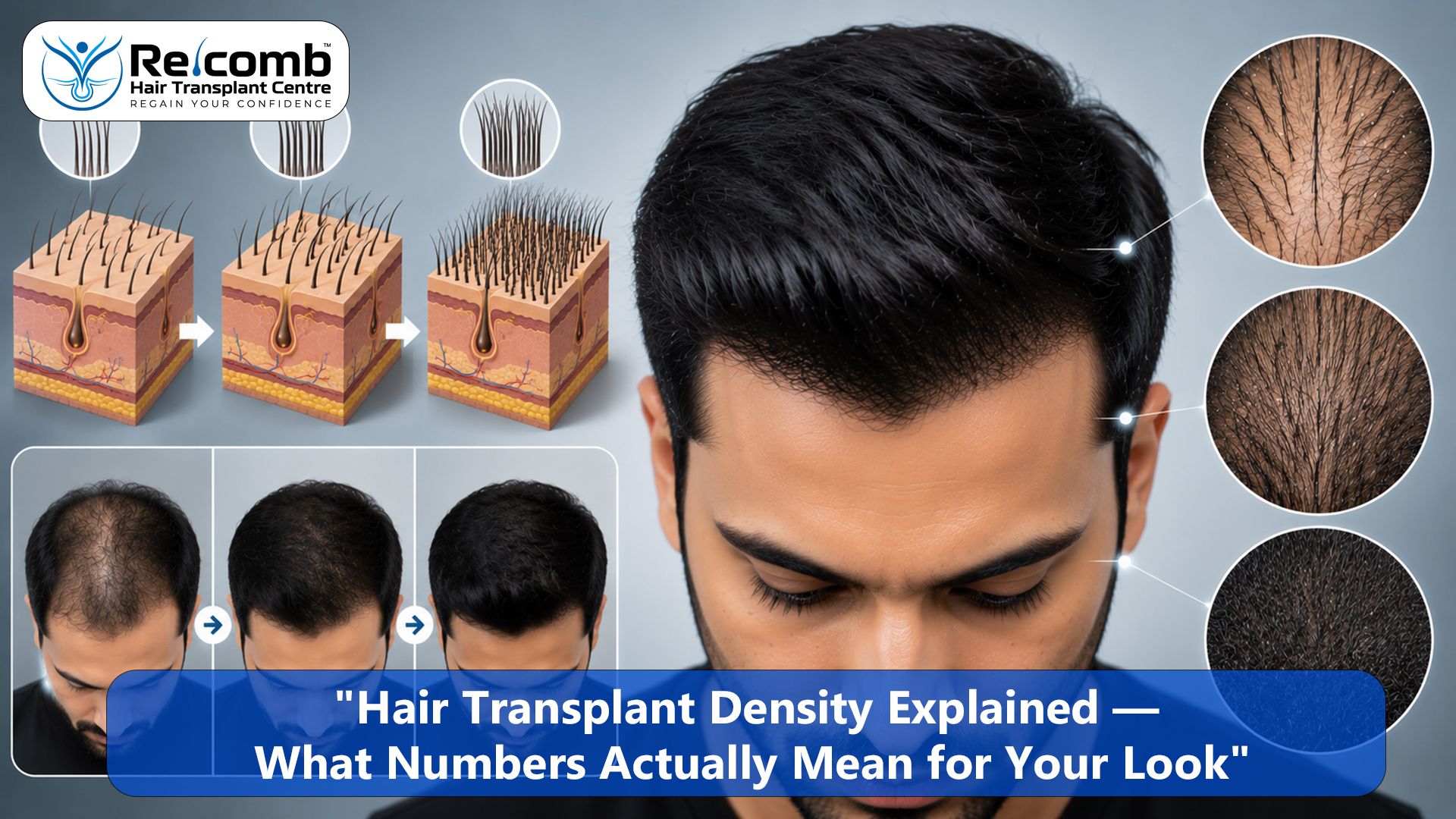
Graft count is the total number of follicular units transplanted. Density is the number of follicular units or hairs per square centimetre in a given area of the scalp. These are related but distinct concepts, and conflating them is the source of most patient confusion about expected results.
A patient who receives 2,500 grafts spread across a recipient area of 100 square centimetres has an average implanted density of 25 follicular units per square centimetre. A patient who receives 2,500 grafts in a recipient area of 60 square centimetres has an average implanted density of approximately 42 follicular units per square centimetre. The same graft count produces a meaningfully different visual result because the area over which those grafts are distributed is different.
This is why the recipient area size is as important as the graft count in any honest transplant plan, and why a clinic that quotes a graft count without specifying the area it will cover has not provided a complete picture of what the result will look like.
What Natural Hair Density Actually Is
Natural scalp hair density in adults ranges from approximately 80 to 120 follicular units per square centimetre, with an average around 100 follicular units per square centimetre in most populations. Within each follicular unit, there are typically one to four hairs, giving a total hair count per square centimetre ranging from roughly 150 to 300 hairs in a fully dense scalp.
A hair transplant cannot replicate this density in the recipient area. Attempting to place 100 follicular units per square centimetre in a recipient zone would exceed the blood supply capacity of the scalp tissue, compromising the survival of grafts placed too close together. The practical maximum implantable density in a single session is approximately 40 to 55 follicular units per square centimetre in most patients, depending on scalp vascularity, graft size, and surgeon technique.
This means a transplanted area will always have lower follicular unit density than a naturally fully dense area. The visual goal of hair transplantation is therefore not to replicate natural density exactly but to achieve density sufficient to produce the illusion of fullness, which is a lower threshold and one that can be reached with appropriate planning.
Why Visual Density Is Different From Measured Density
The brain does not directly perceive follicular units per square centimetre. It perceives the visual impression of coverage, which is influenced by several factors that make measured density only one component of the visual result.
Hair shaft diameter is the most significant modifier. Thicker hair shafts occupy more visual space per hair than fine ones. A patient with coarse, thick dark hair can achieve visually satisfying coverage with 25 to 30 follicular units per square centimetre. A patient with fine, light-coloured hair may need 40 follicular units per square centimetre in the same area to achieve comparable visual fullness, because each shaft covers less visual area.
Curl and wave amplify the visual perception of density because curled hairs spread laterally across the scalp surface, covering more area per shaft than straight hairs growing in the same direction. A patient with naturally wavy or curly hair achieves better visual density from the same graft count than a patient with pin-straight hair.
Colour contrast between hair and scalp affects perceived density significantly. A patient with dark hair on a light scalp has high contrast, meaning any gap between hairs is visible and perceived density appears lower than the measured count would suggest. A patient with hair colour that closely matches their scalp tone, or with a naturally tanned scalp, has lower contrast and appears denser from the same measured follicular unit count.
These variables, shaft diameter, curl, and colour contrast, are assessed as part of any properly planned transplant because they directly determine what density target is required to achieve a satisfying visual result for a specific patient. A density target appropriate for one patient's hair characteristics may be insufficient or unnecessarily high for another's.
Zone-Specific Density: Why Uniform Distribution Is Wrong
A common error in poorly planned transplants is distributing grafts uniformly across the recipient area at the same density in every zone. This approach fails to produce a natural result because natural hair does not grow at uniform density across the scalp.
The hairline zone requires the lowest density of implanted grafts but the most precise placement. Single-hair grafts at 15 to 20 follicular units per square centimetre at the very front edge create the soft, gradual transition that reads as natural. Behind this transition zone, density increases progressively into the frontal zone proper, where two and three hair grafts at 30 to 40 follicular units per square centimetre produce the visual weight needed to create an impression of fullness.
The midscalp typically requires 35 to 45 follicular units per square centimetre to achieve adequate coverage, with the specific target determined by the patient's hair characteristics. The crown requires careful planning because the radial vortex growth pattern means grafts must be placed at variable angles across the zone, and the visual impression of density changes significantly with lighting angle, making this zone more technically demanding per graft than the frontal zone.
Planning density by zone rather than applying a uniform number across the entire recipient area produces a result that is fuller where fullness matters most, graduated where nature would graduate it, and uses grafts more efficiently by concentrating them where visual impact is highest.
How Density Interacts With Native Hair
The transplanted density does not exist in isolation. In most patients, a portion of the native hair in the recipient zone is still present at the time of surgery, even if thinning. This native hair contributes to the total visual density of the area alongside the transplanted grafts.
A patient with Norwood Grade 3 loss who has maintained some density of miniaturising native hair in the frontal zone will achieve a visibly fuller result from 1,800 transplanted grafts in that zone than the graft count alone would suggest, because the native hair supplements the transplanted density. The same patient five years later, if medical management is not in place and native hair continues to thin, will perceive their result as declining even though the transplanted grafts themselves are unchanged, because the native hair contribution to total density has reduced.
This interaction between transplanted density and native hair density is precisely why medical management alongside surgery is not optional for patients with ongoing androgenetic alopecia. The total visual density of the result depends on both components. Protecting the native hair component with finasteride and minoxidil preserves the total density picture for longer and makes the transplanted graft count deliver more sustained visual value.
Density Expectations by Norwood Grade: Realistic Numbers
A useful reference for patients planning a transplant is what density is realistically achievable by loss grade given typical donor budgets.
For Norwood Grade 2 to 3, where the recipient area is limited to the frontal hairline and early frontal zone, 1,500 to 2,200 grafts distributed across 50 to 70 square centimetres can achieve an average density of 22 to 40 follicular units per square centimetre. With good hair characteristics, this produces visually satisfying fullness that blends naturally with maintained surrounding hair.
For Norwood Grade 4, where the frontal zone and midscalp are affected over approximately 80 to 100 square centimetres, 2,500 to 3,500 grafts distributed across this area produce an average density of 25 to 35 follicular units per square centimetre. This is adequate for most hair types with appropriate zone-specific distribution but may produce thinner-than-desired coverage in patients with fine, high-contrast hair.
For Norwood Grade 5 to 6, where the total recipient area may reach 150 to 200 square centimetres or more, 3,500 to 5,000 grafts across this area produce average densities of 20 to 30 follicular units per square centimetre, which is sufficient for coverage but not for the impression of genuine fullness in all lighting conditions. In these cases, staged procedures and realistic expectation management become essential parts of the conversation.
Why Chasing High Density Numbers Causes Problems
Patients who focus on maximising graft density per square centimetre in a single session risk specific clinical consequences that undermine the result they are trying to achieve.
Overcrowding grafts beyond the scalp tissue's capacity to supply blood to all of them simultaneously reduces graft survival. Grafts placed too close together compete for the same blood supply in the early post-operative period, and a proportion fail to establish. The patient ends up with lower actual density than the graft count promised because the over-dense placement compromised survival.
Aggressive single-session extraction to achieve a high graft count depletes the donor area at a rate that may leave insufficient grafts for future sessions. A result that looks complete at 30 may have no reserve for the coverage that will be needed at 45 as hair loss continues to progress.
The correct approach is to plan density that achieves visually satisfying fullness within the safe limits of scalp vascularity, using the donor budget across a staged plan that accounts for future needs. A result that is 80 percent as dense as the theoretical maximum but preserves the donor area for a second session is a better clinical outcome than one that achieves the theoretical maximum at the cost of everything the patient will need later.
RECOMB's Approach (2026)
At RECOMB Hair Transplant Centre, Surat, density planning for every patient begins with the specific variables that determine how density translates to visual result: hair shaft diameter measured through trichoscopy, curl pattern, colour-to-scalp contrast, recipient area size mapped by zone, and the available donor budget across a lifetime plan.
Dr. Krishna Bhalala and Dr. Nilesh Kachhadiya produce a zone-specific density plan for every patient that specifies the follicular unit target per square centimetre by zone, the graft type distribution within each zone, and the total graft allocation with the remaining donor reserve stated explicitly. Patients understand before the procedure what density they will receive in each zone and why that density is appropriate for their hair characteristics and recipient area size.
Density is not maximised for its own sake. It is optimised for the visual result across the patient's lifetime.
Understand What Your Specific Hair Characteristics Mean for Your Result →
WhatsApp: +91 7624008000 | www.recombhair.com
Final Takeaway
Graft count is the starting point of a density conversation, not the conclusion. What a specific graft count looks like on a specific patient depends on hair shaft diameter, curl, colour contrast, recipient area size, zone-specific distribution, and how transplanted density interacts with the native hair that medical management is responsible for protecting.
Patients who understand these variables evaluate transplant recommendations more accurately, ask better questions about what their specific plan will actually produce, and make decisions based on what their result will look like rather than on a number that means different things for different people.
Dr. Krishna Bhalala and Dr. Nilesh Kachhadiya conduct a limited number of personal consultations each week at RECOMB, Surat. If you want to understand specifically what density your plan will produce and what your result will actually look like given your hair characteristics, this is where that conversation starts.
Get a Density Plan Built Around Your Specific Hair Characteristics →
WhatsApp: +91 7624008000
We respond within 24 hours, 6 days a week.
www.recombhair.com
Contact RECOMB Hair Transplant Centre
RECOMB Hair Transplant Centre
19, Ground Floor, Zenon Building, Opp. Unique Hospital, near Kiran Motors, Khatodara Wadi, Surat, Gujarat 395001
Phone: +91 7624008000
Website: www.recombhair.com