
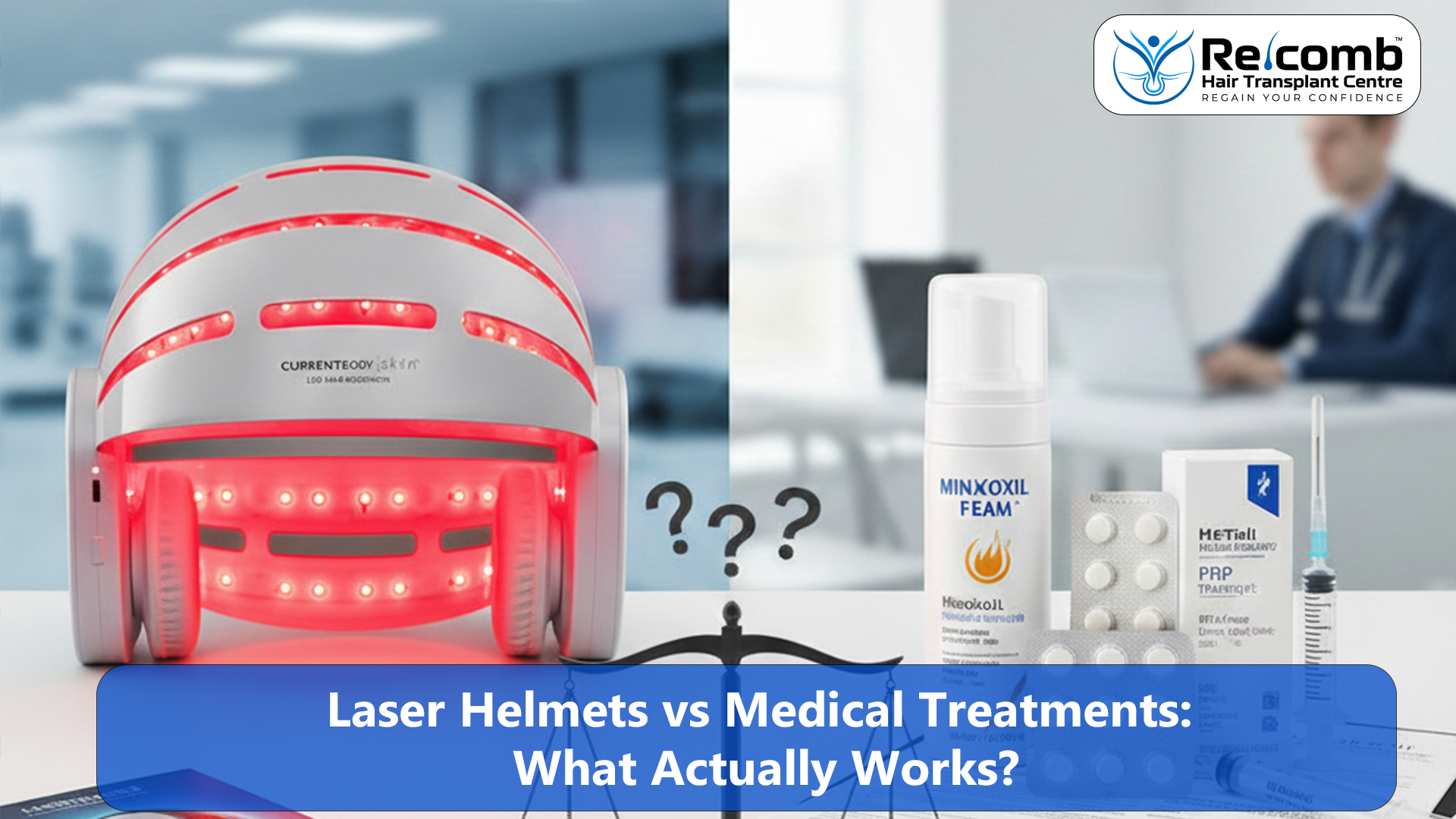
Laser helmets are heavily marketed as a painless, at-home solution for hair regrowth. They promise thicker hair using red light therapy without medicines or surgery.
But the real question is:
Do laser helmets actually work—or are medical treatments more effective?
At RECOMB Hair Transplant Centre, we evaluate hair loss treatments based on biological science, clinical evidence, and long-term outcomes—not marketing trends.
Let’s break this down honestly.
What Are Laser Helmets?
Laser helmets use Low-Level Laser Therapy (LLLT).
They emit:
-
Red light (typically 630–680 nm)
-
Low-energy photons
-
Non-thermal stimulation
The goal is to:
-
Increase blood circulation
-
Stimulate follicle activity
-
Extend growth phase (anagen)
This therapy is FDA-cleared for safety—but clearance does not equal guaranteed effectiveness.
How Laser Therapy Works (The Theory)
LLLT is believed to:
-
Improve mitochondrial activity
-
Increase ATP production
-
Reduce scalp inflammation
-
Stimulate dormant follicles
However, the effect size is generally mild to moderate, not dramatic.
When Laser Helmets May Help
Laser therapy may benefit:
-
Early-stage genetic hair loss
-
Mild thinning
-
Diffuse shedding
-
As supportive therapy post-transplant
It works best when follicles are still alive.
Limitations of Laser Helmets
Laser helmets:
-
Do not block DHT
-
Do not reverse advanced baldness
-
Cannot create new follicles
-
Require consistent long-term use
Most patients need 3–6 months before noticing subtle improvement.
Stopping treatment often reverses gains.
What Are Medical Treatments?
Medical hair loss treatments include:
-
DHT-blocking therapy
-
Topical growth stimulators
-
Regenerative injections (PRP/GFC)
-
Nutritional correction
-
Prescription therapy for autoimmune hair loss
These treatments address the root biological causes of hair thinning.
Comparing Effectiveness
| Factor | Laser Helmets | Medical Treatments |
|---|---|---|
| DHT Control | No | Yes |
| Follicle Revival | Mild | Moderate to High |
| Works in Advanced Baldness | No | Limited |
| Evidence Strength | Moderate | Stronger |
| Long-Term Impact | Supportive | Primary treatment |
Laser helmets are supportive tools—not standalone solutions.
What Actually Stops Genetic Hair Loss?
Genetic hair loss is driven by:
-
DHT sensitivity
-
Follicle miniaturization
-
Progressive thinning
Laser therapy does not stop DHT.
Medical therapy is required to slow progression.
Without DHT control, hair thinning continues.
What About Combining Both?
Laser therapy can be useful as an adjunct:
-
Along with medical treatment
-
After hair transplant
-
For maintaining mild thinning
Combination therapy may provide incremental benefit.
But relying only on laser helmets often leads to disappointment.
Cost vs Value Consideration
Laser helmets are expensive devices.
Before investing, consider:
-
Stage of hair loss
-
Diagnosis accuracy
-
Medical treatment options
-
Long-term cost-benefit
Many patients spend large amounts on devices before seeking medical evaluation.
When Laser Helmets Are Not Recommended
Laser helmets are unlikely to help in:
-
Grade 4–7 baldness
-
Completely bald scalp areas
-
Scarred scalp
-
Advanced miniaturization
In these cases, medical or surgical intervention is required.
RECOMB’s Evidence-Based Position (2026)
At RECOMB:
-
Laser therapy is considered supportive
-
It is not positioned as a replacement for medical care
-
Proper diagnosis comes first
-
Treatment is personalized
We prioritize therapies with proven biological impact.
Final Medical Conclusion
Laser helmets:
-
Can provide mild stimulation
-
May improve early thinning
-
Work best as supportive therapy
Medical treatments:
-
Address the root cause
-
Slow genetic progression
-
Provide stronger evidence-based outcomes
If you are serious about long-term hair preservation, medical evaluation should always be the first step.
Contact RECOMB Hair Transplant Centre
Phone: +91 7624008000
Website: www.recombhair.com