
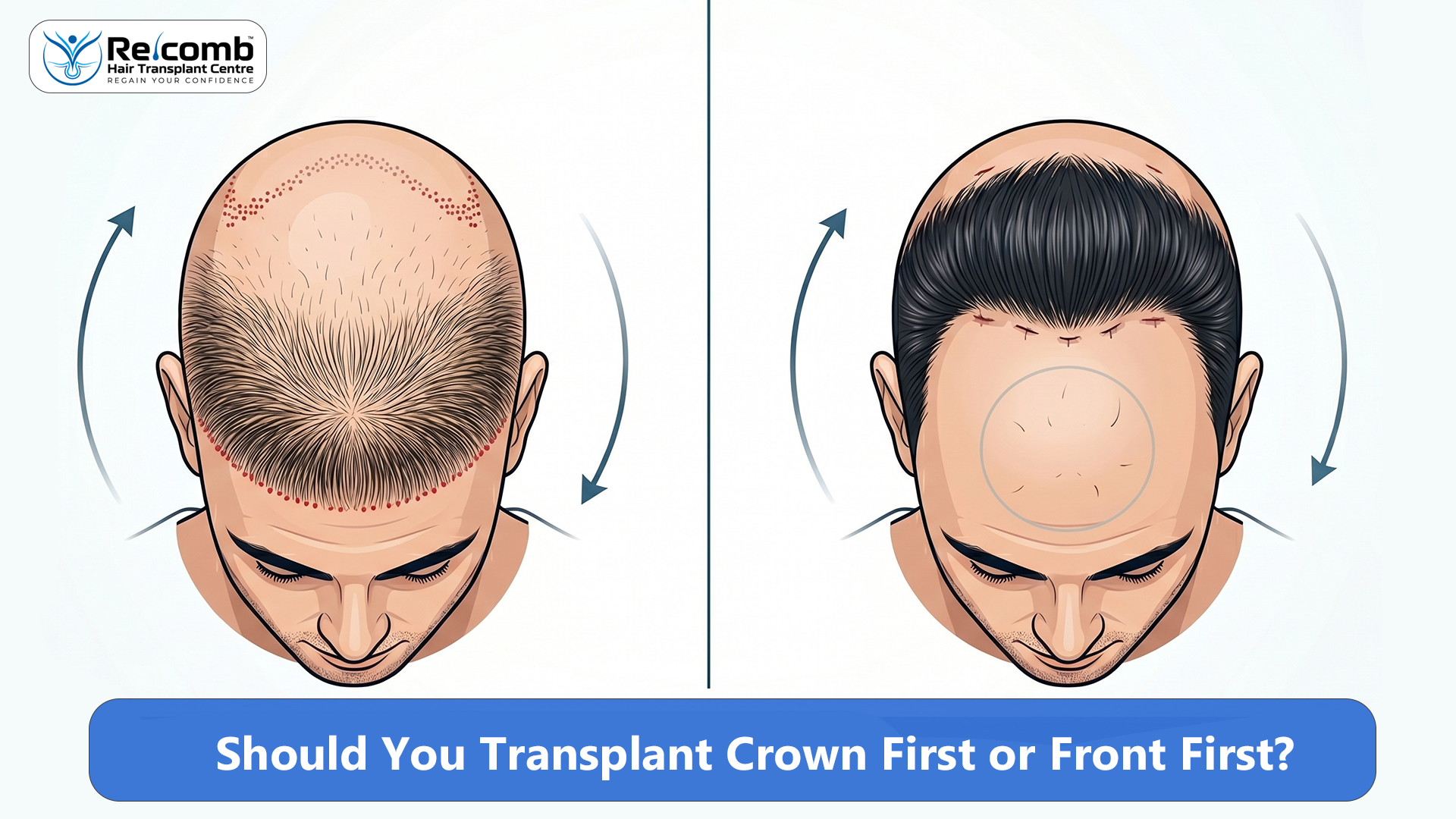
One of the most common questions in hair transplant planning is:
“Should I fix my crown first or my front hairline?”
The answer is not based on preference alone—it is based on visual impact, graft efficiency, and long-term planning.
At RECOMB Hair Transplant Centre, treatment priority is decided strategically to maximize natural results while preserving donor hair.
Let’s understand the logic.
Why the Front Is Usually Prioritized
In most cases, front (hairline + frontal zone) is treated first.
1. Maximum Visual Impact
The frontal area:
- Frames your face
- Is visible in all social interactions
- Defines your overall appearance
Even moderate improvement in the front can significantly enhance how you look.
2. Better Perception of Density
Human perception is front-focused.
A well-designed hairline can make the entire scalp appear fuller—even if the crown is still thin.
3. Efficient Use of Grafts
The frontal area requires:
- Fewer grafts compared to crown
- More controlled density
This allows better aesthetic results with limited donor supply.
Why Crown Is Usually Delayed
The crown (vertex) behaves differently.
1. Requires More Grafts
Crown needs:
- Higher graft distribution
- Circular pattern coverage
- Wider area filling
This consumes a large number of grafts.
2. Lower Visual Priority
The crown is:
- Less visible in face-to-face interactions
- Often noticed later compared to hairline
From a cosmetic perspective, fixing the front gives better immediate benefit.
3. Ongoing Hair Loss Risk
Crown thinning often continues over time.
Treating it too early may lead to:
- Need for repeat procedures
- Unbalanced density later
When Crown Can Be Treated First
In some cases, crown-first approach may be considered:
- Crown is the primary concern
- Hairline is relatively intact
- Donor supply is strong
- Patient has stable hair loss
However, this is less common.
Combined Approach (Front + Crown)
In moderate cases:
- Both areas can be treated in the same session
- Grafts are divided strategically
Example:
- 70% grafts → front
- 30% grafts → crown
This approach balances aesthetics and coverage.
What Happens If You Do Crown First?
If crown is prioritized early:
- Front remains visibly thin
- Overall appearance may not improve significantly
- Grafts may get exhausted
This can lead to dissatisfaction despite technically successful surgery.
Long-Term Planning Strategy
Hair transplant is not a one-time decision.
Proper planning considers:
- Future hair loss progression
- Donor limitations
- Age and expectations
- Need for staged procedures
Front-first approach preserves flexibility for future treatments.
Graft Distribution Strategy Example
For a Grade 4–5 patient:
Total grafts: 3,500
- Front: 2,200–2,500 grafts
- Crown: 1,000–1,300 grafts (optional or second stage)
This ensures optimal visual outcome.
RECOMB’s Priority Approach (2026)
At RECOMB:
- Frontal zone is usually prioritized
- Crown is treated based on donor availability
- Conservative planning is followed
- Long-term results are prioritized over immediate coverage
The goal is to create a natural look that lasts over time.
Final Medical Takeaway
In most cases:
Front should be treated first.
Because:
- It has maximum visual impact
- Requires fewer grafts
- Creates immediate aesthetic improvement
- Allows better long-term planning
Crown can be treated later or partially, depending on donor capacity.
Contact RECOMB Hair Transplant Centre
Phone: +91 7624008000
Website: www.recombhair.com