
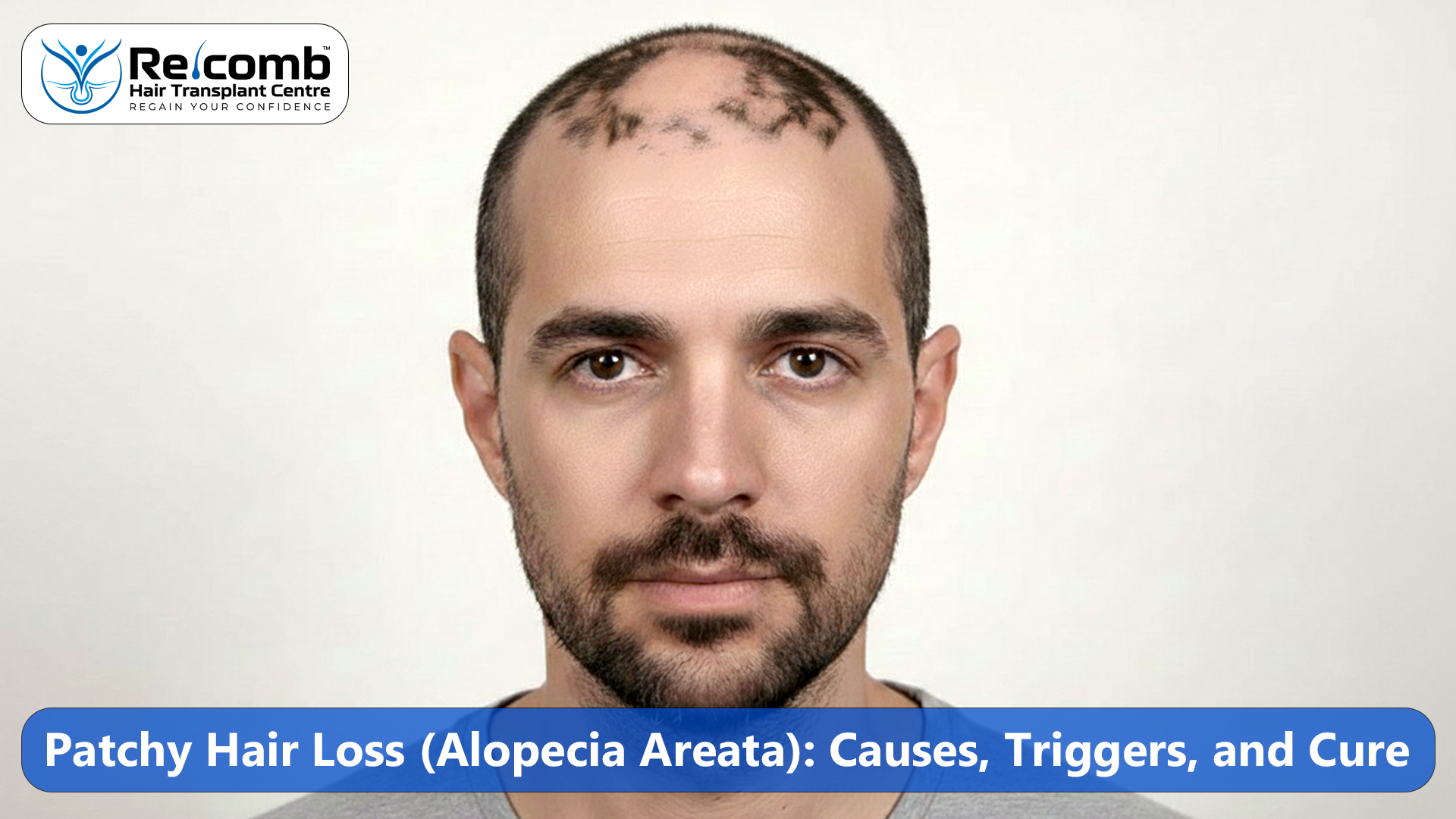
Sudden patchy hair loss can be alarming, especially when it appears without pain or itching. This condition is commonly known as Alopecia Areata, an autoimmune disorder that causes round or oval bald patches on the scalp, beard, eyebrows, or other body areas.
At Recomb Hair Transplant Centre, Surat, alopecia areata is treated as a medical condition, not a cosmetic problem. With early diagnosis and proper therapy, most patients achieve significant or complete regrowth.
What Is Alopecia Areata?
Alopecia areata is an autoimmune disease in which the body’s immune system mistakenly attacks healthy hair follicles.
This disrupts the hair growth cycle and causes sudden hair shedding in patches.
Key features include:
-
Smooth, round or oval bald patches
-
No scarring or redness in most cases
-
Sudden onset
-
Can affect scalp, beard, eyebrows, eyelashes, or body hair
Hair follicles are not destroyed, which means regrowth is possible.
Types of Alopecia Areata
1. Alopecia Areata Patchy
The most common form, involving one or more bald patches.
2. Alopecia Totalis
Complete loss of scalp hair.
3. Alopecia Universalis
Loss of hair from the entire body.
4. Ophiasis Pattern
Hair loss occurs in a band-like pattern along the sides and back of the scalp.
Causes of Alopecia Areata
Alopecia areata is primarily caused by immune system dysfunction.
The immune cells attack hair follicles in the anagen (growth) phase, forcing them into a resting phase.
Major causes include:
-
Autoimmune tendency
-
Genetic predisposition
-
Association with thyroid disease, vitiligo, or diabetes
Common Triggers That Worsen Patchy Hair Loss
Although the root cause is autoimmune, several triggers can activate or worsen alopecia areata:
-
Severe Stress or Emotional Trauma
-
Viral Infections or Fever
-
Vaccinations (rare and temporary trigger)
-
Hormonal Changes
-
Nutritional Deficiencies (Vitamin D, Iron, B12)
-
Poor Sleep and Lifestyle Imbalance
Identifying and managing triggers is essential for long-term control.
Is Alopecia Areata Permanent?
In most cases, alopecia areata is reversible.
Hair follicles remain alive, and regrowth can occur naturally or with treatment.
However, the disease is unpredictable and may:
-
Resolve completely
-
Recur after months or years
-
Progress to extensive forms if untreated
Early treatment significantly improves outcomes.
Best Treatment Options for Alopecia Areata
1. Corticosteroid Therapy
Reduces immune attack on hair follicles.
Administered as topical, injectable, or oral forms depending on severity.
2. Immunotherapy
Used in resistant or recurrent cases to modulate immune response.
3. PRP and GFC Therapy
Improves follicle environment, blood supply, and accelerates regrowth when combined with medical therapy.
4. Topical Growth Stimulators
Encourage faster regrowth once immune activity is controlled.
5. Nutritional and Lifestyle Correction
Correcting vitamin deficiencies and reducing stress improves long-term control.
At Recomb, treatment is individualized based on disease severity, recurrence risk, and patient age.
Can Hair Transplant Treat Alopecia Areata?
Hair transplant is not recommended during active alopecia areata because the immune attack can damage transplanted grafts.
A transplant may be considered only if:
-
Disease is inactive for 1–2 years
-
No new patches appear
-
Condition is medically stable
This decision requires careful evaluation.
When Should You See a Dermatologist?
Seek medical attention if:
-
Hair loss appears suddenly in patches
-
Beard or eyebrow hair is affected
-
Hair loss is rapidly spreading
-
There is a family history of autoimmune disease
Early diagnosis prevents progression and speeds up recovery.
Contact Recomb Hair Transplant Centre
Phone: +91 7624008000
Website: www.recombhair.com