
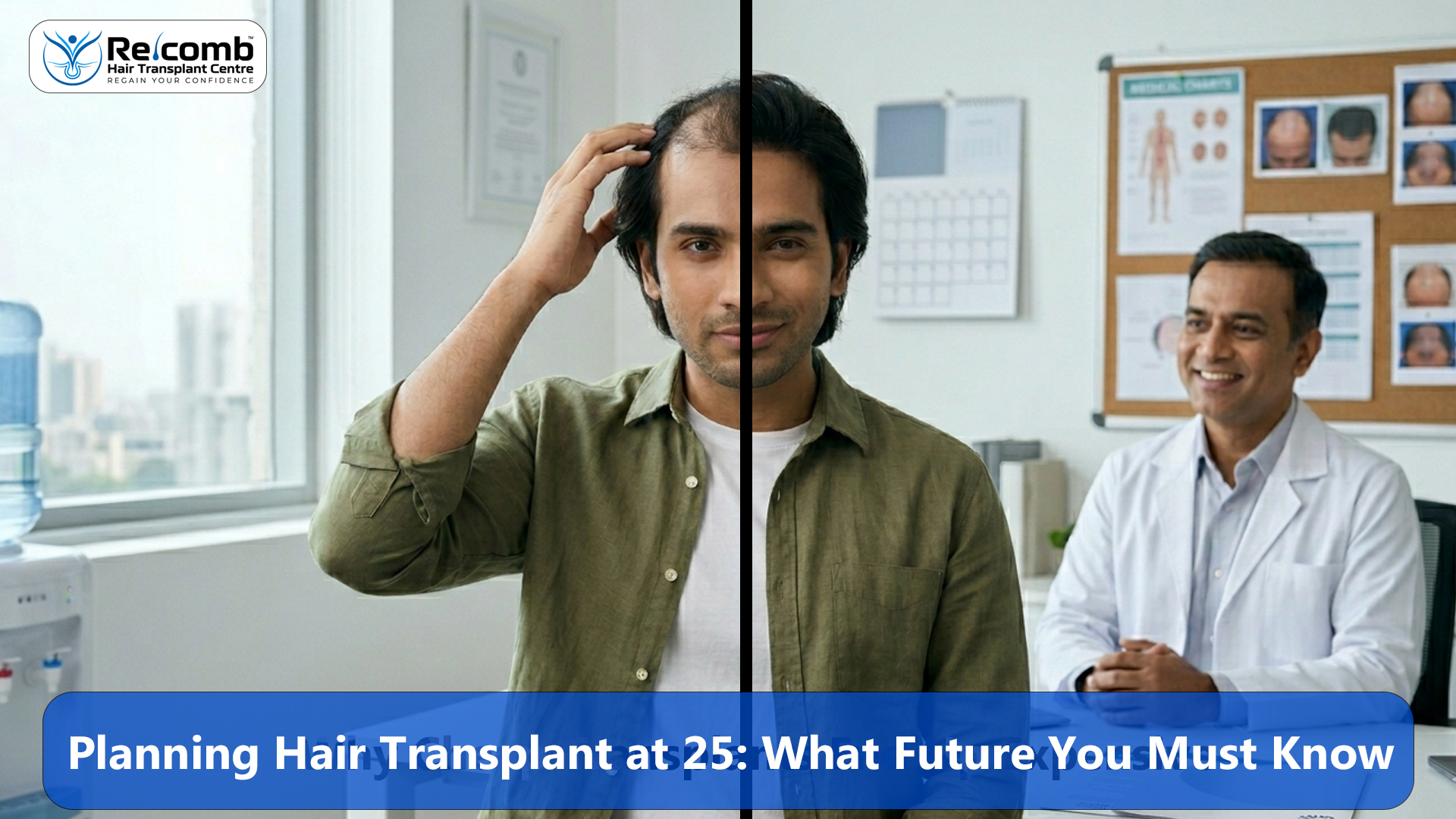
At 25, hair loss feels urgent. What was a slightly receding hairline six months ago now looks visibly thinner in photographs. Friends have not said anything, but you have noticed. The instinct is to act fast, restore what is being lost, and move on.
That instinct is understandable. But in hair transplant surgery, acting at 25 without the right planning is one of the most common reasons patients end up in a surgeon's chair a second time, not for a second session, but for damage control.
This is not a reason to avoid a transplant. It is a reason to approach it correctly.
If you are 25 and researching hair transplants, the most important thing you can do right now is get an honest assessment of where your hair loss is heading, not just where it is today.
Book a Free Donor and Hair Loss Assessment at RECOMB → WhatsApp: +91 7624008000 | www.recombhair.com
Why 25 Is a Complicated Age for Hair Transplant Surgery
Hair loss at 25 is almost always still progressing. The pattern you see today is not the pattern you will have at 35 or 45. This single fact changes everything about how a transplant should be planned at this age.
Most young men presenting at 25 are at Norwood Grade 2 or 3. They have lost ground at the temples and possibly the crown is beginning to thin. The loss feels significant because it is recent and because they remember how their hair looked at 20.
But the clinical reality is that a 25-year-old with Grade 3 loss has a high probability of progressing to Grade 4, 5, or beyond over the next two decades. If a surgeon transplants aggressively into the frontal zone today without accounting for this progression, that patient will have a dense frontal hairline and an increasingly bald midscalp and crown behind it as they age. The result looks unnatural precisely because it was not planned for the future.
The Donor Area Problem at a Young Age
The donor area contains between 4,000 and 6,000 grafts across a lifetime for most patients. At 25, a patient has no idea how far their hair loss will progress. They may need 1,500 grafts today but 4,000 grafts total by the time they are 45.
If a surgeon uses 2,500 grafts at 25 to create a full frontal result, and that patient goes on to develop Grade 5 or 6 loss, there may not be enough donor grafts left to address the midscalp and crown that will thin over the next two decades. The patient is left with a result that looks increasingly disconnected as they age, and no surgical option left to correct it.
This is why donor preservation is not a conservative choice at 25. It is the only responsible choice.
What Happens When Surgery Is Done Too Early Without Planning
The consequences of a poorly timed or poorly planned transplant at a young age are not always visible immediately. They become visible over years.
A transplanted hairline placed too low at 25 will look age-inappropriate at 40. Native hair behind the transplanted zone will continue to fall, creating a visible contrast between the dense transplanted front and the thinning area behind it. Correcting this requires more grafts, but those grafts may no longer be available if the donor area was over-used in the first procedure.
Patients in this situation often describe feeling worse at 35 than they would have felt if they had never had a transplant at all. That is the real cost of poor planning at a young age, not just money, but the permanent loss of options.
The right approach at 25 is not always surgery. Understanding that early protects you.
At RECOMB, we have assessed patients at 25 and advised them to wait. Not because surgery was not possible, but because operating at that stage would have used donor grafts that would deliver far more value two or three years later once the loss pattern was clearer and more stable.
If you are 25 and concerned about your hair, come in for an assessment. You will leave with a clear picture of your hair loss stage, your donor capacity, and whether now is the right time or whether waiting serves your long-term result better.
Get an Honest Assessment of Your Hair Loss Stage at RECOMB → WhatsApp: +91 7624008000 | www.recombhair.com
What Should Actually Happen Before Any Surgery at 25
Before any 25-year-old undergoes a hair transplant, several things must be established clearly.
Hair loss must be assessed for progression rate. How fast has the loss occurred over the last 12 to 24 months? A patient who has lost significant ground quickly is still in an active phase. Operating during active loss is rarely the right decision.
Family history must be evaluated. A patient whose father and maternal grandfather both reached Norwood Grade 6 has a reasonable probability of following a similar trajectory. This changes how many grafts should be used now and how many must be held in reserve.
Medical management must be addressed first. Most hair loss at 25 is androgenetic, driven by DHT. Finasteride and minoxidil, used correctly and under medical supervision, can slow or stabilise progression significantly. Many patients who start medical management at 25 find that their loss stabilises enough to make surgical planning far more predictable. Operating without addressing the medical component first is poor practice.
Donor density must be measured precisely. Not estimated. Measured. A trichoscopy or digital scalp analysis gives a clear picture of how many grafts are available, what the density is, and whether the donor zone is itself thinning, which can happen in some diffuse loss patterns.
A long-term plan must be mapped out. Not just this session. Where will grafts go today, and where will they need to go in 10 and 20 years? Every graft used at 25 is a graft that is no longer available at 40.
When a Hair Transplant at 25 Is the Right Decision
A transplant at 25 is not always the wrong decision. There are patients for whom it is appropriate.
A patient whose loss has been stable for at least 18 to 24 months, who is on medical management, whose family history suggests a limited loss pattern, and whose donor area is strong relative to their projected lifetime need can be a suitable candidate. The procedure must still be conservative, the hairline must still be designed for the long term, and the donor area must be treated as a resource that needs to last 40 or more years.
The point is not that 25 is too young. The point is that 25 requires more careful planning than 35, not less.
RECOMB's Approach (2026)
At RECOMB Hair Transplant Centre, Surat, young patients receive a different kind of consultation. The goal is not to find a reason to operate. The goal is to give the patient a clear, honest picture of where their hair loss is going and what the best strategy looks like across their lifetime, not just for the next 12 months.
If surgery is appropriate, we plan conservatively. Hairlines are designed for the age the patient will be at 45, not the age they are today. Donor grafts are allocated with future sessions in mind. Medical management is discussed as a non-negotiable part of the long-term plan.
If surgery is not yet appropriate, we say so directly and explain why. We would rather a patient wait 18 months and have a better long-term outcome than operate today and create a problem we cannot fix later.
Final Takeaway
At 25, the most valuable thing you can do for your hair is not to act fast. It is to plan well.
Hair loss at this age is almost always still progressing. The donor area is finite. Every graft you use today is a graft that is no longer available when you are 40. A transplant planned without accounting for this will look increasingly unnatural as the years pass, and correcting it may not be possible.
The patients who are happiest with their results at 45 are not the ones who operated the fastest at 25. They are the ones who got a proper assessment, started medical management early, and let a surgeon plan their restoration across their lifetime rather than just their current hairline.
Dr. Bhalala conducts a limited number of personal consultations each week. If you are 25 and thinking seriously about a hair transplant, come in for an honest assessment before making any decision.
Start With a Lifetime Hair Restoration Plan at RECOMB → WhatsApp: +91 7624008000 We respond within 24 hours, 6 days a week. www.recombhair.com
Contact RECOMB Hair Transplant Centre
Website: www.recombhair.com