
Patients researching hairline restoration often treat the temples and the frontal hairline as one connected zone requiring the same approach. Clinically they are distinct areas with different hair growth patterns, different design requirements, and different technical demands during the procedure.
Understanding this distinction before planning any hairline work prevents a common error: designing a frontal hairline that looks complete in isolation but creates an unnatural overall appearance because the temples were not planned or executed to complement it.
If you have temple recession alongside or separate from frontal hairline loss and want to understand what restoration of both zones would involve, a consultation at RECOMB gives you a specific plan.
Book a Hairline and Temple Assessment at RECOMB, Surat →
WhatsApp: +91 7624008000 | www.recombhair.com
What Makes the Temples Anatomically Distinct
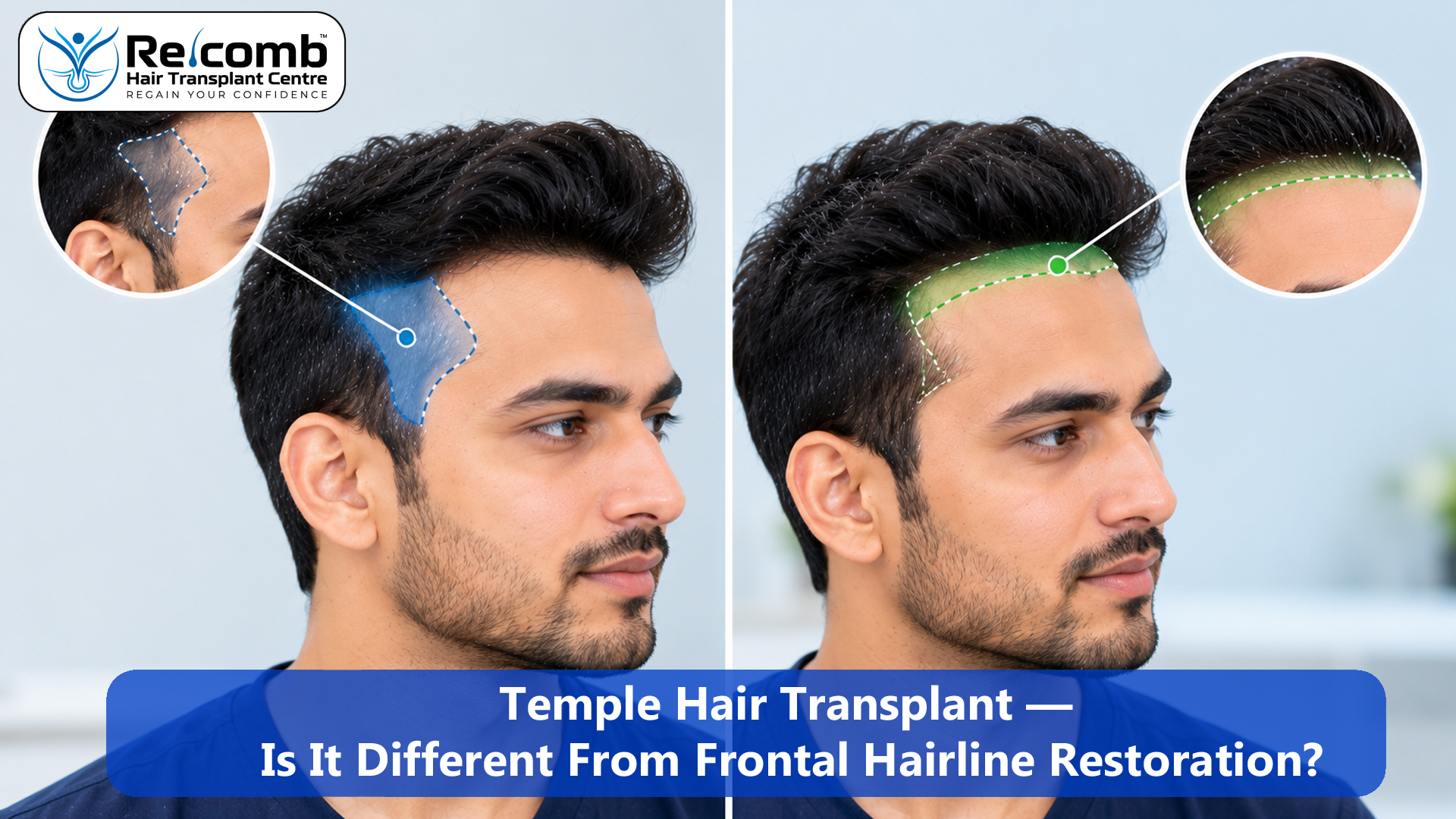
The temporal zone refers to the triangular areas at either side of the frontal hairline, where hair transitions from the scalp surface into the sideburn region. In a natural adult hairline, the temporal peak, the point where the hairline curves from the frontal zone into the temple, creates the characteristic M-shape seen in men and the softer lateral framing seen in women.
Hair in the temple zone grows in a highly specific direction. Unlike the frontal zone where hairs generally grow forward and slightly downward, temple hairs grow in a fan-like spread of directions, some forward, some downward, some laterally toward the ear. This multidirectional growth pattern creates the natural softness and dimensionality of the temple area and is what makes it look anatomically distinct from a simple continuation of the frontal hairline.
Replicating this multidirectional growth requires the surgeon to orient each graft individually during implantation to match the specific directional requirement of its position within the temple zone. A temple designed as a uniform extension of the frontal hairline, without accounting for the directional complexity, produces a flat, artificial-looking result even when the hairline itself is well-designed.
Why Temple Restoration Is Technically More Demanding
The graft requirements for the temple zone are almost exclusively single-hair units. The natural temple has no dense, multi-hair follicular clusters at its visible surface. The entire zone consists of fine, individual hairs that emerge at shallow angles and spread in multiple directions. Placing multi-hair grafts in this zone creates visible density inconsistency.
The angles of implantation in the temple zone are more acute than in the frontal zone. Hairs at the temple edge grow almost parallel to the scalp surface, at angles approaching 10 to 15 degrees in some positions. Creating recipient sites at these angles without damaging adjacent tissue requires precision that is more demanding than the 20 to 30 degree angles typical of the frontal hairline.
The temporal peak, where the hairline turns from the forehead into the temple, is a specific design decision that significantly affects the overall facial framing effect of the result. A peak placed too high creates an overly rounded hairline. One placed too low creates an aggressive, unnatural frame. Its position must be calibrated to the patient’s facial width, forehead height, and the projected position of future hair loss around it.
How Frontal Hairline and Temple Restoration Interact
The frontal hairline and the temples must be designed as a single cohesive frame rather than as two separate zones. A well-designed frontal hairline with poorly executed temples produces a result where the straight-on view looks natural but the three-quarter view reveals an unnatural lateral framing. This is among the most common design failures in hairline restoration and one that is difficult to correct afterward.
At RECOMB, the hairline design consultation addresses both zones simultaneously before any recipient sites are created. The temporal peaks, the transition from the frontal hairline into the temple, and the depth of the temporal recession on each side are all determined together as components of a single facial framing design.
The donor graft allocation for temple restoration must also be planned within the overall session budget. Temples typically require 200 to 500 grafts per side depending on the extent of recession. These grafts come from the same lifetime donor budget as frontal grafts and must be accounted for in the total plan rather than added as an afterthought.
Who Is a Good Candidate for Temple Restoration
Not every patient with temple recession is a good candidate for temple restoration, at least not at every stage.
Patients whose temple recession is still progressing rapidly without medical management are not ideal candidates because the restored temple may look appropriate initially and recede again as the surrounding native temple hair continues to fall. Medical management should be established first and temple design planned when the recession has stabilised.
Patients with adequate donor density and a clear, stable temporal recession pattern are appropriate candidates. The procedure is suitable for men at any Norwood grade where the temporal points have receded, and for women with lateral hairline recession alongside central thinning.
Young patients requesting temple restoration require particular caution. The natural adult hairline includes temporal recession as part of its mature anatomy. A young patient requesting full temporal coverage may be asking for a hairline that will look increasingly unnatural as they age. The temporal peak positions must be designed for the face the patient will have at 40, not at 25.
RECOMB’s Approach (2026)
At RECOMB Hair Transplant Centre, Surat, temple restoration is never planned in isolation from the overall hairline design. Dr. Krishna Bhalala and Dr. Nilesh Kachhadiya design the complete hairline frame, frontal zone, temporal peaks, and temple angles, as a unified clinical and aesthetic decision before any grafts are allocated or sites created.
The technical execution of the temple zone, specifically the multidirectional implantation of single-hair grafts at acute scalp angles, requires the precise surgical involvement and case volume that both surgeons bring to every procedure. This is not a zone that tolerates delegation to technicians.
Get a Complete Hairline and Temple Design Assessment at RECOMB →
WhatsApp: +91 7624008000 | www.recombhair.com
Final Takeaway
Temple hair transplant is not simply an extension of frontal hairline restoration. It involves distinct hair growth directions, more demanding implantation angles, specific single-hair graft requirements, and a design relationship with the frontal hairline that determines whether the overall facial frame looks cohesive or inconsistent.
Patients planning hairline work who do not specifically discuss the temporal zone with their surgeon are leaving a critical component of the result to assumption. The temples are where the three-quarter view of the hairline is determined, and the three-quarter view is how most people see most faces in most interactions.
Dr. Krishna Bhalala and Dr. Nilesh Kachhadiya conduct a limited number of personal consultations each week at RECOMB, Surat. If you have temporal recession and want to understand how it would be addressed within a complete hairline design plan, this is where that conversation starts.
Design Your Complete Hairline Frame at RECOMB, Surat →
WhatsApp: +91 7624008000
We respond within 24 hours, 6 days a week.
www.recombhair.com
Contact RECOMB Hair Transplant Centre
RECOMB Hair Transplant Centre
19, Ground Floor, Zenon Building, Opp. Unique Hospital, near Kiran Motors, Khatodara Wadi, Surat, Gujarat 395001
Phone: +91 7624008000
Website: www.recombhair.com