
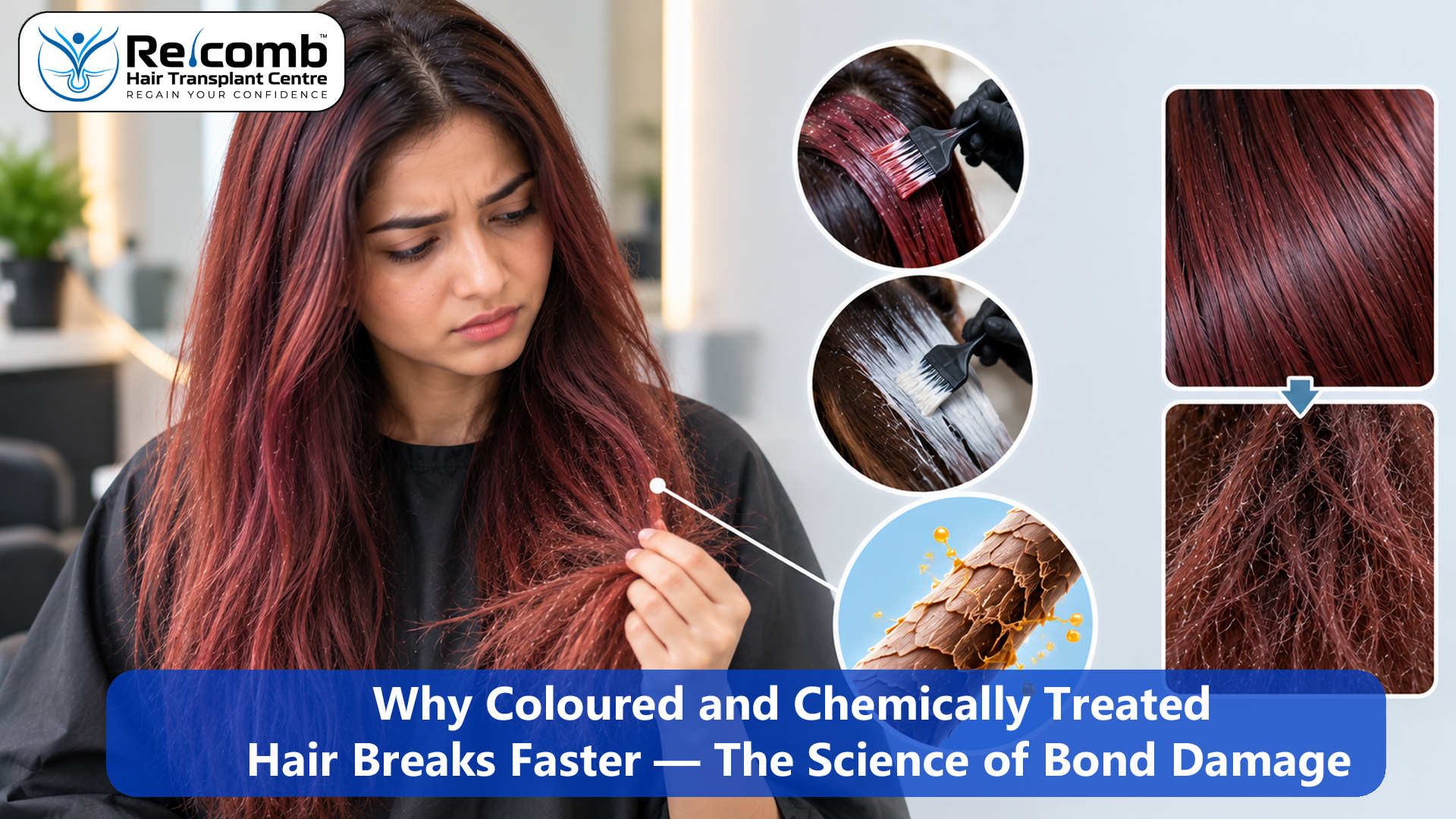
Patients who colour, bleach, straighten, or perm their hair regularly almost universally report the same experience over time. The hair becomes progressively weaker, breaks more easily during combing or styling, and resists the kind of management that was routine before chemical treatments began. Standard conditioning products provide temporary relief but not lasting improvement. The hair continues to break.
The clinical explanation for this pattern lies in what chemical treatments do to the internal structure of the hair shaft, specifically to the chemical bonds that give the shaft its strength, elasticity, and integrity. Understanding this at a biological level separates the interventions that actually address the problem from those that manage the surface appearance without changing the underlying structural reality.
The Bond Architecture of the Hair Shaft
The hair shaft is not a simple protein rod. It is an organised structure of multiple protein chains held together by different types of chemical bonds, each contributing specific mechanical properties to the overall shaft.
The most structurally significant bonds in hair are disulphide bonds, covalent links between sulphur atoms on adjacent protein chains. Disulphide bonds are strong, permanent connections that give the hair shaft its tensile strength and elasticity. They allow the hair to stretch under tension and return to its original length rather than breaking. A hair shaft with an intact disulphide bond network can withstand significant mechanical force without breaking.
Salt bonds are weaker ionic connections between positively and negatively charged amino acid residues on adjacent protein chains. They contribute to the overall structural integrity of the shaft and are sensitive to pH changes. Alkaline conditions, such as those created by many chemical treatments, disrupt salt bonds rapidly and reversibly.
Hydrogen bonds are the weakest of the three major bond types and are responsible for the temporary structure of hair. They are disrupted by water and reformed on drying, which is why wet hair is more elastic and more vulnerable to stretching damage than dry hair, and why hair holds a set shape when dried into a specific configuration.
The lipid layer between the cuticle scales and between the cuticle and cortex also functions as a structural cement that holds the outermost architecture of the shaft together. It is composed of fatty acids including 18-methyleicosanoic acid, which bonds the innermost cuticle layer to the cortex, and is irreversibly removed by alkaline chemical exposure.
What Colouring Does to These Bonds
Permanent hair colour requires two chemical actions that affect the bond architecture directly and cumulatively.
The alkaline phase, using ammonia or an alternative alkaliser, raises the pH of the shaft environment to swell and open the cuticle. This pH elevation disrupts salt bonds throughout the shaft and begins to affect the lipid layer. With a single colour application, the salt bonds reform when the shaft returns to a neutral pH. With repeated applications, the lipid layer sustains cumulative damage that does not fully reform, and the cuticle cells that were cemented by that lipid layer begin to detach and lift.
The oxidative phase, using hydrogen peroxide, generates free radicals within the cortex that break disulphide bonds as part of the mechanism that allows new pigment to deposit. The oxidative process that breaks natural melanin also breaks a proportion of the protein chain disulphide bonds in the immediate vicinity. Some of these reform through a process called recombination, but not all of them. Each colour application leaves a proportion of broken disulphide bonds that do not reform, reducing the structural integrity of the cortex incrementally.
After several colour applications, the cumulative effect is a shaft with a partially degraded disulphide bond network, an eroded lipid layer, lifted and partially detached cuticle cells, and disrupted salt bond equilibrium. This shaft has lower tensile strength, less elasticity, higher porosity, and less resistance to mechanical force than an uncoloured shaft. It breaks where an intact shaft would flex.
What Bleaching Does
Bleaching uses significantly higher concentrations of hydrogen peroxide than permanent colouring, typically thirty to forty volume developer compared to ten to twenty volume in standard permanent colour. The oxidative damage to disulphide bonds and the cortex proteins is proportionally more severe.
Bleaching also removes natural melanin, which in addition to providing colour plays a structural role in the cortex. Melanin granules are embedded within the cortex protein matrix and contribute to its mass and structural integrity. Their removal through oxidative bleaching leaves voids in the cortex structure that reduce the mechanical resistance of the shaft, particularly to compression and bending forces.
Repeated bleaching or high-lift colour applications accelerate the disulphide bond depletion and cortex protein degradation to the point where the hair shaft loses most of its tensile elasticity, becoming brittle and fracturing under very low mechanical force. This is the clinical presentation of severely bleached hair that snaps with minimal handling.
What Relaxers and Straightening Treatments Do
Chemical relaxers and permanent straightening treatments work by deliberately and permanently breaking and reforming disulphide bonds in a new configuration that changes the natural curl pattern of the hair.
Lye relaxers use sodium hydroxide, a strongly alkaline compound, to break disulphide bonds across the shaft. The hair is then physically straightened while the bonds are open, and a neutraliser is applied to reform them in the straightened position. No-lye relaxers use guanidinium or lithium hydroxide systems with similar mechanisms.
The key clinical point is that this process permanently reduces the total number of intact disulphide bonds in the shaft. A proportion of the bonds broken during the relaxer process reform incorrectly or do not reform at all. The shaft has a reduced bond density after relaxing compared to before, meaning it is permanently weaker than the unrelaxed hair, regardless of how carefully the process is performed.
Japanese straightening and keratin treatments work through a combination of chemical bond breaking, physical restructuring, and in some formulations formaldehyde-based cross-linking that temporarily adds rigidity by creating new cross-links between protein chains. These treatments produce a temporarily stronger-feeling shaft but do not restore the broken disulphide bonds. When the formaldehyde cross-links eventually break down, typically over three to six months, the shaft returns to its post-chemical, bond-depleted state.
The Cumulative Nature of Bond Damage
Bond damage from chemical treatments is cumulative and largely irreversible in the existing hair shaft. Each application adds to the deficit. The shaft does not repair its own disulphide bonds between treatments. It cannot synthesise new structural proteins to replace those degraded by oxidative chemistry.
This explains why patients who have been chemically treating their hair for years experience progressively worsening breakage even when the frequency and type of treatment has not changed. The cumulative bond depletion across years of treatment reaches a threshold where the shaft’s resistance to mechanical force falls below the level required for normal daily handling, and the hair begins to break at the scalp or along the mid-length with minimal provocation.
The only hair that is not bond-depleted is new growth from the follicle that has not yet been treated. This is why patients who stop chemical treatment and wait experience the gradual improvement of their hair condition as new undamaged growth replaces treated lengths, but why any attempt to treat the existing damaged lengths produces continued deterioration rather than repair.
What Bond Repair Treatments Actually Do
A category of haircare products marketed as bond building or bond repair has become increasingly common in India over the past several years. Products in this category include Olaplex, K18, and various generic equivalents. Understanding what these products actually do explains when they have clinical rationale and when they do not.
Olaplex’s mechanism involves a small molecule called bis-aminopropyl diglycol dimaleate that works by cross-linking free thiol groups on broken disulphide bond chains. It does not restore the original disulphide bond between the original protein chains. It creates a new connection between free sulphur groups that were previously unconnected after bond breakage. The result is a shaft with more cross-links than it had post-chemical treatment but a different cross-link architecture from the original intact shaft.
The clinical outcome is a measurable improvement in hair tensile strength and elasticity compared to untreated chemically damaged hair, with studies showing reduced breakage and improved stretch recovery. This is genuine clinical benefit, not marketing. However, the improvement is in the degree of damage remaining rather than a restoration of the original architecture, and repeated chemical treatments on top of bond repair treatments continue to add new damage.
K18’s mechanism involves a bioactive peptide that is claimed to penetrate the cortex and reconnect broken keratin chains through a different pathway. The published evidence for K18 is less extensive than for Olaplex but early studies show meaningful improvement in hair mechanical properties.
Both categories have genuine rationale for use during and between chemical treatments to reduce the cumulative damage burden, and as part of the management of already damaged hair while new growth replaces treated lengths. They do not eliminate the need to reduce chemical treatment frequency if breakage is severe, and they do not restore a shaft that has sustained extreme damage to functional integrity.
Practical Guidance for Patients in Surat
For patients managing chemically treated hair in Surat’s specific environment, several factors amplify the bond damage picture.
Hard water deposits calcium and magnesium on the hair shaft surface that interfere with bond repair product penetration. A chelating wash performed before applying bond repair treatment removes mineral deposits and allows the active molecules to access the cortex more effectively.
Monsoon season humidity causes treated hair with lifted cuticles and depleted lipids to absorb atmospheric moisture more aggressively than intact hair, worsening the swelling and frizz that accompanies bond damage. Using a humidity-blocking sealant over bond repair treatment during the monsoon months reduces this.
Heat styling on already bond-depleted hair accelerates further bond breakage through thermal protein denaturation. Reducing heat styling temperature to below 180 degrees Celsius and using a thermal protectant that reduces direct heat transfer to the shaft meaningfully reduces the additional damage added to an already compromised shaft during each styling session.
RECOMB’s Approach (2026)
At RECOMB Hair Transplant Centre, Surat, patients who present with hair breakage alongside hair fall receive a clinical assessment that distinguishes between follicular shedding and shaft breakage through trichoscopy and clinical examination. Dr. Krishna Bhalala’s background as a DNB Dermatologist means that the hair shaft conditions arising from chemical treatment are assessed and managed within the same clinical framework as the follicular conditions that drive hair loss.
For patients planning or undergoing hair transplant surgery who also colour or chemically treat their hair, specific guidance on timing of chemical treatments relative to the surgical procedure, post-operative treatment restrictions, and scalp environment management is provided as part of the pre-surgical and post-operative care plan.
Final Takeaway
Chemically treated hair breaks faster because the chemical processes used in colouring, bleaching, relaxing, and straightening deplete the disulphide bond network and damage the structural proteins and lipid architecture of the hair shaft in ways that accumulate with every treatment and cannot be reversed in existing hair.
Bond repair treatments reduce but do not eliminate this damage. New growth from an untreated follicle is the only genuinely undamaged hair. Managing bond damage productively means reducing the rate of new damage, supporting the shaft architecture that remains, and allowing new growth to replace treated lengths progressively.
Dr. Krishna Bhalala and Dr. Nilesh Kachhadiya conduct a limited number of personal consultations each week at RECOMB, Surat. If you have persistent hair breakage alongside scalp or hair fall concerns that have not responded to product changes, a clinical assessment that examines both the follicular and shaft components of the picture is where an accurate management plan starts.
Get a Clinical Assessment That Addresses Both Your Scalp and Your Hair Shaft →
WhatsApp: +91 7624008000
We respond within 24 hours, 6 days a week.
www.recombhair.com
Contact RECOMB Hair Transplant Centre
RECOMB Hair Transplant Centre
19, Ground Floor, Zenon Building, Opp. Unique Hospital, near Kiran Motors, Khatodara Wadi, Surat, Gujarat 395001
Phone: +91 7624008000
Website: www.recombhair.com