
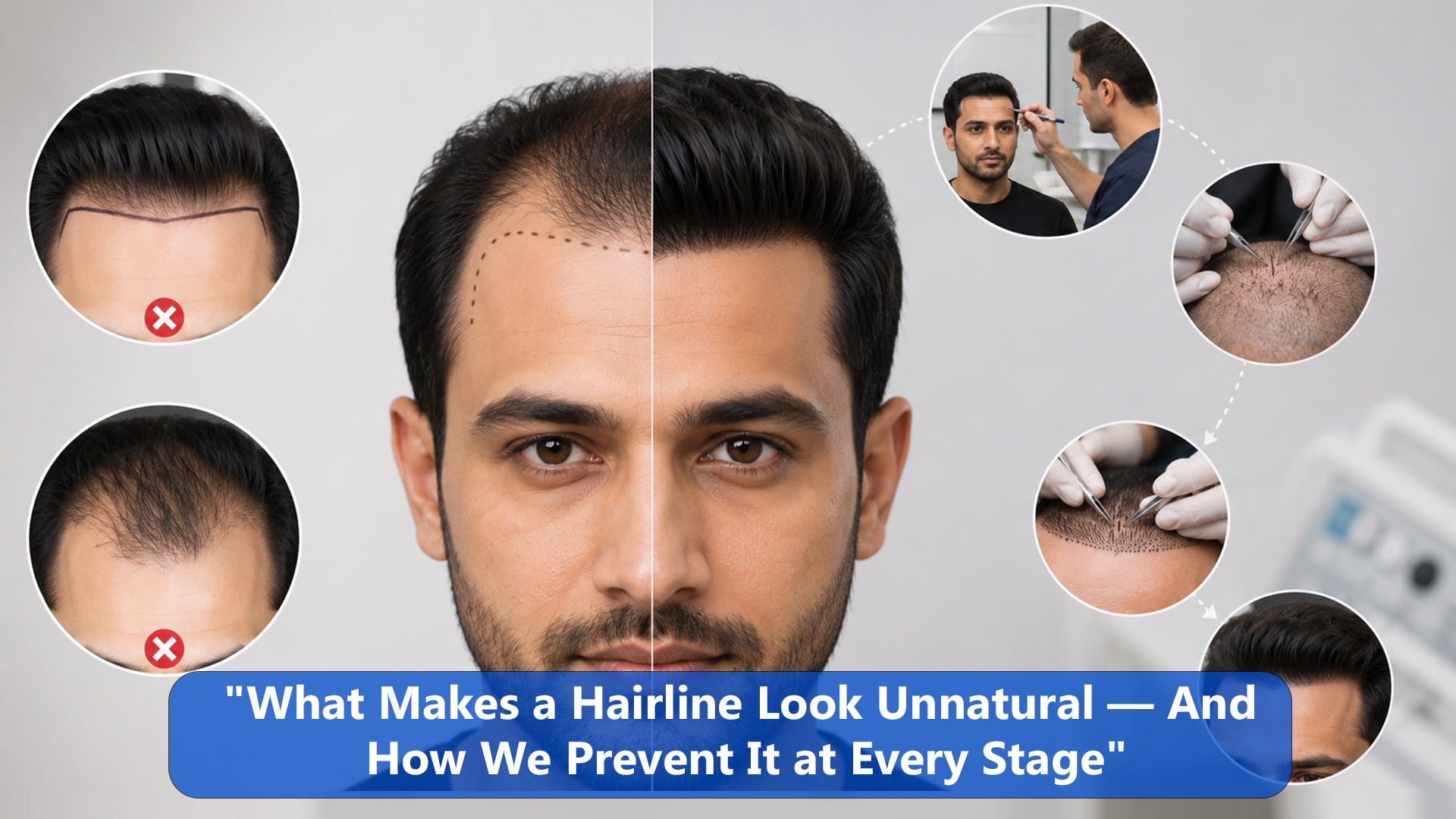
Of all the ways a hair transplant can fall short, an unnatural hairline is the most visible and the hardest to ignore. It is not something that improves with time. It is not something that is only noticeable up close. An unnaturally designed or poorly executed hairline is visible in photographs, in conversation, in mirrors, and in the perception of everyone the patient interacts with.
Understanding what creates an unnatural hairline, and what prevents it, is valuable both for patients evaluating clinics and for patients already planning a procedure. The factors that determine hairline naturalness are almost entirely within the surgeon's control. They are decisions made in the planning stage and executed during the procedure, not outcomes determined by luck or biology.
If you want to understand exactly what goes into designing a hairline that will never be identified as a transplant, a consultation at RECOMB gives you that clinical picture directly.
Book a Hairline Design Consultation at RECOMB, Surat →
WhatsApp: +91 7624008000 | www.recombhair.com
Why the Hairline Is the Most Scrutinised Part of Any Transplant
The hairline sits at the intersection of the scalp and the face. It frames every facial feature and is visible in every social interaction. Unlike density in the midscalp or crown, which requires specific lighting or a particular angle to evaluate, the hairline is assessed continuously and automatically by every person who looks at a face.
This means errors at the hairline are disproportionately consequential. A poorly distributed graft placement in the crown is noticeable only under certain circumstances. An incorrectly designed or poorly executed frontal hairline is visible in every interaction the patient has for the rest of their life.
It also means that the hairline carries the full burden of first impression. A hairline that looks natural immediately signals a natural result to any observer, whether they are examining the scalp critically or simply having a conversation. A hairline that looks constructed immediately raises the question of what else about the hair is constructed.
Cause 1: A Hairline Placed Too Low
This is the most common cause of an unnatural-looking result in the Indian hair transplant market, and it is almost entirely a planning failure rather than a surgical one.
A very low hairline looks appropriate on a face in its mid-twenties. On the same face at 40, it looks wrong because adult men's hairlines naturally sit higher than adolescent ones, and because a low frontal hairline on an older face creates a proportion that the brain registers as inconsistent with age. The result looks not just like a transplant but like a transplant designed for a face 15 years younger.
The underlying cause is usually one of two things: either the patient requested a low hairline and the surgeon complied without clinical pushback, or the clinic lowered the hairline to create a more dramatic before-and-after photograph that serves marketing purposes rather than the patient's long-term interest.
A responsible hairline placement accounts for the face the patient will have in two decades, not just the face they have today. This requires designing slightly higher and slightly more receded than the patient's immediate preference often dictates. Explaining this to a patient in a way they genuinely understand and accept is one of the more demanding aspects of pre-surgical counselling, but it is non-negotiable for a result that will age well.
Cause 2: A Straight or Geometric Hairline Edge
A perfectly straight hairline is one of the clearest visual signals of a transplant because it does not exist in nature. Natural hairlines have micro-irregularities along their front edge. Individual hairs sit slightly forward of the general line, others slightly behind. The edge undulates gently rather than running in a clean geometric arc.
The brain is extraordinarily sensitive to this distinction. A straight hairline edge looks constructed even if every other aspect of the transplant is perfect, because the pattern of regularity that straight lines represent is incompatible with biological growth.
This error can result from hairline design that was drawn with a surgical marker without deliberate introduction of irregularity, or from implantation that followed a regular spacing pattern rather than a naturalistic one. Preventing it requires designing the hairline with intentional micro-variation at the drawing stage and then executing that variation consistently during implantation.
Cause 3: Incorrect Graft Type at the Hairline Edge
The very front row of the hairline must consist exclusively of single-hair grafts. A natural hairline begins with individual fine hairs emerging at a shallow angle, creating a soft, gradual transition from skin to hair. This is what the brain registers as the beginning of a naturally occurring hairline.
When two or three hair grafts are placed at the hairline edge, the front row is immediately too dense. The transition from scalp to hair is abrupt rather than gradual. The result looks like a wall of hair beginning at a defined line rather than a natural emergence of individually growing hairs.
This is a planning and execution error that occurs when insufficient single-hair grafts are available or when the implantation is not sufficiently precise to maintain consistent graft type placement by zone. It is also an error that can result from over-harvesting in the donor area that reduces the proportion of available single-hair units, or from inadequate graft sorting during the procedure.
Cause 4: Incorrect Graft Angulation
Each graft must be implanted at the specific angle and direction of natural hair growth in its zone. At the frontal hairline, natural hair grows forward and slightly downward at an acute angle, typically 15 to 30 degrees relative to the scalp surface. In the temples the direction changes to follow the natural temporal sweep. These angles are not uniform across the hairline: they vary by position and must be individually calibrated during both site creation and implantation.
A graft placed at even five to ten degrees from the correct angle grows in a direction inconsistent with the surrounding hair. The result is not dramatic in isolation but creates a collective impression of hair that does not lie correctly or flow naturally. In certain lighting conditions, incorrectly angled grafts catch light differently from the surrounding hair and become immediately obvious.
Achieving correct angulation requires recipient sites to be created at the precise angle intended, and grafts to be placed within those sites maintaining their original orientation without rotation or tilting. This is a technical skill that improves significantly with case volume and is significantly compromised when procedures are performed by technicians rather than experienced surgeons.
Cause 5: No Temporal Recession
An adult male hairline that runs continuously from temple to temple without any recession looks like a hairline reconstructed without understanding how adult male hair growth actually works. No man past his early twenties has a continuously straight hairline with no temporal recession. The temples recede with age as part of normal adult hairline maturation, and this is true regardless of whether the person has androgenetic alopecia.
A transplanted hairline with no temporal recession looks immediately like a wig line. It is one of the most reliably identifiable markers of a poorly planned transplant because the shape it creates does not correspond to any naturally occurring adult male hairline.
Designing appropriate temporal recession requires the surgeon to place the temples at a position that reflects the patient's age, facial structure, and projected future hair loss, not at the position the patient remembers their hair occupying at 18.
Cause 6: Uniform Density Across the Hairline Zone
A natural hairline does not have uniform density from the front edge to the deeper frontal zone. It has a gradient: lowest density at the very front, progressively increasing as you move further into the scalp. This gradient is what creates the impression of a naturally growing hairline rather than a planted one.
When the entire frontal zone is implanted at a uniform density with no gradient, the result looks artificial even when the hairline edge itself is well-designed. The brain registers the absence of the transition that biology always provides.
Creating this gradient requires deliberate planning of density targets by sub-zone within the frontal area, lower at the hairline edge, progressively denser moving back. It also requires discipline to resist the patient's instinct to request maximum density everywhere, which flattens the gradient and undermines naturalness for the sake of a denser appearance in isolation.
How RECOMB Prevents Each of These at Every Stage
Prevention happens at three distinct points in the process at RECOMB, and failing to address any one of them can undermine the others.
At the planning stage, Dr. Krishna Bhalala and Dr. Nilesh Kachhadiya map the hairline position based on the patient's facial measurements, age, and projected future loss, not on patient preference alone. The position is discussed with the patient with a full explanation of why the recommended placement accounts for their 45-year-old face rather than their current one. Temporal recession angles are designed specifically for the patient's facial structure. Zone density targets are set with a gradient from the hairline edge inward.
At the design stage before any extraction begins, the hairline is drawn on the scalp with deliberate micro-variation along the front edge. This drawing is confirmed with the patient standing upright in a natural position, not lying down, since the relationship between hairline and facial proportions is only fully visible when gravity affects the facial tissues in their normal orientation.
At the execution stage, single-hair grafts are sorted and reserved specifically for the hairline edge before implantation begins. Recipient site creation at the hairline is performed at the precise angles and directions mapped in the design, with calibrated instruments matched to the diameter of single-hair grafts. Implantation maintains each graft's orientation within its site to preserve the angulation determined by the site creation.
Each of these stages requires time, specific equipment, experienced surgical judgment, and a clinical framework where the outcome for the patient in 20 years takes precedence over the outcome for the clinic's next booking.
Get a Hairline Designed to Last Decades, Not Just Look Good Today →
WhatsApp: +91 7624008000 | www.recombhair.com
RECOMB's Approach (2026)
At RECOMB Hair Transplant Centre, Surat, the naturalness of the hairline is treated as the primary quality indicator of every procedure, not the graft count or the before-and-after photograph. A transplant that places an impressive number of grafts but produces an unnatural hairline has failed its most important test regardless of its other metrics.
The combination of Dr. Bhalala's dermatological background in scalp physiology and follicle biology and Dr. Kachhadiya's plastic and reconstructive surgical training in aesthetic proportion and technical precision means that hairline naturalness is approached from both its medical and artistic dimensions simultaneously. These are not separable in practice: a hairline that is medically appropriate in its position but artistically poor in its execution will look wrong just as reliably as one designed without clinical judgment.
Final Takeaway
An unnatural hairline is never accidental. It is the result of specific, identifiable decisions made at the planning or execution stage: a hairline placed too low, an edge that is too straight, incorrect graft types at the front row, wrong angulation, absent temporal recession, or uniform density where a gradient should exist.
Every one of these failures is preventable. Prevention requires a surgeon who prioritises what the hairline will look like in 20 years over what it looks like in the before-and-after photograph, and who has the skill, the equipment, and the clinical framework to execute that priority consistently.
Patients evaluating clinics should ask directly: how is the hairline position determined, what creates the natural irregularity at the hairline edge, and who specifically creates the recipient sites and performs the implantation. The answers to these questions reveal whether the clinic's approach to hairline design is clinical and considered or whether it is guided by patient preference and production volume.
Dr. Krishna Bhalala and Dr. Nilesh Kachhadiya conduct a limited number of personal consultations each week at RECOMB, Surat. If you want to see exactly what a hairline designed for your specific face and your long-term hair loss pattern would look like, this is where that conversation starts.
See What a Hairline That Will Never Be Identified Looks Like →
WhatsApp: +91 7624008000
We respond within 24 hours, 6 days a week.
www.recombhair.com
Contact RECOMB Hair Transplant Centre