
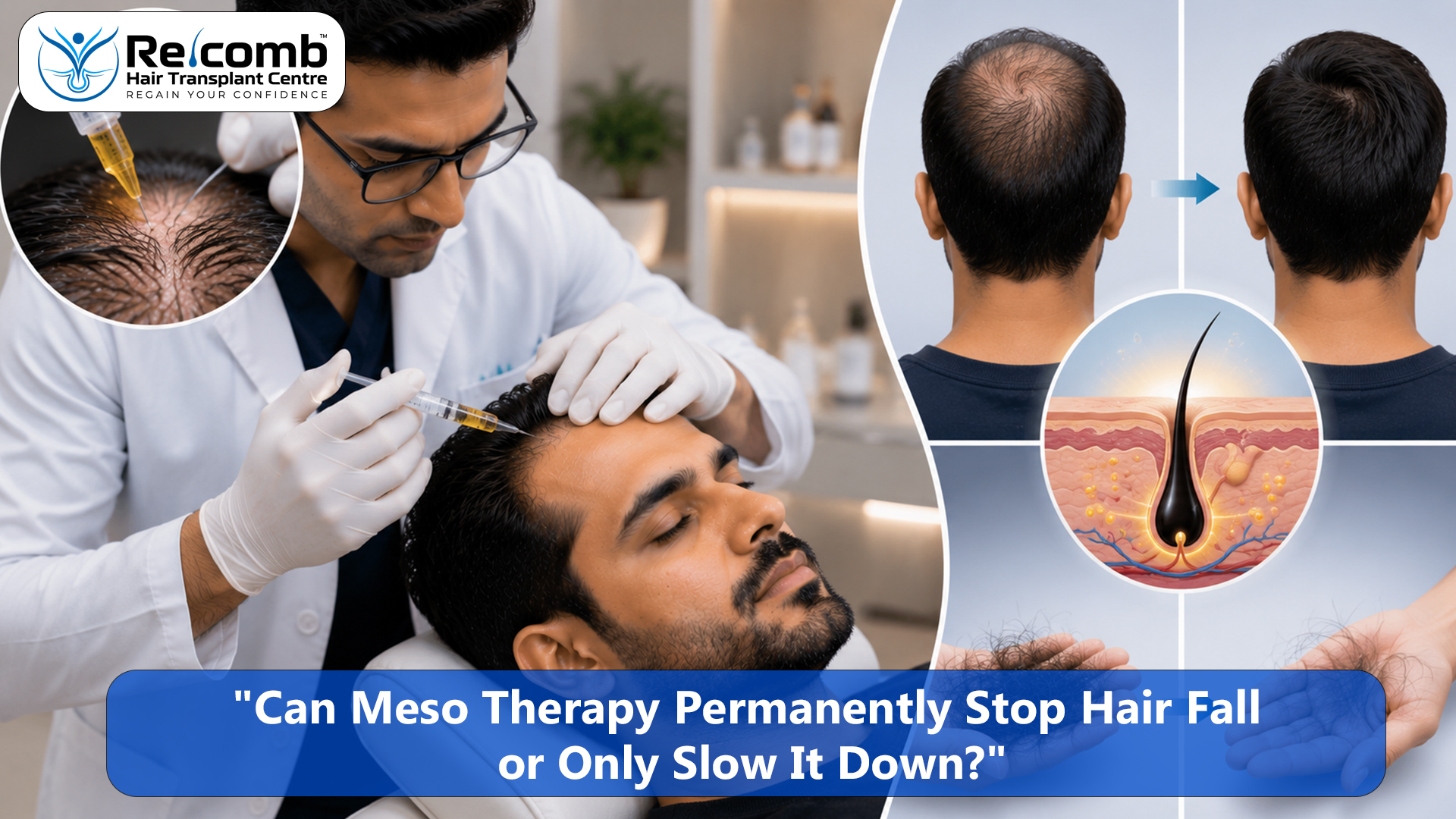
Mesotherapy is one of the most widely recommended non-surgical hair loss treatments in India, and one of the most frequently misunderstood in terms of what it actually achieves. Patients who start a course of mesotherapy sessions often ask, directly or implicitly, a version of the same question: if I complete enough sessions, will my hair fall stop permanently?
The honest clinical answer is nuanced, and patients deserve it directly rather than through the vague reassurances that characterise many non-surgical treatment consultations.
This blog explains what mesotherapy can achieve, how long those effects last, why permanence is not the right expectation for any patient with androgenetic alopecia regardless of how many sessions they complete, and what role mesotherapy genuinely plays in a long-term hair management plan.
If you are currently on mesotherapy and want an honest assessment of whether it is achieving what your clinical situation requires, a consultation at RECOMB gives you that directly.
Book a Mesotherapy Review Consultation at RECOMB, Surat →
WhatsApp: +91 7624008000 | www.recombhair.com
What Mesotherapy Does at the Follicular Level
To understand why permanence is not achievable through mesotherapy, it helps to understand what mesotherapy actually does at the biological level.
Mesotherapy delivers a formulated combination of vitamins, amino acids, minerals, and where indicated pharmaceutical agents including local minoxidil and DHT-blocking compounds directly into the scalp tissue at the follicular level. This local delivery achieves higher tissue concentrations of these active compounds than oral or topical administration and bypasses systemic metabolism.
The effects of this delivery are meaningful but temporary by their biological nature. Vitamins and amino acids are metabolised and consumed by the follicle in its normal functioning. The locally delivered minoxidil exerts its vasodilatory effect on scalp capillaries for a period of hours to days before being cleared. DHT-blocking compounds reduce local androgen receptor activity for a defined period before their effect dissipates.
This means mesotherapy creates a series of improved follicular environments, each lasting days to weeks, that cumulatively support better follicle health than no treatment would produce. But once the treatment course ends, and once the last session's effects have cleared, the follicular environment returns toward its pre-treatment baseline because the underlying causes driving hair loss, primarily DHT in androgenetic alopecia, are still present.
The treatment does not modify the genetic susceptibility of follicles to DHT. It does not alter the 5-alpha reductase enzyme activity that converts testosterone to DHT at the follicular level. It does not repair permanently the dermal papilla structure in follicles that DHT has been damaging progressively. What it does is improve the environment in which those biological processes are occurring, temporarily reducing the burden on follicles that are under stress from multiple directions simultaneously.
What Mesotherapy Can Achieve: The Honest Picture
For patients with early to moderate hair loss where follicles are miniaturising but still active, a properly conducted mesotherapy course can produce the following outcomes.
Reduced shedding rate during and for a period following the active course. Follicles receiving adequate local nutrition, improved circulation, and reduced local DHT activity shed less aggressively than those in a depleted or inflamed environment. This reduction in shedding is real and is often the first benefit patients notice, typically within four to eight weeks of starting treatment.
Improved hair shaft diameter in miniaturising follicles. Follicles that have been producing progressively thinner hairs can produce slightly thicker shafts when the nutritional and circulatory environment around them is improved. This shaft diameter improvement is visible under trichoscopy and contributes to a perception of improved density even before significant regrowth occurs.
Modest density improvement in some patients with early loss where a significant proportion of follicles remain active and responsive to growth factor and nutritional support. This improvement is not dramatic and is not consistent across all patients, but it is measurable in a proportion of responding patients.
Slowing of the progression rate of miniaturisation in follicles that are in the early stages of DHT-driven decline. By improving the follicular microenvironment, mesotherapy reduces the rate at which borderline follicles complete their miniaturisation. This slowing effect extends the window during which those follicles remain viable and responsive to other treatments.
None of these effects are permanent in isolation. Each depends on the continued provision of the treatment to sustain the improved environment. When treatment stops, the improvements begin to reverse over weeks to months.
Why Permanence Is Not Achievable Through Mesotherapy Alone
The reason mesotherapy cannot permanently stop hair fall in androgenetic alopecia is the same reason no non-surgical treatment permanently stops it: the genetic mechanism driving the condition continues regardless of treatment.
DHT is continuously produced from testosterone through 5-alpha reductase activity in the follicle. Genetically susceptible follicles continuously bind DHT through their androgen receptors. The cumulative effect of this ongoing process is progressive shortening of the anagen phase over each successive hair cycle until the follicle stops producing visible hair.
Finasteride permanently reduces the rate of DHT production for as long as it is taken. Even finasteride does not permanently stop androgenetic alopecia because it works by reducing rather than eliminating DHT, and because its effect requires continuous dosing to be maintained. When finasteride is stopped, DHT levels return to baseline and progression resumes.
Mesotherapy has less sustained effect on DHT than systemic finasteride. The local DHT-blocking components delivered through mesotherapy reduce androgen receptor activity at the injection sites during the period the compounds are active. They do not inhibit the 5-alpha reductase enzyme systemically. When the locally delivered compounds clear, DHT activity at the follicle returns to its previous level.
This means mesotherapy's anti-androgenic contribution is a series of temporary reductions in local DHT activity rather than a sustained suppression. It contributes meaningfully to a multi-treatment approach but cannot replicate what systemic finasteride provides when used consistently.
The Role Mesotherapy Genuinely Plays
Given the above, a fair and clinically accurate description of mesotherapy's role in hair loss management is the following.
Mesotherapy is a meaningful adjunctive treatment that improves the follicular environment and reduces the rate of decline in follicles under androgenetic stress. Used alongside finasteride and minoxidil, it addresses dimensions of the hair loss problem that systemic medications do not specifically target: local nutritional repletion, scalp microcirculation enhancement, and directly delivered anti-inflammatory activity. The combination is more effective than either systemic medical management or mesotherapy alone.
Mesotherapy is particularly valuable for patients who cannot or do not want to take systemic finasteride, where it provides a local DHT-reducing effect that partially compensates for the absence of systemic DHT suppression.
Mesotherapy is a useful scalp preparation tool before hair transplant surgery and a useful post-surgical support treatment during the graft growth period, as described in the pre-surgical mesotherapy and post-operative care blogs.
Mesotherapy is not a permanent solution to androgenetic alopecia. It requires ongoing sessions to maintain its effects. Stopping treatment after a course allows the follicular environment to deteriorate back toward its untreated baseline over weeks to months.
How Long the Effects Last Without Maintenance
Patients who complete a four to six session initial course and then stop entirely typically notice a gradual return of shedding over the following three to six months as the locally delivered compounds clear and the follicular environment returns toward its pre-treatment state.
The rate of return varies between patients and depends on what other treatments are in place. A patient on concurrent finasteride and minoxidil who stops mesotherapy after a course will retain more of the improvement than a patient using mesotherapy as a standalone treatment, because the systemic medical management continues to address the DHT and circulation dimensions while only the specific mesotherapy contributions, local nutrition, enhanced microcirculation, and directly delivered anti-androgenic activity, are lost.
This is why maintenance sessions are part of every properly planned mesotherapy protocol. The initial course establishes the improved follicular environment. Maintenance sessions every three to six months sustain it. Stopping entirely reverses it.
What Patients Should Expect and Plan For
Mesotherapy as part of a long-term hair management plan is a reasonable commitment for the right patient. The question patients should ask before starting is not whether mesotherapy will permanently stop their hair fall, because the honest answer is that it will not. The question is whether the improvements it produces, reduced shedding rate, improved shaft quality, slower progression of miniaturisation, and scalp environment support, justify the ongoing time and cost commitment for their specific clinical situation.
For patients with early loss who want active non-surgical management alongside finasteride and minoxidil, the answer is often yes. The combination addresses the problem from multiple directions and the mesotherapy contribution is meaningful within that framework.
For patients with advanced loss where most follicles in the affected zone have already miniaturised beyond response, the answer is no. Mesotherapy cannot stimulate follicles that have stopped producing hair. The right treatment for those patients is a different conversation.
For patients who are planning surgery, mesotherapy as a preparatory and post-operative support treatment is a clearly justified investment in the quality of the surgical outcome, as discussed in the pre-surgical mesotherapy blog.
Get a Clinical Assessment of Whether Mesotherapy Is Serving Your Hair Loss →
WhatsApp: +91 7624008000 | www.recombhair.com
RECOMB's Approach (2026)
At RECOMB Hair Transplant Centre, Surat, mesotherapy is recommended when the clinical assessment identifies a specific role it can fill in the patient's treatment plan. It is not recommended as a standalone permanent solution for androgenetic alopecia because that is not what the treatment provides.
Dr. Krishna Bhalala and Dr. Nilesh Kachhadiya assess each patient's specific combination of hair loss type, stage, concurrent treatments, and response to prior treatment before recommending mesotherapy. Patients who start a mesotherapy course at RECOMB understand from the outset what the treatment will and will not achieve, how long the effects last, what maintenance is required to sustain them, and how mesotherapy fits within the broader treatment plan that addresses their condition from all relevant directions.
The goal is not to provide a treatment that patients return for indefinitely without a clear understanding of what they are receiving. It is to provide a treatment that contributes a specific, justified clinical value within a plan that they understand and can evaluate.
Final Takeaway
Mesotherapy cannot permanently stop hair fall in patients with androgenetic alopecia. No currently available non-surgical treatment can. What mesotherapy can do is meaningfully slow the progression of miniaturisation, reduce shedding rate, improve hair shaft quality, and support follicle health in patients with early to moderate loss, for as long as treatment is maintained.
Understanding this distinction is not discouraging. It is the information that allows patients to use mesotherapy appropriately, within a combination treatment framework that addresses the multiple mechanisms of their hair loss, with realistic expectations about what each component contributes and for how long.
Dr. Krishna Bhalala and Dr. Nilesh Kachhadiya conduct a limited number of personal consultations each week at RECOMB, Surat. If you are on mesotherapy and want to know whether it is genuinely contributing to your hair loss management or whether your plan needs adjustment, this is where that honest assessment happens.
Get an Honest Review of Whether Your Hair Loss Plan Is Working →
WhatsApp: +91 7624008000
We respond within 24 hours, 6 days a week.
www.recombhair.com
Contact RECOMB Hair Transplant Centre
RECOMB Hair Transplant Centre
19, Ground Floor, Zenon Building, Opp. Unique Hospital, near Kiran Motors, Khatodara Wadi, Surat, Gujarat 395001
Phone: +91 7624008000
Website: www.recombhair.com