
Hair transplant clinics across India market technology heavily. Sapphire blades, robotic systems, advanced implanter pens, titanium punches, AI-assisted hairline design. The implication in all of this marketing is that equipment is the primary determinant of outcome, and that the most technologically equipped clinic will produce the best result.
This is not how hair transplantation actually works.
Technology in hair restoration is a supporting factor. The right instruments in the right hands produce better results than inferior instruments. But the best instruments in inadequately skilled or insufficiently experienced hands do not produce good results, and mediocre instruments used by an experienced surgeon with sound clinical judgment consistently outperform advanced technology deployed without that judgment.
This blog explains what tools and technology RECOMB actually uses, why each is used, what clinical problem each solves, and where the honest limits of what equipment contributes to outcomes lie.
Trichoscopy and Scalp Imaging
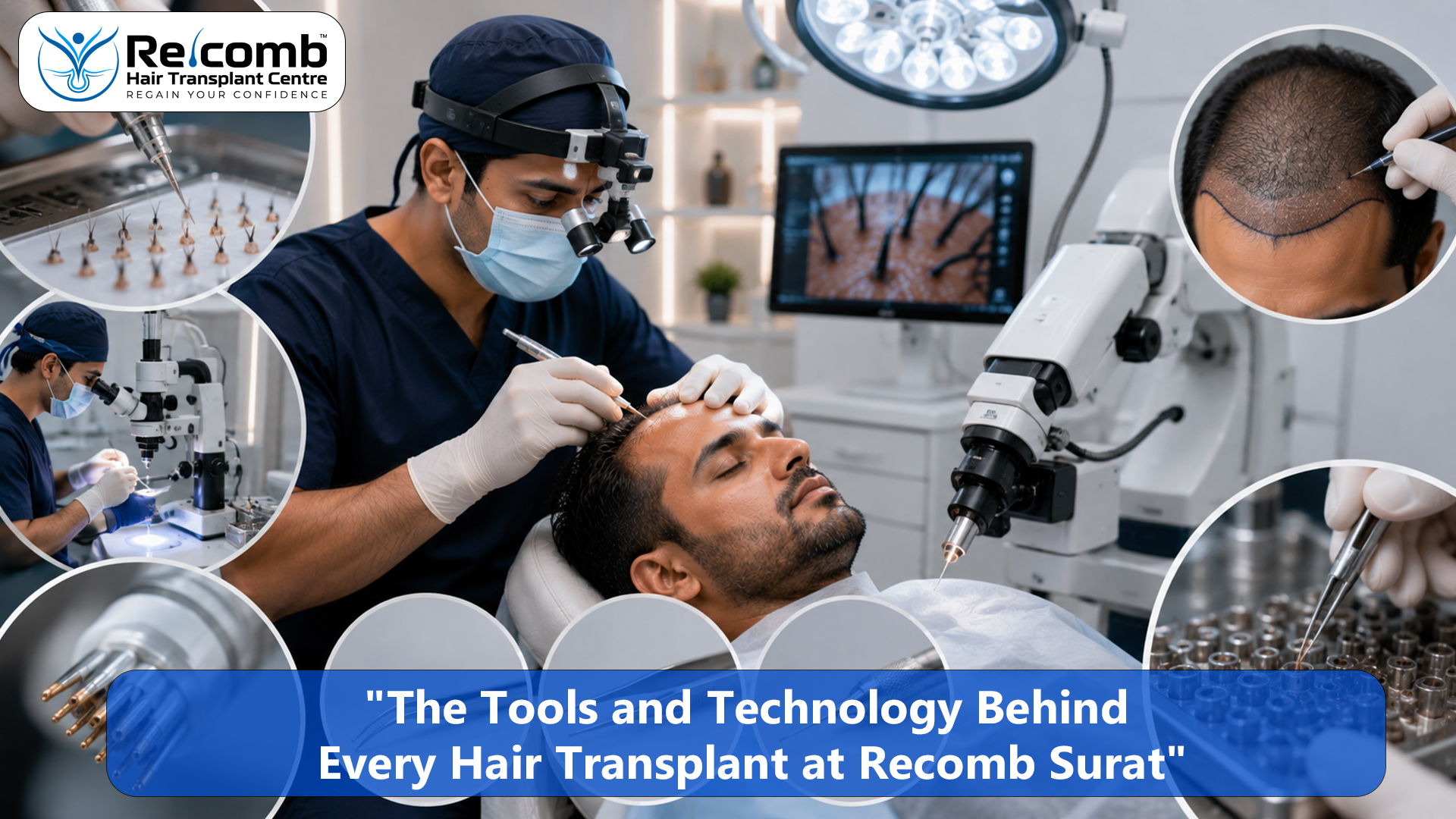
The most clinically important piece of technology in RECOMB's assessment and planning process is the dermatoscope used for trichoscopy. As detailed in the scalp analysis blog, this instrument provides magnified examination of the scalp at 10 to 70 times, revealing follicle miniaturisation patterns, donor density measurements, and scalp condition information that cannot be obtained through visual examination alone.
The specific dermatoscope used at RECOMB provides high-resolution imaging of the scalp with consistent lighting that allows comparison between examinations over time. This is clinically important because tracking changes in follicular density, miniaturisation extent, and donor zone health at follow-up visits requires reliable comparable imaging rather than subjective visual impression.
Trichoscopy-derived donor density measurement is the foundation of the graft plan. This is not marketing technology. It is the clinical measurement that separates a calculated graft recommendation from an estimate.
The FUE Punch: What Size and Type Actually Matter
In FUE hair transplant, the punch tool that makes the circular incision around each follicular unit during extraction is the instrument most commonly discussed in marketing terms. Clinics advertise specific punch diameters, specific materials including titanium or diamond coating, and specific motion types including rotary versus oscillating.
The clinically relevant considerations for punch selection are more specific than marketing suggests.
Punch diameter is the most important variable. Smaller punches, typically 0.7 to 0.9 millimetres, produce smaller extraction wounds that heal with less visible scarring and allow closer spacing between extraction sites, preserving more of the donor zone's visual density after the procedure. The appropriate diameter depends on the follicular unit size of the individual patient. A patient with larger follicular units requires a slightly larger punch to extract without transecting the follicle. Using a punch that is too small for the patient's follicle size increases transection rates and compromises graft survival. Matching punch diameter to the patient's specific follicle characteristics, assessed through trichoscopy before the procedure, is more important than the punch material or brand.
The sharpness of the punch edge is more clinically significant than its material. A sharp punch requires less force and rotation to penetrate to extraction depth, reducing the thermal and mechanical trauma to the follicle during the incision. Sharp punches are replaced or resharpened regularly at RECOMB because punch sharpness degrades with use and a dull punch increases follicle trauma regardless of how sophisticated its material composition is.
Oscillating versus rotary motion has genuine clinical relevance for specific hair types. Oscillating motion, where the punch rotates in alternating directions rather than continuous rotation, reduces the twisting force on the follicle during extraction, which is particularly relevant for patients with very curly hair where continuous rotation risks wrapping the follicle in the punch. At RECOMB, the motion type is selected based on the patient's hair characteristics rather than applied uniformly.
Graft Holding and Storage Solution
How grafts are stored between extraction and implantation directly affects graft survival, as discussed in the extraction to implantation blog. This is an area where the difference between good and inadequate practice is biologically significant but not visually obvious to the patient or easily marketed.
At RECOMB, extracted grafts are placed immediately into chilled physiological saline-based holding solution. The temperature is maintained at approximately four degrees Celsius using a controlled cooling system throughout the procedure. This temperature management slows the metabolic rate of the follicle outside the body, extending viability and maintaining the biological integrity required for successful growth after implantation.
The holding solution itself is a physiological preparation that maintains the ionic environment the follicle needs to remain viable. This is standard practice at any qualified facility and its importance is in consistent execution rather than in the specific branded product used.
The clinical outcome of proper graft holding is measurably better graft survival per unit than procedures where temperature management is inconsistent or the out-of-body time is extended beyond safe limits. The difference between 88 percent and 94 percent graft survival across 2,500 grafts is 150 additional growing grafts, which is a clinically significant density difference in the final result.
Recipient Site Creation Instruments
Recipient sites, the small incisions into which each graft is placed, are created using either a custom blade or a needle depending on the site size required and the graft type being implanted. The specific instrument used is less important than the calibration of the site to the graft it will receive.
At RECOMB, recipient site blades are selected based on the follicular unit type being placed in each zone. A site created for a single-hair graft at the hairline edge is smaller and at a more acute angle than a site created for a three-hair graft in the midscalp density zone. This calibration ensures that each graft fits its site without compression damage or excessive looseness, both of which compromise survival and orientation.
The angle and direction of each site is determined by the hairline design mapped in the pre-surgical assessment and varies across the scalp based on the natural growth direction of hair in each zone. This requires the surgeon to manually orient each incision individually rather than following a uniform direction across the recipient area, which is a time-consuming but clinically essential aspect of producing a natural result.
Implanter Pens
Implanter pens are devices that place grafts into recipient sites without the graft being handled by forceps during the implantation step. The graft is loaded into the implanter, which then deposits it at the correct depth with minimal direct contact.
The clinical advantage of implanters in appropriate cases is reduced handling trauma to the graft during placement and more consistent depth control compared to forceps implantation in some operators. The disadvantage is that implanters are less adaptable to recipient sites of irregular depth or orientation, which can occur in scalp areas with variable thickness.
At RECOMB, the choice between implanter pen and forceps implantation is made based on the specific recipient zone characteristics rather than applied uniformly. Implanters are used where consistent depth and minimal handling trauma are the primary considerations. Forceps are used where adaptability to site variation is more important than standardised depth.
Neither is universally superior. The appropriate choice depends on the surgeon's experience with each method and the specific technical requirements of the zone being implanted.
Magnification and Lighting
Graft sorting and quality assessment, performed between extraction and implantation, requires magnification. At RECOMB, stereo microscopes are used for graft examination, allowing the assessment team to identify follicular unit type, detect transection or graft damage during extraction, and separate compromised grafts from viable ones before implantation.
Surgical loupes are used during extraction and implantation to provide the magnification required for precise punch placement and site creation at the correct depth and angle. The magnification level used is matched to the surgical task.
Consistent, high-quality lighting in the operating room is not a luxury. Adequate illumination is essential for accurate punch placement in the donor zone, correct site creation in the recipient area, and reliable graft quality assessment. Inadequate lighting increases error rates in each of these steps regardless of the quality of other instruments being used.
What Technology Cannot Do
This is the part of the technology conversation that marketing never addresses but that every patient should understand.
Technology cannot design a clinically appropriate hairline. The decision about where the hairline sits, what temporal angles reflect, and how the design accounts for the patient's age and future hair loss trajectory is made by the surgeon based on clinical judgment. No software or device produces these decisions. They require the application of medical knowledge, aesthetic judgment, and an understanding of how the face will change over decades.
Technology cannot determine the appropriate graft count. A graft recommendation requires trichoscopy-derived donor density measurement, zone-by-zone recipient area assessment, lifetime graft budget calculation, and future loss projection. These are clinical calculations. The instruments that facilitate the measurements do not make the decisions that follow.
Technology cannot compensate for inadequate surgical training or experience. The most advanced punch tool in the hands of a technician without surgical training will produce higher transection rates and less consistent depth control than a standard punch in the hands of an experienced surgeon. The surgical judgment applied in real time during extraction, the decision to adjust depth at a specific site, the recognition of a follicle approaching at an unusual angle, and the adaptation of technique in response to scalp characteristics encountered during the procedure cannot be built into equipment.
Technology cannot guarantee graft survival. Graft survival depends on the combination of extraction technique, holding solution temperature management, recipient site calibration, implantation precision, and scalp vascularity. Equipment contributes to several of these but does not control all of them.
RECOMB's Approach (2026)
At RECOMB Hair Transplant Centre, Surat, instrument selection follows clinical need rather than marketing preference. Every instrument used in the procedure is selected for a specific clinical reason related to the patient's hair characteristics, the zones being treated, and the technical requirements of the procedure planned.
Dr. Krishna Bhalala and Dr. Nilesh Kachhadiya perform every critical stage of each procedure personally, using appropriate instruments selected for that patient's case. The clinical decisions that determine outcome, hairline design, punch selection and depth, recipient site calibration, graft type allocation by zone, are made by experienced surgeons, not delegated to technology or to technicians operating technology.
The instruments at RECOMB are current, well-maintained, and appropriate to the standard of care. They are not the most expensive available in every category because expense does not determine clinical appropriateness. They are the instruments that serve the patient's result best for their specific clinical profile.
Understand What Actually Determines Your Result at RECOMB →
WhatsApp: +91 7624008000 | www.recombhair.com
Final Takeaway
Technology in hair transplant surgery is a supporting factor, not the primary determinant of outcome. The instruments that matter most are those used in assessment and planning, particularly trichoscopy for donor density measurement and follicular miniaturisation mapping, and those that support consistent graft survival, including calibrated punch selection and temperature-controlled graft holding.
The decisions that most directly determine whether a result looks natural and lasts well are clinical and surgical: hairline design, graft plan, zone prioritisation, site calibration, and the surgical judgment applied in real time during the procedure. These decisions are made by surgeons, not by equipment.
Patients evaluating clinics should ask not what equipment is used but who makes the clinical decisions and who performs the surgical steps. The answers to those questions predict outcome far more reliably than a list of technology brand names.
Dr. Krishna Bhalala and Dr. Nilesh Kachhadiya conduct a limited number of personal consultations each week at RECOMB, Surat. If you want to understand specifically how your procedure would be planned and executed, this is where that conversation happens with complete transparency.
Find Out What Goes Into Your Procedure at RECOMB Before You Commit →
WhatsApp: +91 7624008000
We respond within 24 hours, 6 days a week.
www.recombhair.com
Contact RECOMB Hair Transplant Centre
RECOMB Hair Transplant Centre
19, Ground Floor, Zenon Building, Opp. Unique Hospital, near Kiran Motors, Khatodara Wadi, Surat, Gujarat 395001
Phone: +91 7624008000
Website: www.recombhair.com