
Many patients who undergo their first hair transplant often ask:
“When should I plan my second sitting?”
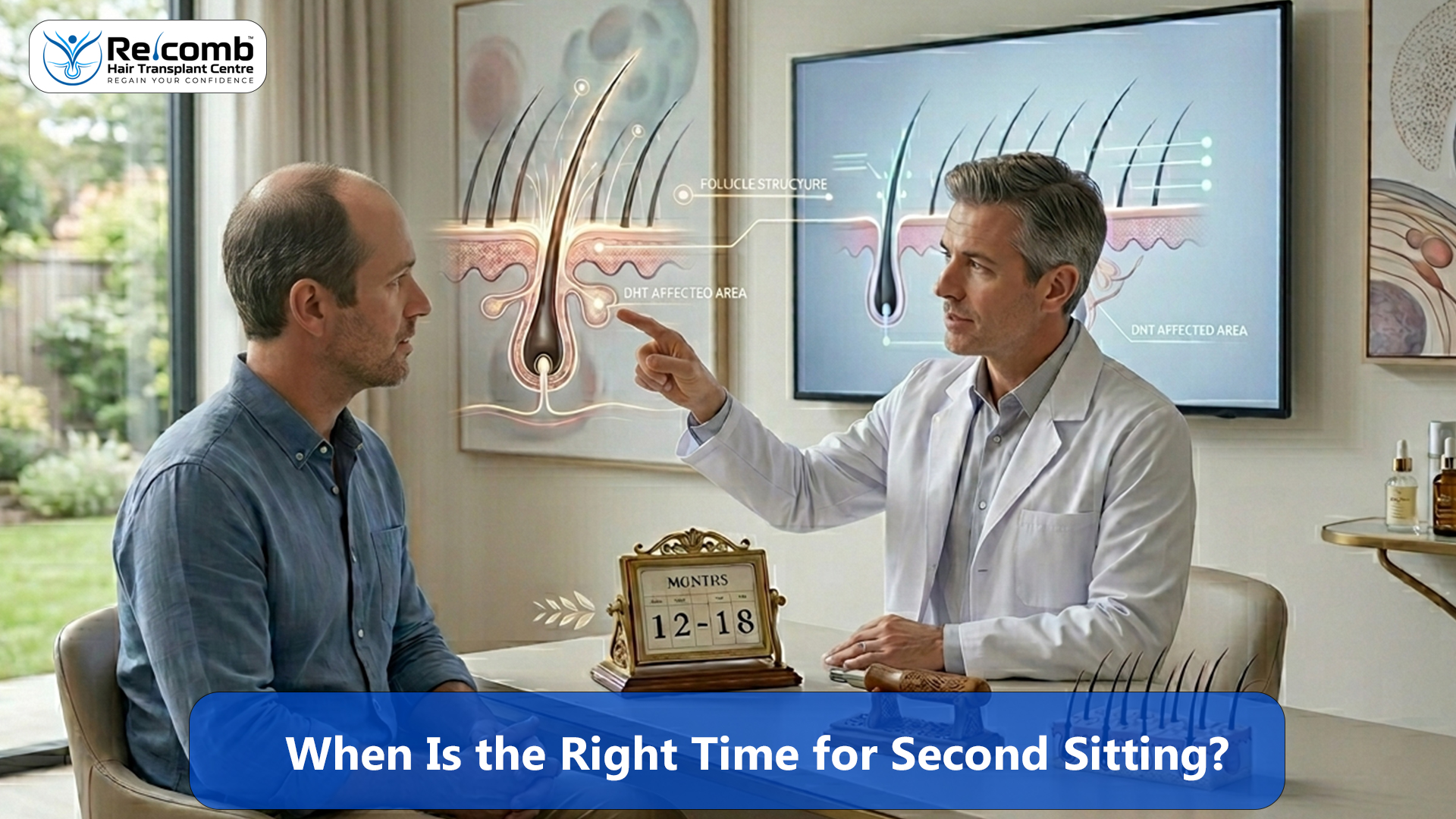
The answer is not fixed. It depends on healing, growth assessment, donor availability, and future planning.
At RECOMB Hair Transplant Centre, second sittings are planned strategically—not routinely—to ensure long-term natural results.
Why a Second Sitting May Be Needed
A second session is usually considered when:
- Baldness is extensive (Grade 4–7)
- Crown was not covered in first session
- Higher density is desired
- Hair loss has progressed further
- First session was planned in stages
Hair transplant is often a phased restoration process, not always a single procedure.
Ideal Time Gap Between Two Sessions
Recommended Gap:
6 to 12 months
Why Waiting Is Important
1. Full Growth Assessment
Hair growth timeline:
- 3–4 months → initial growth
- 6–8 months → visible improvement
- 10–12 months → final density
Planning a second sitting before full growth can lead to:
- Overestimation or underestimation of required grafts
- Improper density planning
2. Complete Healing
The scalp needs time for:
- Tissue recovery
- Blood supply normalization
- Donor area healing
Operating too early may compromise graft survival.
3. Better Planning for Remaining Areas
After first session:
- Baldness pattern becomes clearer
- Future hair loss progression is easier to predict
- Graft distribution can be optimized
Situations Where Earlier Sitting May Be Considered
In selected cases:
- Large bald area with staged planning
- Strong donor area
- Patient understands long-term plan
Second sitting may be done around 6 months, but only after proper evaluation.
Situations Where You Should Delay Further
You should wait longer if:
- Hair growth is still incomplete
- Donor area is healing slowly
- Hair loss is still progressing
- You are unsure about density goals
Rushing can compromise final results.
Front vs Crown Planning in Second Sitting
Most commonly:
First Sitting:
- Focus on frontal hairline and mid-scalp
Second Sitting:
- Crown restoration
- Density enhancement
This approach gives:
- Better visual impact early
- Balanced long-term results
How Many Grafts in Second Sitting?
Depends on:
- Remaining bald area
- Donor availability
- Desired density
Typical range:
- 1,500 – 3,000 grafts
Each case varies significantly.
Signs You Are Ready for Second Sitting
You may be ready when:
- First transplant result is clearly visible
- Hair growth has stabilized
- Donor area looks healthy
- You have a clear expectation for next stage
A proper clinical evaluation is essential.
Common Mistakes to Avoid
Doing It Too Early
Leads to poor planning and uneven density.
Overusing Donor Area
May cause permanent thinning and limit future options.
Chasing High Density
Aggressive density can compromise graft survival.
Ignoring Future Hair Loss
Planning only for present leads to unnatural long-term results.
RECOMB’s Staged Planning Strategy (2026)
At RECOMB:
- Second sitting is recommended only when needed
- Graft usage is planned across multiple stages
- Donor preservation is prioritized
- Long-term hair loss progression is considered
The goal is natural, sustainable results—not rushed density.
Final Medical Takeaway
The right time for second sitting is:
6 to 12 months after first procedure
But more importantly:
- It should be based on growth assessment
- Donor health
- Long-term planning
Hair transplant is a journey—not a one-time event.
Contact RECOMB Hair Transplant Centre
Phone: +91 7624008000
Website: www.recombhair.com