
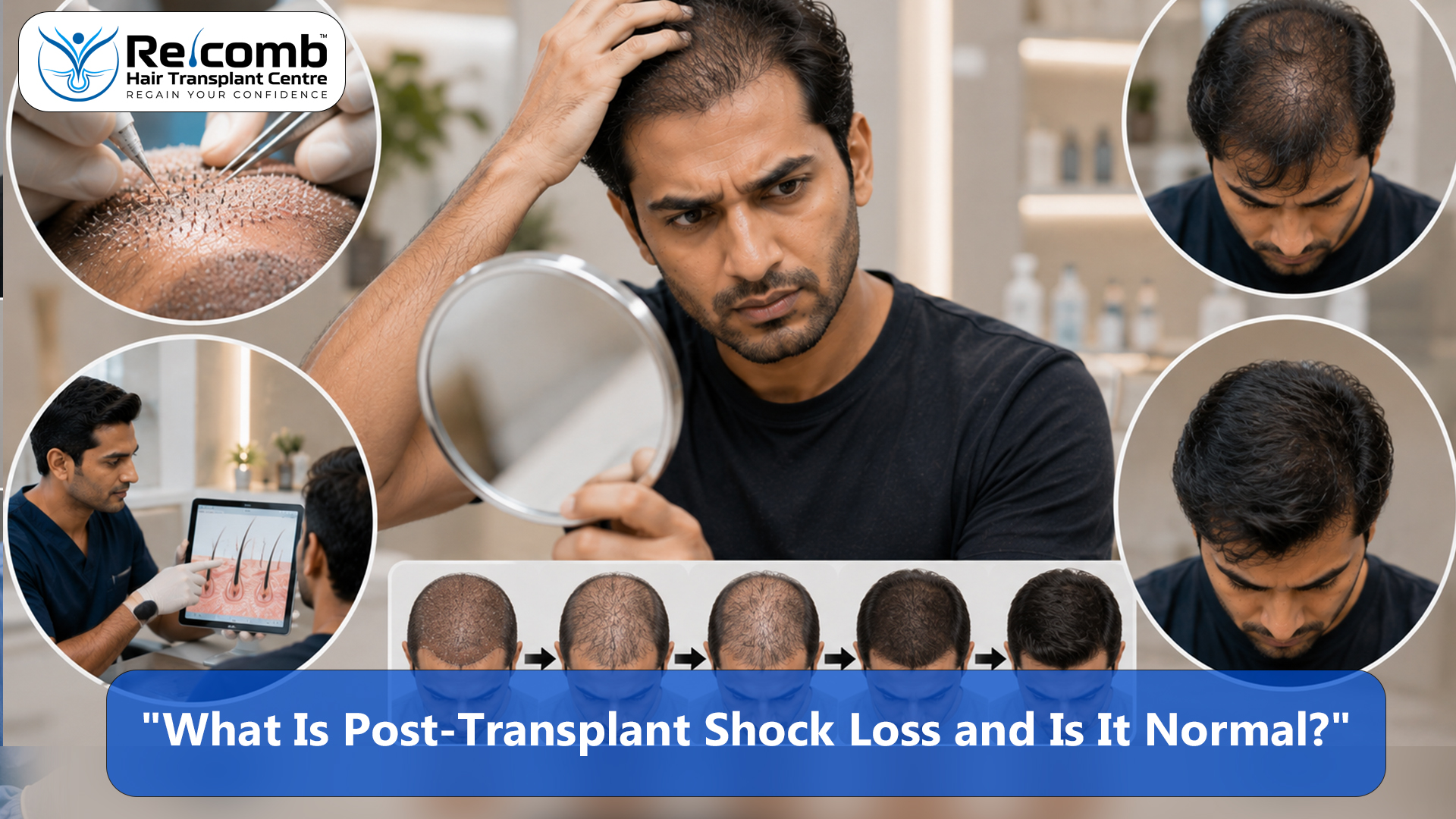
One of the most distressing experiences a hair transplant patient can have in the weeks following their procedure is watching their existing hair fall out. They came for more hair. Instead, they are losing what they had. The transplanted hairs have shed as expected and now native hairs that were present before the surgery seem to be falling too.
This phenomenon has a specific clinical name: shock loss, or effluvium following hair transplant surgery. It is real, it is common, and in most cases it is temporary. But understanding the difference between normal shock loss that resolves and a more significant problem that requires attention is something every patient deserves to know before their procedure, not after they are experiencing it.
This blog explains what shock loss is, why it happens, which hairs are affected, what the expected timeline for recovery is, and the clinical signs that distinguish normal post-operative shedding from a concern that warrants specific management.
What Shock Loss Actually Is
Shock loss refers to the temporary shedding of existing native hair in the recipient zone or adjacent areas following hair transplant surgery. It is not the shedding of transplanted hairs, which is a separate and expected process that occurs between weeks three and eight for a different biological reason. Shock loss is the shedding of hairs that were already present before the procedure.
The mechanism is well understood. Hair transplant surgery involves creating thousands of small recipient sites across the scalp, which represents a significant local tissue disruption. This disruption affects the blood supply, the inflammatory environment, and the mechanical stability of the scalp in the treated area. Native hair follicles in and around the recipient zone experience this disruption and respond by entering the resting phase of their growth cycle prematurely, releasing their existing hairs in the weeks following surgery.
This is the same mechanism as telogen effluvium triggered by other physiological stressors, such as illness, nutritional deficiency, or significant physical stress. The follicles are not permanently damaged by the disruption. They are temporarily pushed into resting mode by the stress of the procedure on the surrounding scalp environment. In the vast majority of cases, these follicles resume normal growth within three to six months of the surgery.
Which Hairs Experience Shock Loss
Understanding which hairs are and are not vulnerable to shock loss helps patients interpret what they are seeing after surgery.
Native hairs in the recipient zone, specifically hairs that were present in the thinning areas where the new grafts were placed, are the most commonly affected. These follicles are typically already miniaturising due to androgenetic alopecia and are therefore more susceptible to the additional stress of surgical disruption. A follicle that was already in a compromised state due to DHT-driven miniaturisation requires less additional stress to be pushed into telogen than a fully healthy follicle.
Native hairs in the area immediately surrounding the recipient zone can also experience shock loss, though typically to a lesser degree than those within the treated area itself.
Transplanted hairs, the grafts that were placed during the procedure, are not what is meant by shock loss. The shedding of transplanted hairs between weeks three and eight is called the telogen effluvium of the transplant and is a separate, expected process as discussed in the post-operative care blog. These hairs shed because the transplanted follicle enters a resting phase after the trauma of being moved, not because of the surgical disruption to the surrounding scalp.
Donor area hairs are not typically affected by shock loss because the donor zone is not the site of the surgical disruption that triggers the resting phase response.
The Timeline of Shock Loss and Recovery
Shock loss typically begins two to eight weeks after surgery. The shedding can be significant in volume and alarming to patients who were not expecting it or who were not adequately prepared for this possibility during their pre-surgical counselling.
The shedding phase typically lasts four to eight weeks. By the end of this period, most of the native hairs that entered telogen due to the surgical disruption have shed.
Recovery begins as the shocked follicles exit their resting phase and re-enter anagen. This typically occurs three to six months after surgery, overlapping with the timeline of early transplanted hair growth. By the time the transplanted hairs are producing visible growth at four to six months, most of the shocked native hairs have either recovered or are in the process of recovering.
At the twelve month assessment, the combined density of recovered native hair and matured transplanted hair represents the full result. In most patients with good shock loss recovery, the overall density at twelve months is meaningfully better than the pre-surgical baseline because both the transplanted grafts and the recovered native hairs contribute.
Who Is More Susceptible to Significant Shock Loss
While shock loss can occur in any hair transplant patient, certain clinical characteristics increase the likelihood and extent of it.
Patients with significant ongoing androgenetic alopecia in the recipient area are at higher risk because their native hairs in that zone are already miniaturised and vulnerable. A follicle that is already producing a thin, weak hair due to DHT exposure is closer to its threshold for entering telogen than a fully healthy follicle and requires less additional stress to cross it.
Patients who did not start finasteride before surgery have higher circulating DHT activity in the recipient area follicles, which compounds the surgical stress. This is one of several clinical reasons why medical management is recommended before surgery rather than only after it.
Patients with nutritional deficiencies, particularly low ferritin or vitamin D, have follicles with reduced metabolic capacity for managing the stress of surgical disruption. Correcting these deficiencies before surgery, as part of the pre-surgical preparation protocol, reduces the severity of shock loss in susceptible patients.
Large session volumes create more recipient sites and therefore more widespread surgical disruption to the scalp than smaller sessions. This is one of the clinical arguments for staged procedures in extensive loss cases rather than attempting comprehensive coverage in a single large session.
When Shock Loss Raises a Clinical Concern
Most shock loss is temporary and resolves within six months without specific intervention. The following patterns warrant clinical attention and should prompt a consultation rather than continued observation.
Shock loss that does not show signs of recovery by the six-month post-operative mark is beyond the expected timeline for a temporary telogen response. If native hairs that shed in the weeks following surgery have not produced any visible regrowth by month six, clinical assessment is warranted to evaluate whether those follicles have recovered or have been more permanently affected.
Shock loss that extends well beyond the recipient zone into areas of the scalp that were not part of the procedure suggests a more generalised telogen effluvium response that may have been triggered by the overall physiological stress of surgery, nutritional depletion, or an unidentified concurrent cause rather than the localised surgical disruption alone.
Shock loss accompanied by signs of scalp inflammation, redness, tenderness, or pustule formation in the recipient zone suggests an active folliculitis or infection that requires prompt clinical management rather than watchful waiting.
What Can Be Done to Reduce Shock Loss
Several clinical steps reduce the likelihood and severity of post-operative shock loss. All of these are most effective when implemented before the procedure rather than as a response to shedding that has already begun.
Starting finasteride before surgery reduces DHT activity in the recipient zone follicles before they are subjected to the additional stress of surgical disruption. Follicles with lower DHT burden have a higher threshold for shock loss entry and a more resilient recovery response.
Correcting nutritional deficiencies, particularly ferritin, vitamin D, and protein status, through targeted supplementation in the weeks before surgery provides the follicle with the metabolic resources needed to withstand surgical stress.
Post-operative GFC or PRP therapy, introduced at the three to four month mark when follicles are re-entering the growth phase, supports the recovery of shocked native follicles during their re-entry into anagen by providing growth factor signals that favour anagen phase entry over continued resting.
Avoiding unnecessary scalp trauma in the post-operative period, including aggressive washing, direct sun exposure to the recipient area, and strenuous physical activity that increases scalp sweating and blood flow to the area, reduces the secondary stressors that can compound the primary surgical disruption.
At RECOMB, patients are counselled about shock loss before their procedure, given specific guidance on reducing its severity, and monitored at the three and six month follow-up appointments specifically for native hair recovery progress in addition to transplanted hair growth.
Book a Post-Operative Assessment If You Are Experiencing Shock Loss →
WhatsApp: +91 7624008000 | www.recombhair.com
RECOMB's Approach (2026)
At RECOMB Hair Transplant Centre, Surat, shock loss is addressed as a known and manageable aspect of the post-operative experience rather than an unexpected complication. Dr. Krishna Bhalala and Dr. Nilesh Kachhadiya discuss its likelihood, typical timeline, and management approach with every patient during the pre-surgical consultation, so that when it occurs it is contextualised correctly rather than experienced as a sign that something has gone wrong.
The pre-surgical preparation protocol at RECOMB, including medical management initiation, nutritional assessment, and where indicated pre-surgical scalp optimisation through mesotherapy, is specifically designed to reduce the severity of shock loss by improving the baseline resilience of the recipient zone follicles before they are subjected to surgical disruption.
Post-operative follow-up at one, three, and six months includes specific assessment of native hair recovery alongside transplanted hair growth, so that any pattern suggesting incomplete shock loss recovery is identified at the point where intervention is most effective.
Final Takeaway
Post-transplant shock loss is a normal and expected aspect of the hair transplant recovery process for many patients. It represents a temporary resting phase response in native follicles triggered by the stress of surgical disruption, and it resolves in most patients within three to six months as those follicles re-enter the growth phase.
Understanding this before surgery allows patients to experience the post-operative period with accurate expectations rather than alarm. It also highlights the clinical value of pre-surgical preparation, medical management, and post-operative support treatments that reduce its severity and support recovery.
The patients who are most distressed by shock loss are those who were not told it was likely before their procedure. The patients who manage it most effectively are those who were prepared, monitored, and supported through the recovery period by a clinical team that treats follow-up as an integral part of the procedure rather than an optional extra.
Dr. Krishna Bhalala and Dr. Nilesh Kachhadiya conduct a limited number of personal consultations each week at RECOMB, Surat. If you are in the post-operative period and experiencing shock loss, or if you are planning a procedure and want to understand how RECOMB manages this aspect of recovery, this is where that conversation starts.
Understand Every Stage of Your Recovery Before and After Surgery at RECOMB →
WhatsApp: +91 7624008000
We respond within 24 hours, 6 days a week.
www.recombhair.com
Contact RECOMB Hair Transplant Centre
RECOMB Hair Transplant Centre
19, Ground Floor, Zenon Building, Opp. Unique Hospital, near Kiran Motors, Khatodara Wadi, Surat, Gujarat 395001
Phone: +91 7624008000
Website: www.recombhair.com