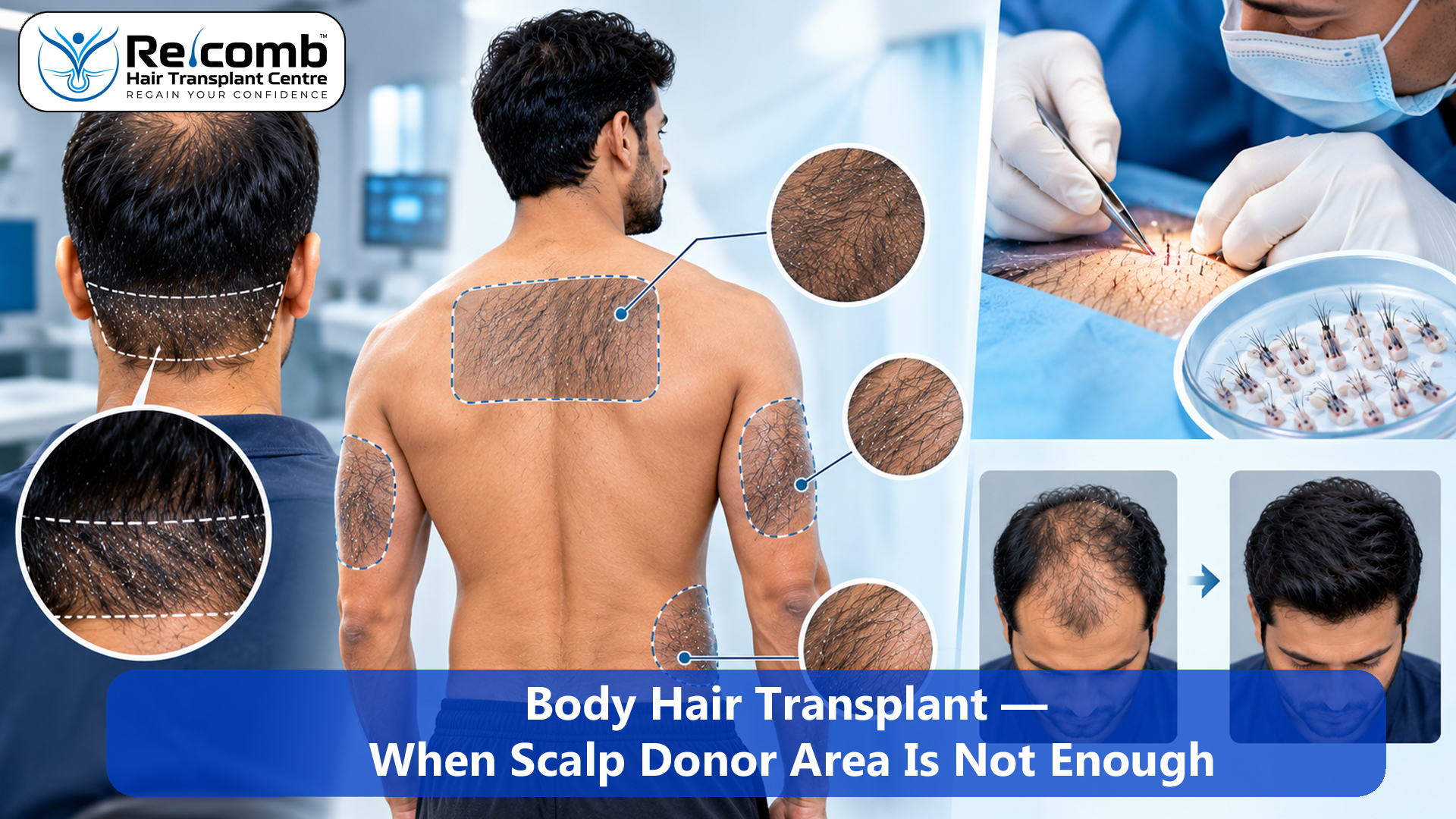

Hair transplant technology has improved significantly over the last decade. Modern procedures like FUE and advanced implantation techniques can create extremely natural results.
However, many patients still encounter hair transplants that appear artificial or easily recognizable.
Why does this happen?
Most unnatural results are not caused by the technology itself but by poor planning, incorrect technique, and unrealistic expectations.
At RECOMB Hair Transplant Centre, careful planning and surgical precision are prioritized to ensure results blend naturally with existing hair.
Understanding the common causes of unnatural results helps patients make better decisions.
1. Poor Hairline Design
Hairline design is the most important factor in determining whether a hair transplant looks natural.
Common mistakes include:
- Straight hairlines
- Hairlines placed too low
- Lack of natural irregularity
Natural hairlines have subtle variations and follow facial proportions.
When designed properly, the transplanted hairline becomes almost undetectable.
2. Incorrect Angle and Direction
Hair grows at specific angles depending on the region of the scalp.
For example:
- Frontal hair grows forward and slightly downward
- Temple hair grows at a sharper angle
- Crown hair follows a circular pattern
Incorrect placement angles can make hair stand upright or grow unnaturally.
This mistake immediately reveals the transplant.
3. Improper Graft Distribution
Hair follicles naturally grow in groups of one to four hairs.
Natural hairlines require:
- Single-hair grafts in the front
- Multi-hair grafts behind the hairline
If multi-hair grafts are placed at the very front, the hairline can appear dense and artificial.
Balanced graft distribution is essential for realism.
4. Overharvesting the Donor Area
Some clinics remove excessive grafts to create high-density results in one session.
This may cause:
- Patchy donor area
- Visible thinning at the back of the scalp
- Long-term donor damage
A natural transplant should look balanced from both the front and back.
5. Aggressive Density Claims
Advertisements often promise extremely high density.
However, excessive graft placement can:
- Damage blood supply
- Reduce graft survival
- Create unnatural hair patterns
A realistic density plan ensures healthy follicle growth.
6. Technician-Led Procedures
In some clinics, technicians perform most of the procedure while doctors supervise multiple surgeries.
Hair transplant requires:
- Precise graft extraction
- Accurate implantation angles
- Artistic hairline design
Insufficient medical supervision can increase the risk of unnatural results.
7. Ignoring Future Hair Loss
Hair loss is progressive.
If transplanted hair is placed without considering future thinning, the result may look unnatural later.
For example:
- A dense hairline with bald areas behind it
- Uneven distribution as natural hair continues to thin
Long-term planning prevents these issues.
How to Avoid an Unnatural Hair Transplant
Patients can reduce the risk by focusing on several key factors.
Choose an Experienced Surgeon
Experience plays a major role in:
- Hairline design
- Graft placement
- Long-term planning
Evaluate Real Patient Results
Before-and-after photographs should show:
- Natural hairline shape
- Consistent density
- Healthy donor area
Understand Realistic Expectations
Hair transplant aims to improve appearance, not recreate teenage density.
Balanced results look more natural than aggressive designs.
Focus on Donor Preservation
Donor hair is limited.
A responsible clinic plans procedures to protect donor reserves for future needs.
RECOMB’s Approach to Natural Hair Restoration (2026)
At RECOMB, every procedure follows principles designed to maximize natural results.
These include:
- Conservative hairline design
- Proper graft selection and distribution
- Safe donor extraction limits
- Long-term hair loss planning
This approach helps ensure that results remain natural not only immediately after surgery but also years later.
Final Takeaway
Unnatural hair transplants usually result from poor planning rather than technological limitations.
The key factors that determine natural results include:
- Hairline design
- Angle and direction of implantation
- Balanced graft distribution
- Donor preservation
- Long-term treatment planning
Choosing the right clinic and surgeon is the most important step toward achieving natural-looking hair restoration.
Contact RECOMB Hair Transplant Centre
Phone: +91 7624008000
Website: www.recombhair.com