
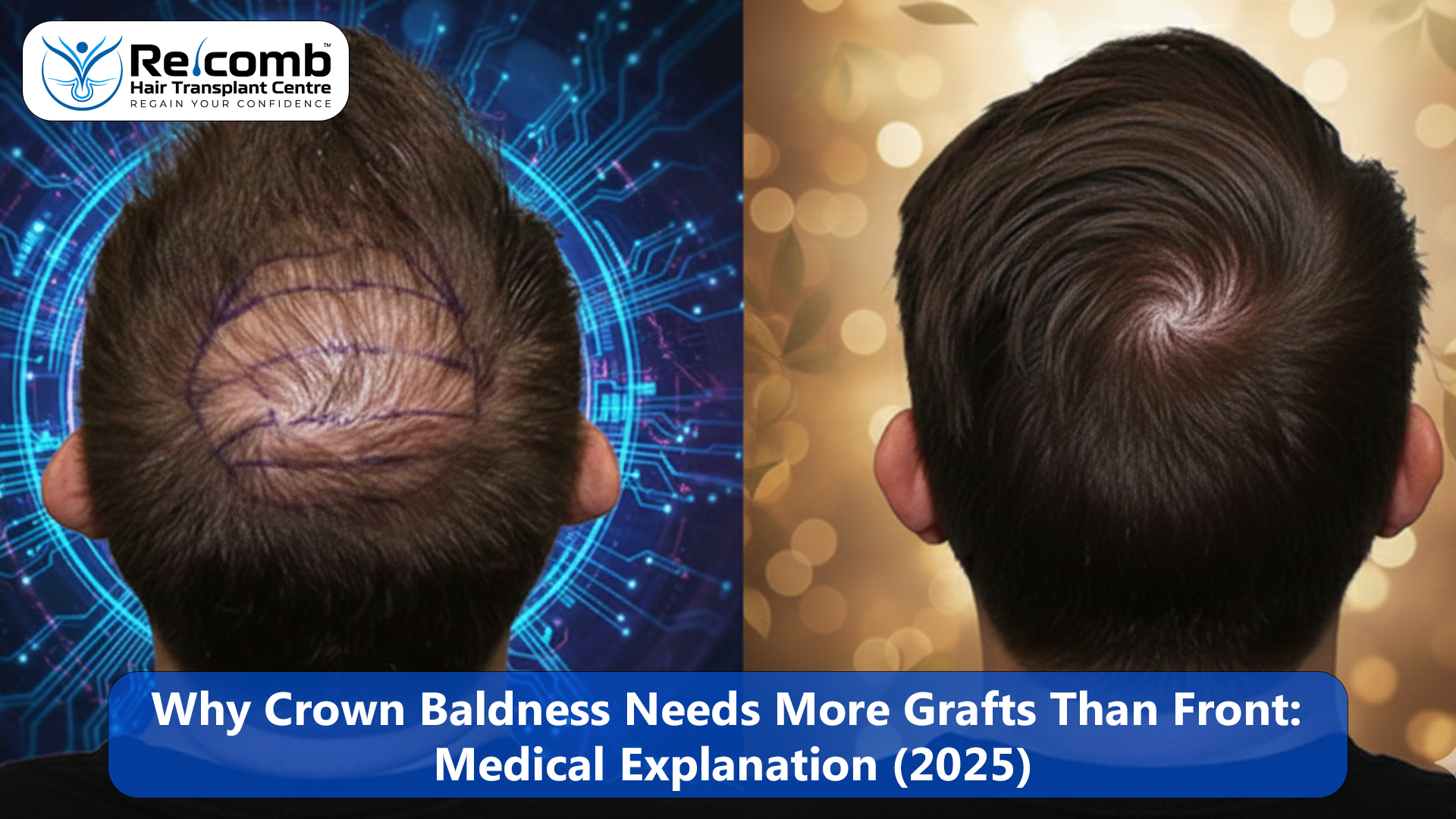
Patients frequently ask why a crown transplant requires significantly more grafts than the frontal hairline, even when the bald area looks similar in size. The answer lies in scalp anatomy, hair growth patterns, optical density, and blood supply dynamics.
At RECOMB Hair Transplant Centre, Surat, graft planning is always zone-specific. The crown (vertex) behaves very differently from the frontal scalp, both biologically and cosmetically. Understanding these differences helps set realistic expectations and prevents overharvesting or poor outcomes.
1. Crown Anatomy Is Circular, Not Linear
The frontal hairline is a linear zone.
The crown is a circular or spiral zone.
In the crown:
-
Hair radiates in multiple directions
-
Density must be evenly distributed 360 degrees
-
Grafts are spread over a wider surface area
Even a small-looking crown bald spot actually covers more square centimeters than it appears.
This geometric reality alone increases graft requirements.
2. Whorl (Spiral) Hair Growth Pattern
The crown contains a natural whorl, where hair grows in a spiral pattern.
To recreate this:
-
Grafts must be placed at varying angles
-
Density must be uniform from center to periphery
-
Directional errors become immediately visible
Because hair does not fall forward like the frontal scalp, more grafts are needed to create visual coverage.
3. Crown Requires Higher Visual Density to Look “Filled”
In the frontal area:
-
Hair falls forward
-
Styling and layering create an illusion of density
-
Even 45–55 grafts/cm² can look full
In the crown:
-
Hair stands more upright
-
Light reflects directly off the scalp
-
Gaps are easily visible
To compensate, the crown often needs:
-
55–70 grafts/cm²
-
Sometimes staged in two sessions
This is why crown restoration is graft-intensive.
4. Blood Supply Is Relatively Weaker in the Crown
The crown has:
-
Less robust blood circulation compared to frontal scalp
-
Higher susceptibility to DHT-related miniaturization
To ensure survival and visual coverage:
-
Grafts are placed slightly less densely per session
-
More total grafts are needed overall
-
Medical therapy is critical alongside transplant
This biological limitation often necessitates higher total graft numbers.
5. Crown Baldness Progresses More Aggressively
Medically, crown baldness:
-
Progresses silently
-
Expands centrifugally (outward in all directions)
-
Continues even after frontal loss stabilizes
If graft planning does not anticipate future expansion, patients may experience:
-
A “donut” pattern
-
Need for repeat surgery
-
Wasted donor capacity
At RECOMB, crown graft planning always accounts for future hair loss, increasing initial graft requirements.
6. Optical Illusion Works Against the Crown
The crown is:
-
Viewed from above
-
Exposed to direct overhead lighting
-
Harder to camouflage with styling
The frontal hairline benefits from facial framing and downward hair direction.
The crown does not.
Hence, more grafts are required to achieve the same cosmetic satisfaction.
7. Donor Hair Must Be Used Strategically
Because the donor area is limited:
-
Front is always prioritized
-
Crown is restored conservatively
-
Density is built gradually
In many ethical practices, crown restoration is:
-
Deferred to second session
-
Combined with medical therapy
-
Treated only after frontal stabilization
This approach may increase total graft numbers over time but protects donor safety.
Typical Graft Requirement: Front vs Crown
| Area | Average Density Needed | Typical Grafts |
|---|---|---|
| Frontal Hairline | 45–55 grafts/cm² | 1,500–2,500 |
| Mid-Scalp | 40–50 grafts/cm² | 1,000–2,000 |
| Crown (Vertex) | 55–70 grafts/cm² | 2,000–3,500+ |
Exact numbers vary based on:
-
Baldness grade
-
Hair caliber
-
Scalp laxity
-
Donor density
How RECOMB Plans Crown Transplants Ethically
At RECOMB Hair Transplant Centre, crown restoration follows strict medical principles:
-
Front-first prioritization
-
Conservative crown density
-
No overharvesting of donor
-
Sapphire FUE for precise angulation
-
Mandatory medical maintenance
-
Honest discussion about staged procedures
We never promise “full crown density” in one session if it risks donor damage.
Final Medical Conclusion
Crown baldness needs more grafts than the front because:
-
The area is circular and larger than it looks
-
Hair grows in a spiral pattern
-
Optical density is harder to achieve
-
Blood supply is relatively weaker
-
Hair loss progression is more aggressive
Understanding this prevents unrealistic expectations and ensures long-term success.
At RECOMB, our goal is not just graft placement—but lifelong, natural-looking results.
Contact RECOMB Hair Transplant Centre
Phone: +91 7624008000
Website: www.recombhair.com