
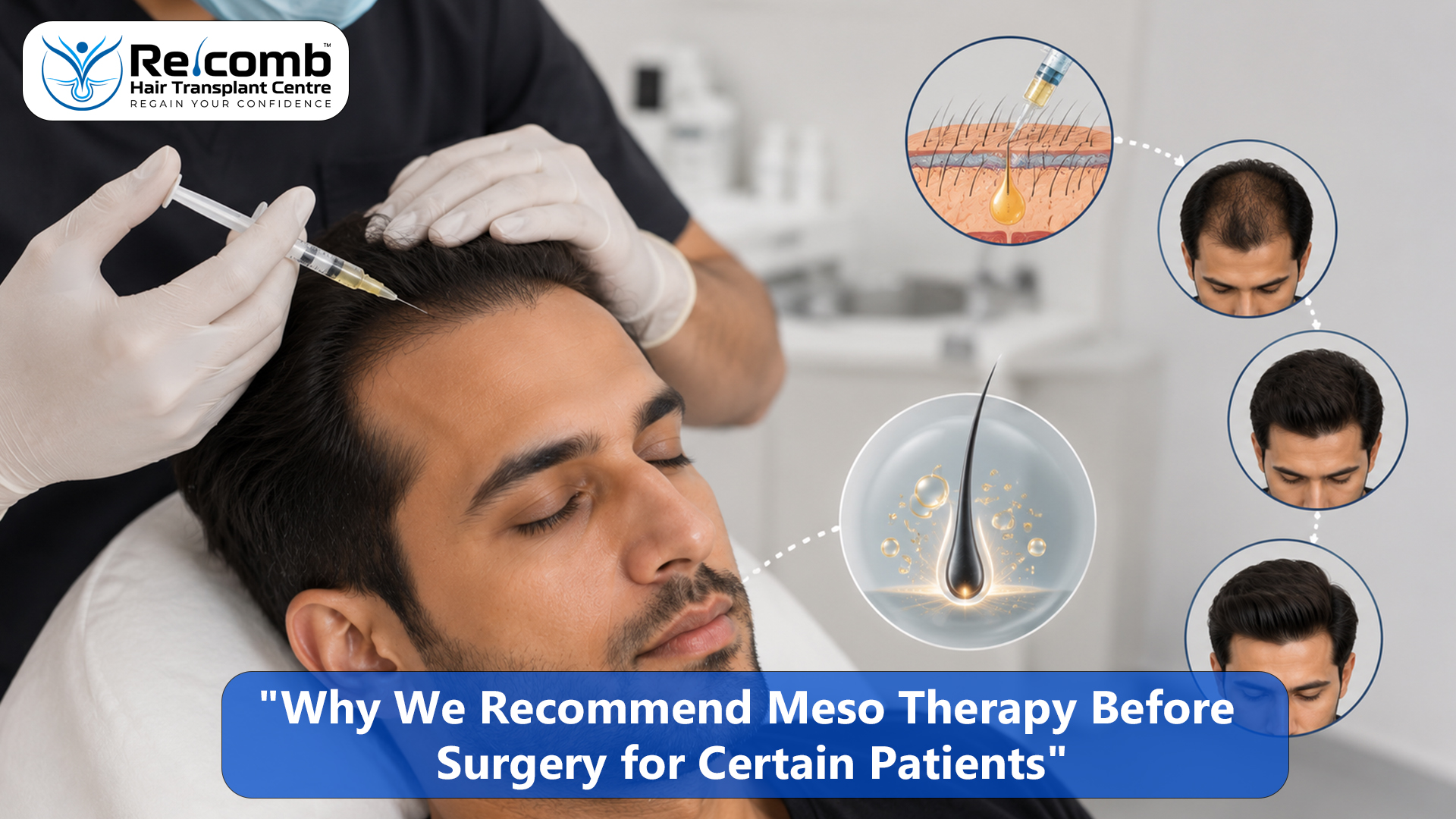
When a patient comes to RECOMB with confirmed androgenetic alopecia and asks about a hair transplant, surgery is not always the immediate next step. For a specific group of patients, the recommendation is to complete a course of mesotherapy first, wait three to four months, and then reassess for surgery.
This sequence is not a delay tactic. It is a clinical decision based on what the scalp assessment reveals about the follicular environment at the time of consultation. A hair transplant performed on an unprepared scalp produces lower graft survival, slower healing, and a less natural result than the same procedure performed after the scalp has been optimised. For certain patients, mesotherapy is the preparation that makes the difference.
This blog explains which patients fall into this category, what mesotherapy does to the scalp environment before surgery, and why this sequencing produces better surgical outcomes.
If you have been assessed elsewhere and told you are ready for surgery, but your scalp has not been examined for the factors described below, a consultation at RECOMB may give you a more complete picture before you commit.
Book a Pre-Surgical Scalp Assessment at RECOMB, Surat →
WhatsApp: +91 7624008000 | www.recombhair.com
What the Scalp Environment Must Support Before Surgery
A hair transplant asks a great deal of the scalp. Thousands of follicular units are extracted from the donor zone, creating multiple small extraction wounds that must heal cleanly. Recipient sites are created across the thinning area, each one a small incision in scalp tissue that must have adequate blood supply to accept and nourish a newly placed graft. The grafts themselves, once implanted, depend entirely on the surrounding tissue environment for survival during the critical first days before new blood vessel connections form.
For this environment to function optimally, several conditions must be met. The scalp microcirculation must be adequate to deliver oxygen and nutrients to newly placed grafts. The follicular environment must be free of significant active inflammation that would compete with graft integration. The nutritional status of the scalp tissue must be sufficient to support the wound healing and new growth processes that follow implantation.
When these conditions are not met, graft survival rates fall, healing is slower, the risk of complications increases, and the density achieved in the final result is lower than what the graft count would suggest it should be. Mesotherapy addresses each of these conditions directly.
Patient Profile 1: Significant Nutritional Deficiency With Active Hair Loss
The most common patient profile where pre-surgical mesotherapy is recommended is one where blood investigations reveal significant nutritional deficiencies, particularly low ferritin, low vitamin D, or inadequate protein status, alongside active hair loss that is partly driven by these deficiencies on top of the underlying androgenetic alopecia.
In this patient, operating immediately has two problems. First, the nutritional deficiency is contributing to active shedding, meaning the recipient area has follicles that are already stressed and underperforming. Second, the poor nutritional status of the scalp tissue reduces its capacity to support graft survival and integrate new follicles efficiently.
Oral supplementation addresses systemic levels over weeks to months. Mesotherapy delivers the same nutrients, biotin, vitamin B complex, zinc, amino acids including cysteine and methionine, directly to the follicular level within the first session. For patients where the timeline to surgery is set and oral supplementation alone would not achieve adequate scalp tissue nutritional status before the procedure date, mesotherapy accelerates the preparation of the scalp environment specifically.
After three to four sessions of mesotherapy alongside oral supplementation, trichoscopy typically shows improved follicle shaft diameter and reduced shedding rate, indicating that the scalp environment has reached a better baseline for receiving transplanted grafts.
Patient Profile 2: Active Seborrheic Dermatitis or Scalp Inflammation
A patient with significant seborrheic dermatitis or chronic scalp inflammation presents a specific surgical risk. Active Malassezia-driven inflammation around hair follicles creates a hostile environment for newly placed grafts, competing with their integration and increasing the risk of folliculitis in the post-operative period.
Operating on an inflamed scalp is not best practice. The inflammation response around recipient sites in the early post-operative period is already significant as a normal consequence of the procedure. Adding active pre-existing scalp inflammation compounds this response and can reduce graft survival in the most affected zones.
Mesotherapy formulations containing anti-inflammatory agents and antifungal compounds can reduce the seborrheic load and follicular inflammation burden significantly within four to six weeks of treatment. Combined with topical ketoconazole or zinc pyrithione shampoo use during this period, the scalp can be brought to a much cleaner inflammatory baseline before any surgical procedure is performed.
The practical result is a recipient scalp that responds more predictably to graft placement, heals more cleanly, and achieves better density from the same number of grafts than would have been possible with the inflammatory burden present.
Patient Profile 3: Poor Scalp Microcirculation
This profile is particularly relevant in patients who are heavy smokers, have longstanding poorly managed diabetes, are significantly sedentary, or have other factors known to compromise microvascular health. In these patients, scalp blood flow is reduced and the capillary network supplying the dermal papilla of each follicle is less robust than in a patient with good vascular health.
Poor scalp microcirculation directly affects graft survival because newly placed grafts depend on the surrounding capillary network to begin receiving oxygen and nutrients within the first 24 to 72 hours of implantation. In a poorly perfused scalp, this process is slower and less complete, reducing the proportion of grafts that successfully establish and produce hair.
Mesotherapy with minoxidil as a vasodilatory component, delivered directly to the scalp, improves local microcirculation within the scalp tissue specifically. A course of four to six sessions before surgery primes the vascular environment of the recipient area, improving the blood supply that newly placed grafts will depend on. Post-operative healing is also improved in a better-perfused scalp, with faster resolution of the redness and swelling that follows graft placement.
Patient Profile 4: Borderline Candidacy With Salvageable Follicles
A specific subset of patients presents where trichoscopy reveals follicles in the recipient zone that are miniaturising but not yet completely inactive. These follicles are producing fine, thin hairs that are not cosmetically significant on their own but represent an opportunity. If the miniaturisation process can be slowed or partially reversed before surgery, the baseline density going into the procedure is higher, the area requiring surgical coverage may be reduced, and the overall result of the same number of grafts is more satisfying.
In this patient, mesotherapy combined with finasteride and minoxidil for three to four months before surgery can produce partial recovery of miniaturising follicles. The number of grafts required to achieve a satisfying density is lower when the native hair baseline has improved, and the donor budget is used more efficiently.
This pre-surgical optimisation is not always dramatic but it is clinically meaningful, particularly in patients where donor supply is limited and every graft needs to be placed where it produces the most value.
What the Pre-Surgical Mesotherapy Course Looks Like
For patients where pre-surgical mesotherapy is recommended, the typical course involves four to six sessions spaced two weeks apart. The formulation is selected based on the specific patient profile: nutritional repletion emphasis for deficiency-driven patients, anti-inflammatory and antifungal components for seborrheic dermatitis patients, and minoxidil-dominant formulation for microcirculation-compromised patients.
At the end of the course, trichoscopy is repeated to assess whether the targeted improvements have been achieved: reduced shedding rate, improved follicle shaft diameter, reduced scalp inflammation score, or improved response of miniaturising follicles. This repeat assessment informs whether the scalp is now ready for surgery or whether an additional course or a different preparation strategy is needed.
The surgery date is confirmed only after this reassessment confirms the scalp is in the best achievable condition for receiving transplanted grafts. This is a longer pre-surgical timeline than most clinics use, but it is the timeline that produces the highest graft survival rates and most consistent density outcomes.
RECOMB's Approach (2026)
At RECOMB Hair Transplant Centre, Surat, the decision to recommend mesotherapy before surgery is made individually based on the pre-surgical assessment findings. Dr. Krishna Bhalala and Dr. Nilesh Kachhadiya do not apply this recommendation universally. Patients whose scalp assessment shows adequate microcirculation, no significant inflammation, good nutritional status, and no miniaturising salvageable follicles proceed directly to surgical planning without a mandatory mesotherapy course.
The recommendation is reserved for patients where the clinical evidence indicates that the scalp environment at the time of assessment is not optimal for surgery, and where mesotherapy can specifically address the identified gaps within a reasonable preparation timeline.
This approach reflects RECOMB's broader clinical philosophy: every decision is made in service of the patient's long-term result, not the fastest path to a procedure booking.
Understand Whether Your Scalp Needs Preparation Before Surgery →
WhatsApp: +91 7624008000 | www.recombhair.com
Final Takeaway
A hair transplant is only as good as the environment it is performed in. For certain patients, that environment needs preparation before surgery can deliver the result it is capable of. Mesotherapy before surgery is not a delay or an upsell. It is a clinical investment in a scalp that will perform better during the procedure, heal more effectively afterward, and deliver higher graft survival and more natural density in the final result.
Patients who are told they are ready for immediate surgery at every clinic they consult, without any assessment of scalp inflammation, nutritional status, microcirculation, or miniaturising follicle salvageability, may be receiving an accurate assessment or they may be being moved toward a booking without the preparation that would make their result significantly better.
Knowing which situation you are in requires a thorough scalp assessment, not just a visual graft count estimate.
Dr. Krishna Bhalala and Dr. Nilesh Kachhadiya conduct a limited number of personal consultations each week at RECOMB, Surat. If you want to know whether your scalp is genuinely ready for surgery or whether preparation would improve your result, this is where that question gets a clinical answer.
Find Out If Your Scalp Is Ready for Surgery at RECOMB →
WhatsApp: +91 7624008000
We respond within 24 hours, 6 days a week.
www.recombhair.com
Contact RECOMB Hair Transplant Centre
RECOMB Hair Transplant Centre
19, Ground Floor, Zenon Building, Opp. Unique Hospital, near Kiran Motors, Khatodara Wadi, Surat, Gujarat 395001
Phone: +91 7624008000
Website: www.recombhair.com