
Of all the decisions made during a hair transplant, hairline design is the one that determines whether the result looks like a procedure or like your own hair. Get it right and nobody notices. Get it wrong and nobody can stop noticing.
Most patients focus on graft numbers, technique names, and cost comparisons when researching a transplant. Very few ask the question that actually drives the visible outcome: how does this clinic design a hairline, and what principles guide that design?
This blog answers that question directly, explaining what goes into hairline design at RECOMB, why it cannot be standardised across patients, and why a hairline drawn for the face you have at 28 may look completely wrong by the time you are 45.
If you want to understand what a hairline designed specifically for your face, your age, and your projected hair loss trajectory would look like, a consultation at RECOMB is where that conversation starts.
Book a Hairline Design Consultation at RECOMB, Surat → WhatsApp: +91 7624008000 | www.recombhair.com
Why Hairline Design Is Not a Drawing Exercise
The instinct most patients bring to hairline discussions is visual. They want to see a line on their forehead and decide whether they like it. This is understandable but it misses the clinical dimension entirely.
A hairline is not a cosmetic preference. It is a surgical decision with permanent consequences. Once grafts are placed, the hairline exists. It cannot be moved easily, it cannot be erased, and it will be on that face for the next 40 to 50 years while the face itself ages and the surrounding native hair continues to change.
This means every hairline design decision must account for at least three things simultaneously: what looks natural on this face today, what will look age-appropriate on this face in 20 years, and what the donor area can support given the full projected course of hair loss. A hairline that satisfies only the first condition is a hairline that will eventually look wrong.
The Anatomy of a Natural Hairline
Understanding what makes a hairline look natural begins with understanding what natural hairlines actually look like, which most people have never consciously examined.
A natural hairline is not a straight line. It has a gentle, irregular edge with micro-variations in the position of individual hairs. Some hairs sit slightly forward of the general line, others slightly behind. This irregularity is what the brain registers as natural because it matches what has been seen on every human face since childhood.
A natural hairline is not uniformly dense at the front edge. The very first row of hairs at the hairline consists of single-hair grafts, fine and soft, emerging at a shallow angle. Behind this transition zone, density gradually increases as two and three hair grafts take over. The visual effect is a soft, gradual emergence from skin to hair that mimics exactly how hair grows naturally.
A natural hairline has appropriate temporal recessions. Perfectly straight hairlines that extend to the temples without any recession do not exist on adult men past their early twenties. A hairline with no temporal recession signals surgery immediately to any observer. The shape and depth of the temporal recession must be designed to match the patient's facial proportions and age.
A natural hairline follows the facial frame, not a geometric rule. The midpoint, the peak positions, the temple angles, and the overall width are determined by the patient's specific facial structure, forehead height, and facial width, not by a standard template applied to every patient.
The Five Principles RECOMB Uses in Every Hairline Design
Age Appropriateness
The hairline is designed for the age the patient will be in 15 to 20 years, not the age they are today. A 28-year-old requesting a hairline at the position it was when he was 18 is requesting a hairline that will look increasingly incongruous as he ages into his forties. At RECOMB, the hairline position is set conservatively, meaning slightly higher and more receded than the patient's ideally requested position, to ensure it remains appropriate as the face matures.
This is one of the most important and least popular conversations in a pre-surgical consultation. Patients often want what they remember. Surgeons who give it to them without correction are prioritising the booking over the long-term result.
Facial Proportion and Framing
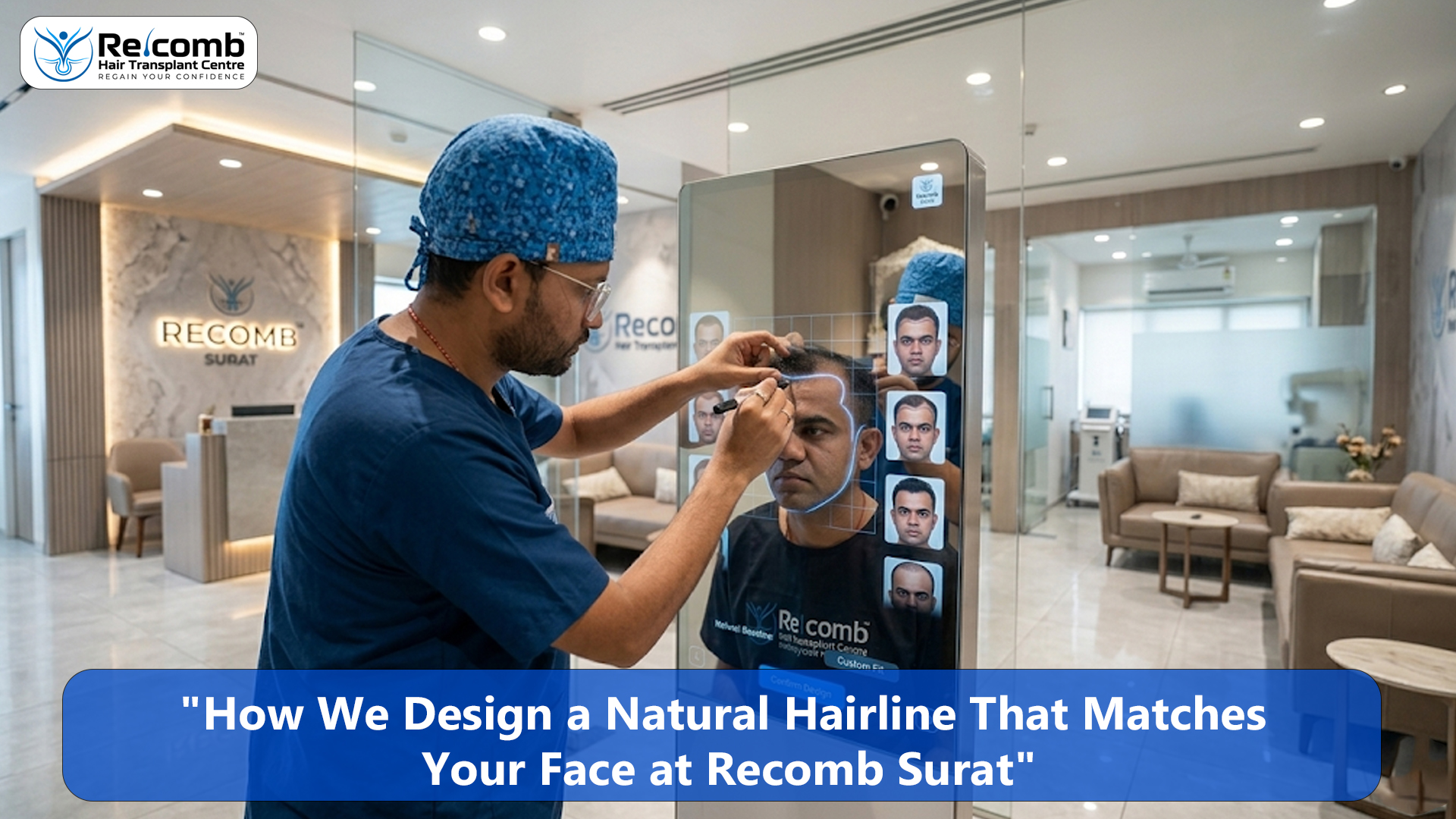
The hairline is mapped against the patient's specific facial measurements. Forehead height, the width of the face at the temples, the position of the brow ridge, and the overall facial shape all influence where the hairline should sit and how the temporal angles should be drawn.
A hairline that looks balanced on a narrow, long face will look too wide or too low on a broad, shorter face. There is no universal template. The design is drawn fresh for each patient based on their own facial geometry.
Future Hair Loss Projection
Before the hairline is drawn, the patient's current Norwood stage and the projected trajectory of future loss are mapped. If a patient is at Grade 3 today and family history suggests Grade 5 or 6 progression, the hairline is designed with that future state in mind. This means leaving sufficient donor grafts for a second session addressing the midscalp and crown, and not placing the hairline so low that it will look isolated when surrounding native hair continues to thin.
This is the planning dimension that most patients do not think about and that many clinics skip entirely. A hairline drawn without a projection of future loss is a hairline designed for today at the expense of tomorrow.
Graft Type Sequencing
The hairline is not built from uniform grafts. The design specifies exactly which follicular unit types go where. Single-hair grafts are placed at the very front edge across the entire hairline length to create the soft transition zone. Two-hair grafts are placed in the row immediately behind. Three-hair grafts begin one to two rows further back into the frontal zone proper.
This sequencing must be planned before the procedure begins and executed consistently throughout. A hairline built without this structure, where two and three hair grafts are placed at the front edge for density, will look pluggy and unnatural regardless of how well everything else was done.
Angulation and Direction
Each graft in the hairline is placed at a specific angle and direction that matches the natural growth pattern of hair in that zone. At the frontal hairline, hairs grow forward and slightly downward at an acute angle relative to the scalp, typically 15 to 30 degrees. In the temples, the angle and direction change to follow the natural sweep of the temporal hair. In the frontal zone behind the hairline, the angle and direction again adjust.
These angles are not incidental. They determine how the hair falls, how it catches light, and whether it blends with the surrounding native hair. Grafts placed at incorrect angles create an artificial, directional inconsistency that is immediately visible, especially in certain lighting conditions.
The Most Common Hairline Design Mistakes
Understanding what goes wrong in poorly designed hairlines helps patients ask the right questions before committing to any procedure.
A hairline placed too low is the most frequent and most damaging mistake. It looks appropriate at 28 and increasingly artificial at 40 and beyond. It also consumes a disproportionate number of grafts in the frontal zone, leaving insufficient donor supply for the midscalp and crown coverage that will be needed as loss progresses.
A hairline that is too straight produces an unnaturally geometric appearance. The brain recognises straight lines as constructed rather than grown. Even a millimetre of deliberate irregularity along the hairline edge changes the perception entirely.
A hairline with no temporal recession looks like a wig line. It is one of the clearest signals of a poorly planned transplant and one of the hardest to correct once grafts are in place.
A hairline with incorrect graft density at the front edge, where high-density multi-hair grafts create a solid wall of hair rather than a graduated transition, looks dense from a distance but artificial up close and in photographs.
RECOMB's Approach (2026)
At RECOMB Hair Transplant Centre, Surat, hairline design is a pre-surgical process that takes place before any procedure date is set. Dr. Krishna Bhalala and Dr. Nilesh Kachhadiya each bring a specific surgical perspective to hairline planning. Dr. Bhalala's dermatological background informs the medical dimensions of follicle behaviour and long-term projection. Dr. Kachhadiya's plastic and reconstructive surgical training brings a precise technical and aesthetic framework to the physical design and execution.
Every hairline drawn at RECOMB is discussed in detail with the patient before any incision is made. The patient understands why the position is where it is, why it is not lower, what the temporal angles reflect about their facial structure, and how the design accounts for where their hair loss is heading. There are no surprises on the day of the procedure because the design has been agreed upon, explained, and confirmed in advance.
We do not draw the hairline the patient wants if that hairline will look wrong in 15 years. We draw the hairline that serves the patient for life, and we explain why that is the better outcome.
Final Takeaway
A natural hairline is not the lowest hairline or the densest hairline. It is the hairline that looks like it grew there, that fits the face it sits on, that will remain appropriate as that face ages, and that was built within the realistic limits of what the donor area can sustain across a lifetime.
The difference between a result that patients are proud of at 50 and one they regret at 40 is almost always in the hairline design, specifically in whether the surgeon prioritised what the patient wanted on the day of the consultation or what would genuinely serve them over the following decades.
Dr. Krishna Bhalala and Dr. Nilesh Kachhadiya conduct a limited number of personal consultations each week at RECOMB, Surat. If you want to see what a hairline designed for your specific face and your long-term hair loss trajectory looks like, this is where that conversation begins.
See What a Hairline Designed for Your Face Looks Like at RECOMB → WhatsApp: +91 7624008000 We respond within 24 hours, 6 days a week. www.recombhair.com
Contact RECOMB Hair Transplant Centre
Phone: +91 7624008000
Website: www.recombhair.com