

Most patients who eventually have a hair transplant spent years before it telling themselves they were not quite ready. The timing was not right. The loss had not stabilised. They wanted to try a few more things first. They would think about it next year.
Then something shifted. A photograph, a conversation, a moment in the mirror. And they knew.
But knowing emotionally that you are ready is different from knowing clinically that you are ready. The emotional readiness and the clinical readiness do not always arrive at the same time, and the consequences of acting when only one of the two is present are significant and in some cases permanent.
This blog identifies the five clinical signs that indicate a patient is genuinely ready for a hair transplant, not just motivated to have one. Each sign reflects a specific clinical condition that, when present, makes the procedure more likely to produce a result the patient will be satisfied with for decades rather than one that requires revision or produces disappointment.
If you recognise these signs in your own situation, a consultation at RECOMB will confirm whether the clinical picture supports your readiness and what a specific plan for your case looks like.
Book a Readiness Assessment at RECOMB, Surat →
WhatsApp: +91 7624008000 | www.recombhair.com
Sign 1: Your Hair Loss Pattern Has Been Stable for at Least 12 Months
This is the most fundamental sign of readiness and the one most patients underestimate in importance.
A hair transplant is designed around the hair loss pattern that exists at the time of surgery. The hairline is placed to complement the current recession. The graft allocation addresses the current bald and thinning zones. The donor budget is committed to the current need with a reserve for anticipated future progression.
When hair loss is still actively changing, designing a procedure around it is like designing a building for land that is still shifting. The plan may look correct today and wrong within two years as the pattern continues to evolve in directions the design did not account for.
Stability does not mean the hair loss has completely stopped. Androgenetic alopecia rarely stops entirely before the mid-forties. Stability means the pattern has not changed significantly over the previous 12 months, either because it has naturally reached a slower phase or because medical management with finasteride and minoxidil has brought the rate of change to a manageable level.
Patients who present with rapidly progressing loss, losing significant ground month by month without any medical management in place, are not clinically ready regardless of how emotionally prepared they feel. The right response is to establish medical management first, assess stability after six to twelve months, and then plan surgery on a pattern that is predictable enough to design around confidently.
Sign 2: You Have Tried Medical Management and Know How Your Hair Responds
A patient who has been on finasteride and minoxidil for at least six months before their transplant consultation arrives at that consultation with information that an untreated patient cannot have: they know how their hair responds to medical management.
Some patients stabilise significantly on finasteride, with minimal further loss and in some cases partial recovery of early miniaturisation. These patients have a more favourable surgical context because the rate of change around their transplanted grafts will be lower post-operatively. Others find that their loss continues to progress even on finasteride, indicating a more aggressive DHT-driven pattern that requires more conservative surgical planning and more robust post-operative management.
Medical management before surgery also directly improves surgical outcomes. The follicles in the recipient zone of a patient on finasteride have lower DHT activity than those of an untreated patient, making them more resilient to the surgical stress that triggers shock loss. Graft survival rates are consistently better in patients whose scalp environment has been medically optimised before the procedure.
A patient who has never tried finasteride is not automatically unready for surgery, particularly if they have a medical contraindication or have made an informed decision not to use it. But a patient who has tried it and knows their response has a clinical advantage that changes both the surgical plan and the realistic outcome expectation.
Sign 3: Your Donor Area Has Been Assessed and Can Support the Result You Need
Readiness is not just about the hair loss pattern. It is about the resources available to address it.
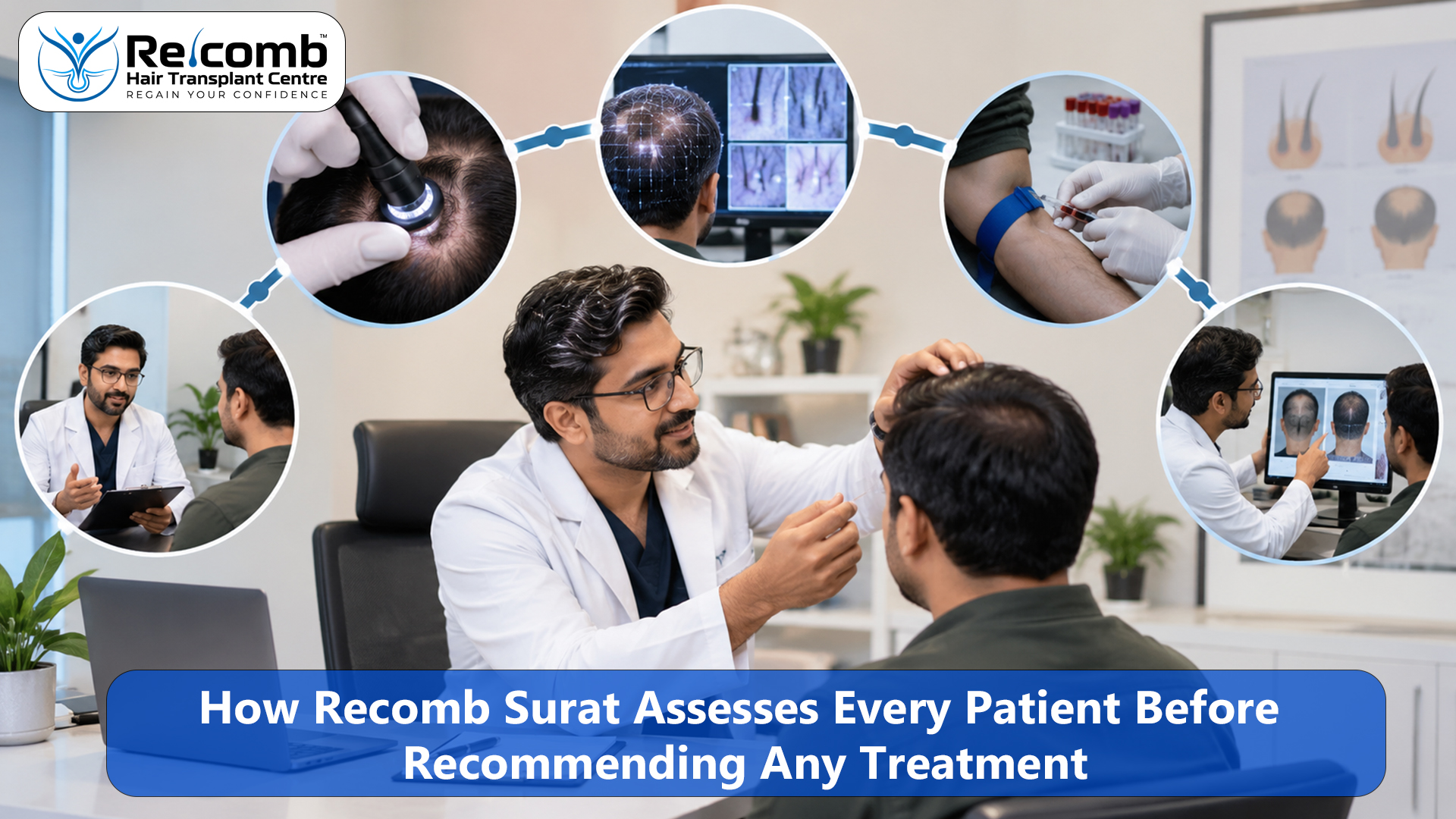
The donor area contains a finite number of grafts available across a lifetime. A patient whose donor density has never been measured does not know whether they have the supply to achieve a satisfying result without depleting the reserve needed for future sessions. A patient whose donor density has been formally measured through trichoscopy knows exactly what they have to work with and whether the result they are expecting is achievable within those limits.
This is the difference between a patient who is ready and one who only thinks they are ready. Readiness for a hair transplant includes specifically knowing that the donor area can support the coverage required, that the lifetime graft budget allows for this procedure plus anticipated future needs, and that the result being planned is within the realistic achievable range given what is available.
Patients at RECOMB receive this measurement as a standard component of the pre-surgical assessment. Patients who arrive having been quoted a graft count elsewhere without a trichoscopy-based donor density measurement have not had this component confirmed and therefore cannot yet know whether they are clinically ready in this respect.
Sign 4: Your Expectations Match What the Biology Can Actually Deliver
This sign is the most subjective to assess but clinically among the most important. A technically excellent procedure that produces a result within the expected range for the patient's hair characteristics, donor capacity, and Norwood grade will be experienced as a failure by a patient whose expectations significantly exceeded what the biology could deliver.
Genuine readiness includes understanding specifically what the result will look like, how dense the transplanted area will be relative to natural density, that 12 to 15 months are required before the final result is assessable, that surrounding native hair will continue to thin without medical management, and that a transplant restores what has been lost rather than permanently freezing the scalp in its post-surgical state.
Patients who expect to recover the hair density they had at 20, who expect a full result within three months, or who believe a single session will permanently solve their hair loss regardless of future progression are not yet ready in this sense, regardless of how clinically appropriate their other parameters are. The procedure will disappoint them.
A patient is ready when they can say specifically what they expect the result to look like at 12 months, and that expectation has been confirmed as realistic by the surgeon based on their individual clinical parameters.
Sign 5: You Have Chosen a Surgeon and Clinic Based on Clinical Criteria, Not Price
The fifth sign of readiness is external rather than personal. It is the quality of the decision about where to have the procedure.
A patient who has chosen a clinic based on the lowest per-graft price, a promotional discount, or because it was convenient and appeared similar to other options has not completed the readiness process. The clinical variables that determine outcome, surgeon involvement in the procedure, trichoscopy-based assessment, donor density measurement, hairline design philosophy, and follow-up protocol, vary enormously between clinics and are not reflected in price comparisons.
A genuinely ready patient has asked specifically who will perform the extraction and implantation and received a direct answer. They have confirmed that their donor density was measured and their lifetime graft budget was calculated. They understand why the proposed hairline position is where it is and how it accounts for future hair loss. They know what the follow-up schedule looks like and what is included in the quoted cost.
This preparation is not excessive caution. It is the minimum due diligence for a permanent surgical decision. A patient who has done this work and arrived at a clinic that satisfies each of these criteria is ready in a way that a patient who simply responded to a promotional advertisement is not.
At RECOMB, patients who arrive for a consultation are invited to ask every one of these questions directly. The answers form the basis of the clinical relationship that carries through the procedure and the 12-month follow-up that follows.
You Are Ready When These Five Signs Are Present — Confirm It at RECOMB →
WhatsApp: +91 7624008000 | www.recombhair.com
RECOMB's Approach (2026)
At RECOMB Hair Transplant Centre, Surat, readiness is assessed explicitly rather than assumed from the patient's request for a procedure. Dr. Krishna Bhalala and Dr. Nilesh Kachhadiya evaluate each of the five signs described above as part of the pre-surgical consultation: the stability of the loss pattern, the response to medical management, the donor capacity, the alignment of expectations with realistic outcomes, and the clinical basis on which the patient has chosen to proceed.
Patients who present all five signs are booked for surgery with confidence that the result will meet both the clinical standard and the patient's own informed expectations. Patients where one or more signs are absent leave with a specific plan for what needs to happen before they will be genuinely ready, and a scheduled reassessment at the point where those conditions should be met.
The goal is not to increase booking volume. It is to ensure that every procedure performed at RECOMB is performed on a patient whose clinical and personal readiness produces a result that serves them for decades.
Final Takeaway
Emotional readiness and clinical readiness are both necessary for a hair transplant to produce lasting satisfaction. Emotional readiness without clinical readiness produces procedures performed at the wrong time, on unstable patterns, with expectations that the biology cannot meet. Clinical readiness without the preparatory work described above produces patients who are technically suitable but not fully informed.
The five signs described in this blog are the checkpoints that confirm both dimensions are present. A stable loss pattern. A known response to medical management. A measured donor area that can support the needed result. Expectations that match what the biology can deliver. And a surgeon and clinic chosen for clinical rather than commercial reasons.
When all five are present, the decision to proceed is genuinely ready and the result it produces reflects that readiness.
Dr. Krishna Bhalala and Dr. Nilesh Kachhadiya conduct a limited number of personal consultations each week at RECOMB, Surat. If you believe the time has come and want to confirm it against these five clinical signs for your specific case, this is where that conversation starts.
Confirm You Are Ready and Build Your Plan at RECOMB →
WhatsApp: +91 7624008000
We respond within 24 hours, 6 days a week.
www.recombhair.com
Contact RECOMB Hair Transplant Centre
RECOMB Hair Transplant Centre
19, Ground Floor, Zenon Building, Opp. Unique Hospital, near Kiran Motors, Khatodara Wadi, Surat, Gujarat 395001
Phone: +91 7624008000
Website: www.recombhair.com