
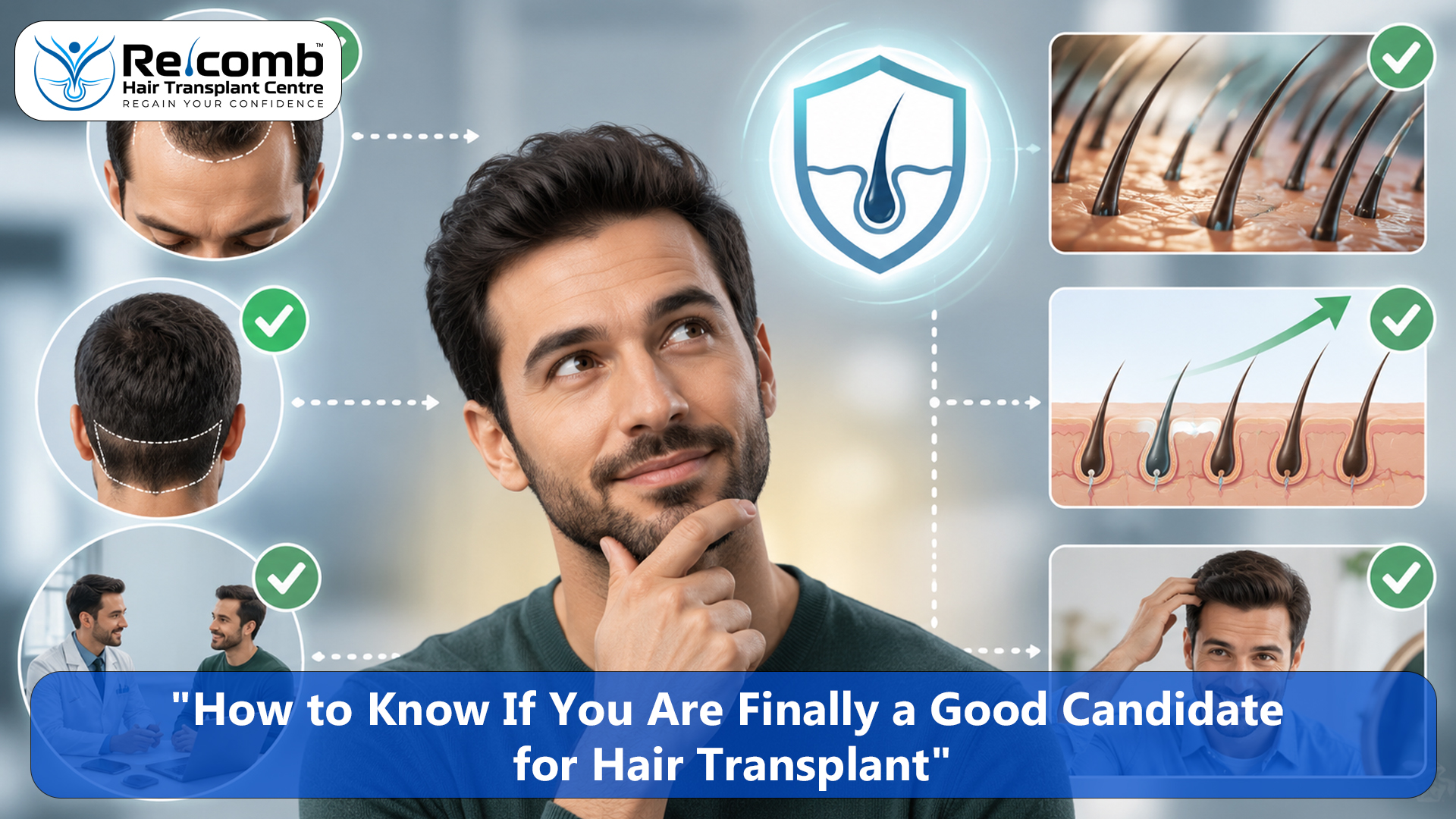
Hair loss and hair transplant candidacy are not the same thing. Every patient who walks into a hair restoration clinic has hair loss. A meaningful proportion of them are not yet, or never will be, ideal candidates for surgery. Understanding the difference before committing to a procedure is one of the most clinically important things a patient can do.
This matters in both directions. Patients who are good candidates but keep delaying lose hair and donor viability while they wait. Patients who are not yet candidates but proceed anyway risk depleting their donor area on a procedure that serves neither their current nor their future needs. The question of candidacy deserves a direct clinical answer, not a general reassurance.
This blog outlines exactly what makes someone a genuine candidate for hair transplant surgery, what disqualifies a patient at this stage, and what the realistic path to candidacy looks like for those who are not there yet.
If you want a direct clinical answer about whether you are a candidate right now, a consultation at RECOMB gives you that specifically.
Book a Candidacy Assessment at RECOMB, Surat →
WhatsApp: +91 7624008000 | www.recombhair.com
What Candidacy Actually Means
Being a candidate for hair transplant surgery does not simply mean having hair loss. It means having a specific combination of clinical factors that make surgery likely to produce a result that is natural, durable, and appropriate across the patient's lifetime.
Candidacy is not a binary yes or no for all time. A patient who is not a candidate today may become one in 12 to 18 months with the right medical management and stabilisation. A patient who is a candidate today may no longer be one if they wait several more years and exhaust a greater portion of their donor reserve before seeking treatment. Timing is part of candidacy.
The Positive Indicators: What Makes a Good Candidate
Established and Relatively Stable Hair Loss Pattern
The single most important candidacy criterion is that the hair loss pattern is established enough to plan around. This does not mean hair loss must be completely finished, since androgenetic alopecia rarely stops entirely before the mid-forties. It means the current pattern gives a surgeon enough information to design a result that will remain appropriate as loss continues at a managed rate.
In practical terms, this usually means the loss has not changed significantly in the previous 12 to 18 months, or that any ongoing loss is being adequately slowed by medical management. A patient losing hair rapidly without any stabilisation has a moving target that makes surgical planning unreliable. The hairline and zone coverage designed today may look wrong in 18 months if loss continues at the same rate unchecked.
Adequate Donor Density
A good candidate has sufficient donor density in the occipital and lateral safe zone to provide the grafts required for a result that looks naturally dense in the recipient area, while retaining enough reserve for anticipated future sessions as hair loss continues to progress.
This is assessed through trichoscopy and cannot be estimated reliably through visual inspection. Patients with diffuse thinning that extends into the donor zone, a pattern seen in some women and in certain types of diffuse androgenetic alopecia in men, may not have the donor density to support a satisfying result regardless of how their recipient area looks.
Realistic Expectations Aligned With What the Donor Area Can Deliver
A candidate understands that hair transplantation improves coverage and density within the limits of what their own donor area can provide. They are not expecting the density of their hair at 18, a result that would require more grafts than most patients have available. They understand that the result will develop over 12 to 18 months, that there will be a shedding phase, and that the transplanted hairline is a permanent surgical decision that will age with their face.
Patients who expect transformation beyond what the donor area and the biology of hair growth can deliver are not candidates regardless of their other clinical parameters. Surgery will disappoint them and they will attribute that disappointment to the procedure rather than to the mismatch between expectation and clinical reality.
Age Appropriate for Surgical Planning
Candidacy has an age dimension that is frequently underestimated. Most hair surgeons are cautious about operating on patients under 25 because the hair loss pattern is not yet established, the projected lifetime extent of loss is unclear, and the risk of designing a result that will look inappropriate as loss continues to advance is high.
A 27-year-old at Norwood Grade 3 whose loss has been stable for 18 months and who is on finasteride may be a reasonable candidate. A 22-year-old at Norwood Grade 3 who has been losing hair rapidly for the past year is not, regardless of how much they want the procedure, because the pattern has not stabilised and the surgical plan cannot be made with confidence.
General Medical Fitness for Surgery
A candidate is medically fit for a procedure performed under local anaesthesia. Active scalp conditions including seborrheic dermatitis, psoriasis, or any inflammatory scalp disease need to be controlled before surgery because operating on an inflamed scalp compromises both graft survival and healing. Bleeding disorders, uncontrolled diabetes, or conditions affecting wound healing require assessment and management before any surgical procedure.
Willingness to Commit to Medical Management Alongside Surgery
A good candidate understands that surgery addresses the hair that has already been lost, not the ongoing process of hair loss in the surrounding areas. They are willing to use finasteride and minoxidil, or have a clinical reason documented for not doing so, to protect the native hair surrounding the transplanted area and preserve the overall result over time.
A patient who wants surgery but refuses all medical management is not an ideal candidate because their native hair will continue to thin around stable transplanted grafts, progressively undermining the result and requiring additional surgical sessions earlier than would otherwise be necessary.
What Disqualifies a Patient at This Stage
Active, Rapidly Progressing Hair Loss Without Medical Stabilisation
A patient losing significant ground month on month without any medical management is not a good surgical candidate. Surgery in this context uses donor grafts to address a moving target, and the result will require early revision as loss continues. The correct first step is medical management for six to twelve months to establish whether stabilisation is achievable, then reassessment for surgical candidacy.
Insufficient Donor Density for the Coverage Required
A patient whose donor area cannot provide enough grafts to produce a satisfying result in the recipient area is not a good candidate. This can occur in patients with extensive hair loss relative to their donor capacity, in patients whose donor zone shows diffuse thinning, or in patients who have already had a previous procedure that over-harvested their donor area.
It is better to tell a patient this clearly than to proceed with a procedure that will produce an unsatisfying density outcome and leave the patient dissatisfied with a result that was always going to be inadequate given their donor limitations.
Unrealistic Expectations That Cannot Be Met
A patient who expects to look exactly as they did at 18, who wants a very low hairline regardless of their age and projected future loss, or who believes a single session will permanently address all of their hair loss regardless of how it progresses is not a good candidate until those expectations are addressed. Surgery performed for a patient with expectations the procedure cannot meet will always produce a dissatisfied patient, regardless of the technical quality of the work.
Active Scalp Disease
Alopecia areata in an active phase, active frontal fibrosing alopecia or other scarring alopecias, and significant untreated seborrheic dermatitis with active follicular inflammation are contraindications to surgery until the condition is controlled. Transplanting into actively diseased scalp compromises graft survival and risks worsening the underlying condition.
Certain Medical Conditions Without Adequate Management
Uncontrolled diabetes, active autoimmune conditions affecting the scalp, bleeding disorders, and certain medications including blood thinners at therapeutic doses require evaluation before any surgical procedure. These are not absolute contraindications in most cases but require specific management and medical clearance before proceeding.
The Path to Candidacy for Those Who Are Not There Yet
If a patient is not yet a good candidate, the path to candidacy is usually defined and achievable. It typically involves starting medical management with finasteride and minoxidil to stabilise ongoing loss, treating any active scalp conditions identified during assessment, addressing nutritional deficiencies identified through blood investigations, allowing 12 to 18 months for stabilisation to be assessed, and returning for reassessment at that point with updated trichoscopy and staging.
This is not a delay for its own sake. It is the preparation that makes surgery more effective, the result more natural, and the long-term outcome more durable when the procedure is ultimately performed.
RECOMB's Approach (2026)
At RECOMB Hair Transplant Centre, Surat, candidacy is assessed honestly for every patient regardless of how much they want surgery or how far they have travelled for the consultation. Dr. Krishna Bhalala and Dr. Nilesh Kachhadiya have a consistent policy: surgery is recommended when it serves the patient's long-term interest, not when the patient requests it.
Patients who are not yet candidates receive a clear explanation of why, a specific plan for what needs to happen before candidacy is established, and a realistic timeline for reassessment. Patients who are candidates receive a complete graft plan, a hairline design discussion, and a transparent cost assessment before any commitment is made.
The consultation is not structured to produce a booking. It is structured to produce the right answer for the patient's specific case, whatever that answer is.
Final Takeaway
Hair transplant candidacy is a clinical determination, not a commercial one. It requires an established loss pattern, adequate donor density, realistic expectations, appropriate age, medical fitness, and willingness to use medical management alongside surgery.
Patients who meet these criteria and proceed with a well-planned procedure consistently report satisfaction with their results over the long term. Patients who proceed without meeting them frequently report dissatisfaction that is not a failure of the surgery itself but of the candidacy determination that preceded it.
If you have been wondering whether you are finally ready for a hair transplant, the only way to know with certainty is a thorough clinical assessment that evaluates each of these factors specifically for your case.
Dr. Krishna Bhalala and Dr. Nilesh Kachhadiya conduct a limited number of personal consultations each week at RECOMB, Surat. If you want a direct answer to whether you are a good candidate right now, this is where that answer comes from.
Find Out If You Are a Candidate at RECOMB, Surat →
WhatsApp: +91 7624008000
We respond within 24 hours, 6 days a week.
www.recombhair.com
Contact RECOMB Hair Transplant Centre
RECOMB Hair Transplant Centre
19, Ground Floor, Zenon Building, Opp. Unique Hospital, near Kiran Motors, Khatodara Wadi, Surat, Gujarat 395001
Phone: +91 7624008000
Website: www.recombhair.com