

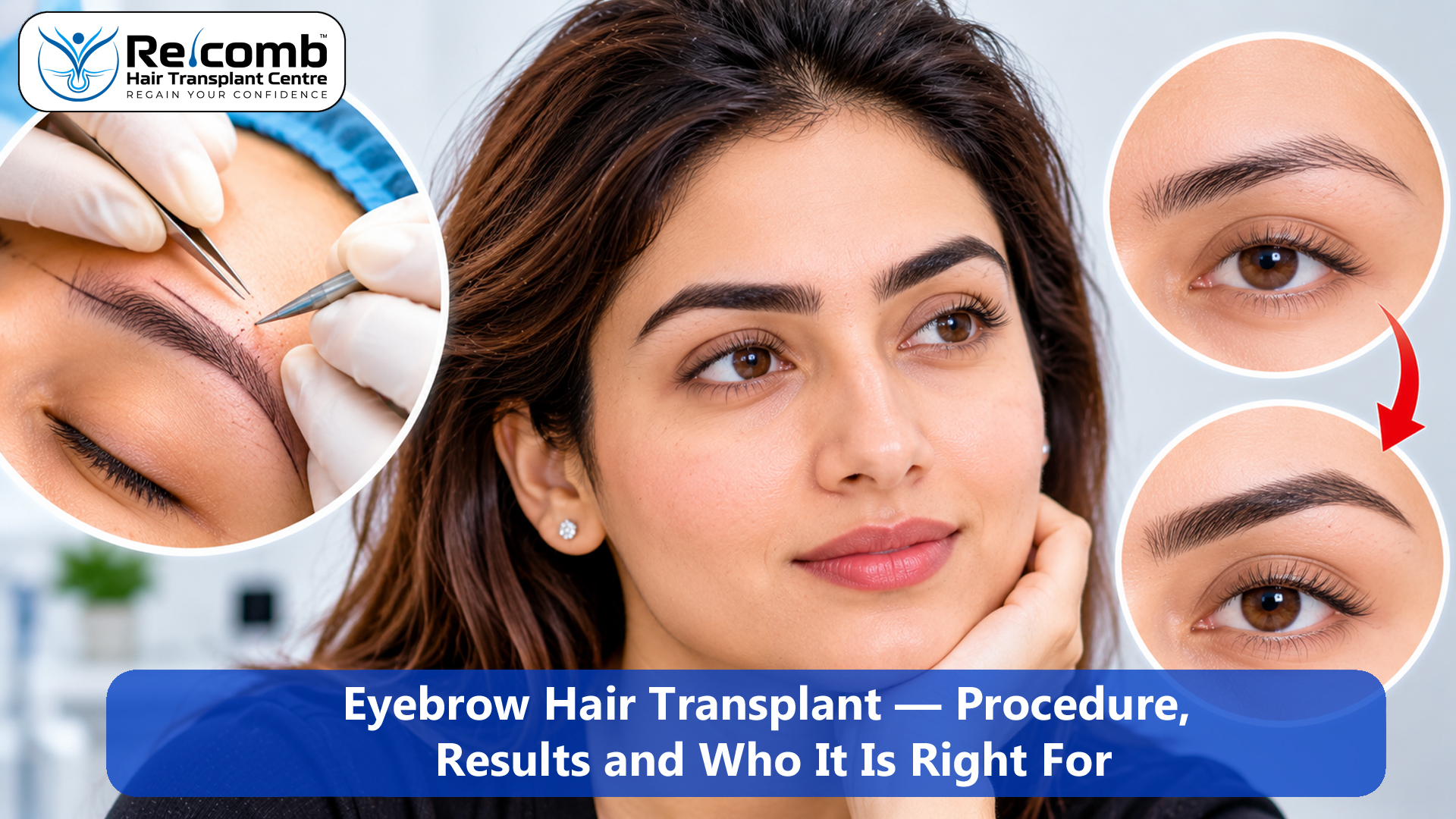
Eyebrows frame the face and shape expression. When they are thin, patchy, or missing, the change is noticeable and often distressing. Over-plucking, threading and waxing over years, scars, medical conditions, and genetics are common reasons.
An eyebrow hair transplant moves living hair follicles to the brow area to create natural, permanent eyebrows. This blog explains how the procedure works, what results to expect, and who is a good candidate.
If you are considering eyebrow restoration, a consultation at RECOMB will show whether it suits your case.
Book an Eyebrow Restoration Consultation at RECOMB, Surat →
WhatsApp: +91 7624008000 | www.recombhair.com
Why Eyebrows Thin or Disappear
Common causes include years of plucking, threading, or waxing that damages follicles; over-tweezing in the teens and twenties; scars from injury, burns, or surgery; thyroid disease, where the outer third of the brow thins; alopecia areata and other autoimmune conditions; chemotherapy; and genetically sparse brows.
The cause matters. Some causes are reversible and some are not, and that decides whether a transplant is appropriate.
How the Procedure Works
Eyebrow transplant uses the same principle as scalp transplant, but the technique is more delicate.
Grafts, mostly single-hair units, are taken from the donor area at the back of the scalp using FUE. The finest, softest hairs suit best, because brow hair is short and fine.
The surgeon designs the brow shape with the patient, based on face, symmetry, and the remaining natural hair. The aim is a natural arch and thickness, not a drawn line.
Tiny recipient sites are created, and each graft is placed at the correct angle and direction. Eyebrow hair grows at a shallow angle, lying flat and pointing outward, so direction and angle are critical for a natural look.
A typical eyebrow transplant uses about 150 to 400 grafts per brow, depending on the starting density and the shape wanted. It is usually done under local anaesthesia and takes a few hours.
Recovery and Results Timeline
In the first week, there are small scabs and mild redness around the brows, which settle within about seven to ten days. Most patients can return to normal activity quickly, though swelling around the eyes can appear in some.
Around two to four weeks, the transplanted hairs shed, which is normal. The follicles stay in the scalp tissue and begin new growth.
New hair appears from about three to four months, and the brows keep filling in. Results are usually assessed at nine to twelve months.
Important Things to Know About Results
Transplanted eyebrow hair keeps the characteristics of scalp hair. It continues to grow and needs trimming, sometimes every few weeks, and may be longer than natural brow hair. Many patients trim it regularly.
The hair often grows with a slightly different texture or direction at first and settles with time. Because the donor is the scalp, the hair is permanent, but it does not stop growing at brow length.
Density depends on the donor hair and how many grafts are placed. A natural, soft brow is the aim, rather than a very thick, heavy one.
Results are generally permanent, but some brows benefit from a second session to refine density.
Who Is a Good Candidate
Good candidates include patients with thin brows from past over-plucking or waxing, scars in the brow area, sparse brows from genetics, and brow loss from a stable, inactive cause. Patients should have a healthy donor area on the scalp.
Candidates who should wait or be assessed carefully are those with active alopecia areata or an active autoimmune condition, because grafts can be rejected and relapse can occur; those with unrealistic expectations of density or very thick brows; and those with an unstable thyroid or other medical cause that has not been treated.
If the cause is thyroid-related or nutritional, correcting it first can bring back natural brow hair without surgery.
Book an Eyebrow Candidacy Assessment at RECOMB →
WhatsApp: +91 7624008000 | www.recombhair.com
Risks and Limitations
Possible risks include temporary swelling or redness, ingrowing hairs, uneven growth or asymmetry if the design is poor, and some grafts that do not grow. A well-planned procedure by an experienced surgeon reduces these.
Eyebrow work leaves very little room for error because the area is small and on the centre of the face. Surgeon experience matters.
RECOMB's Approach (2026)
At RECOMB Hair Transplant Centre, Surat, an eyebrow assessment begins with finding the cause of the thinning and confirming that the disease is inactive. Dr. Nilesh Kachhadiya's plastic and reconstructive surgery background and experience in eyebrow and beard restoration support the fine design and placement this area needs, and Dr. Krishna Bhalala's dermatology expertise guides diagnosis of medical causes.
The brow is designed with the patient, the number of grafts is planned for a natural result, and expectations about trimming and growth are explained in advance.
Final Takeaway
Eyebrow hair transplant can restore natural, permanent brows when the cause is stable and the design is done carefully. It needs realistic expectations about trimming, patience for the growth timeline, and an experienced surgeon.
Dr. Krishna Bhalala and Dr. Nilesh Kachhadiya conduct a limited number of personal consultations each week at RECOMB, Surat. If you are considering eyebrow restoration, this is where you find out if it is right for you.
Find Out If Eyebrow Transplant Is Right for You at RECOMB →
WhatsApp: +91 7624008000
We respond within 24 hours, 6 days a week.
www.recombhair.com
Contact RECOMB Hair Transplant Centre
RECOMB Hair Transplant Centre
19, Ground Floor, Zenon Building, Opp. Unique Hospital, near Kiran Motors, Khatodara Wadi, Surat, Gujarat 395001
Phone: +91 7624008000
Website: www.recombhair.com